

Dr. Devaka K. Weerakoon |
In our day to day life, we interact with a large number
of organisms. Some of these organisms are pathogens, in other words' organisms
that can cause diseases in human beings. In fact a fair number of potentially
pathogenic organisms live on and within us. However, most of us rarely
become sick. This is because our immune system defends our body against
such potentially harmful pathogens.
The human immune system comprises of three components. These are,
Lymphatic vessels
Organs of the immune system
Cells of the immune system
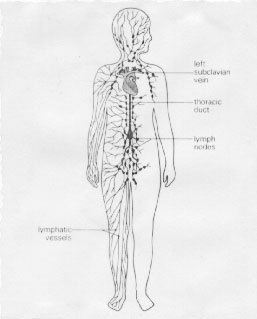
Figure 1. The lymphatic vessels
Lymphatic vessels are a system of conduits that functions
as a roadway, through which cells of the immune system can travel from
one part of the body to another, thereby keep the body under constant surveillance.
These vessels also interconnect organs of the immune system (fig. 1).
Organs of the immune system can be divided into
primary lymphoid organs and secondary lymphoid organs (fig. 2). The primary
lymphoid organs include the bone marrow and the thymus where cells of the
immune system are produced. The secondary lymphoid organs include the spleen
and the lymph nodes that provides an environment for the lymphocytes to
carry out their functions.
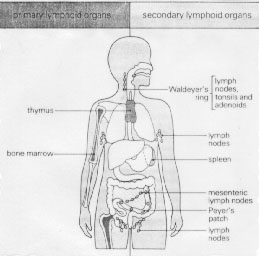
Figure 2. Organs of the immune system.
Cells of the immune system include all white blood cells
such as monocytes, macrophages, neutrophils, eosinophils, basophils, natural
killer cells, T-lymphocytes (cytotoxic and helper), and B-lymphocytes.
The function of the immune system is to protect the body from potentially harmful pathogens. Immunity, or the state of protection from infectious disease provided by the immune system, can be divided into two categories.
Nonspecific or innate immunity
Specific or acquired immunity
Innate or nonspecific immunity refers to the basic immunity an organism posses against disease causing agents. Innate immunity is achieved through number of different mechanisms. These include,
Mechanisms that prevent entry of pathogens into the body
Mechanisms to destroy pathogens that enter into the body
Human body posses number of physical and chemical barriers
that prevent entry of pathogens (fig. 3).
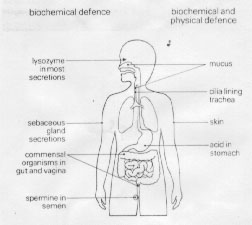
Figure 3. Physical and chemical barriers against entry of foreign pathogens.
Of these, perhaps the most important physical barrier
is the skin. The skin consists of two distinct layers, a relatively thin
outer epidermis and a thicker layer, the dermis. The epidermis consists
of several layers of tightly packed epithelial cells that are dead and
filled with a water proof protein called keratin. Therefore, it acts as
a physical barrier against entry of foreign pathogens into the body. The
dermis contains a gland called the sebaceous gland that produces an oily
secretion called sebum. Sebum consists of number of organic acids that
maintain the pH of the skin between 3 and 5. Therefore, intact skin not
only prevents entry of pathogens but also inhibits the growth of most pathogenic
bacteria due to its low pH. However, the skin does not cover the entire
surface of the human body. Conjunctiva of the eye, alimentary, respiratory,
and urinogenital tracts are not covered by dry, protective skin but by
mucous membranes. Therefore, these places function as potential entry sites
for pathogens. As a protective mechanism against such pathogens, humans
have evolved number of chemical barriers. For instance the first compartment
of the alimentary tract is the stomach that has a highly acidic environment
that prevents the growth of bacteria. Likewise, the female vagina also
contains a highly acidic environment that prevents bacterial growth.
Other chemical barriers include soluble factors such as
lysozyme, interferons, and complement. Lysozyme, a hydrolytic
enzyme present in tears and mucous secretions protects the mucous membranes
and conjunctiva of the eye from pathogenic bacteria. Interferons, a group
of proteins secreted by virus infected cells makes adjacent cells resistant
against viral infection. Complement is a group of proteins that are found
in the blood in an inactive proenzyme state. These proenzymes can be activated
by a number of specific and nonspecific immunological mechanisms. Once
activated complement proteins carry out three major functions. First, it
can directly destroy foreign pathogens by causing damage to the outer body
wall of these pathogens. Second, complement system can attract phagocytic
cells to the site of infection that can engulf the pathogen. Third, complement
proteins can enhance the efficiency of phagocytosis (fig. 4).
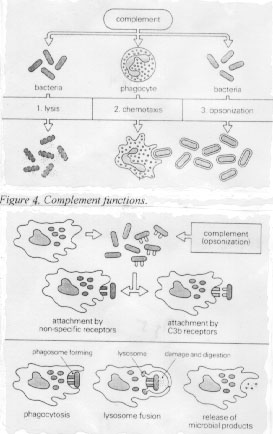
Figure 5. Phagocytosis
Another important innate defense mechanism is the ingestion
of pathogens by certain white blood cells, a process known as phagocytosis
(fig. 5). Monocytes, macrophages, and neutrophils are the white blood cells
that are capable of phagocytosis. Efficiency of phagocytosis can be further
enhanced by antibodies and activated complement proteins..
Some of the pathogens such as worm-like parasites are
much too larger to be ingested. White blood cells such as eosinophils and
basophils play an important role in the defense against such parasites.
These cells secrete a number of soluble factors that can damage or destroy
the parasites.
In summary, the human body contains a number of anatomical
and physiological adaptations to prevent entry of pathogenic agents. However,
some pathogens are capable of breaching these barriers. Entry of such pathogenic
microorganism induces immunological processes such as complement activation,
phagocytosis, and secretion of various soluble factors by the cells of
the immune system that would eventually lead to the destruction of the
pathogen.
Acquired or specific immunity involves specific recognition
and selective elimination of foreign microorganisms and molecules. Unlike
the innate immunity, acquired immunity displays specificity, diversity,
memory, and the ability to discriminate between self and nonself. The specificity
of the immune system can be seen in its ability to distinguish subtle differences
between various molecules. The immune system is capable of generating tremendous
diversity in its recognition molecules, allowing it to specifically recognize
billions of different foreign molecules. Once the immune system comes into
contact with a foreign molecule it has the capability to memorize that
encounter. Therefore, if the molecule is encountered again, the immune
system can respond rapidly and much more efficiently to neutralize or destroy
the foreign molecule. Finally, the immune system is capable of distinguishing
between self and nonself and therefore, can selectively destroy foreign
molecules without causing damage to one's own body tissue. Therefore, acquired
immunity is much more efficient at destroying pathogenic microorganisms.
Acquired immune system includes three types of cells, the B-lymphocytes, cytotoxic T-lymphocytes, and helper T-lymphocytes. Function of the B-lymphocytes is to produce a group of proteins called antibodies. An antibody is a multimeric protein molecule that consists of four protein chains, two small protein chains (light chains) and two large protein chains (heavy chains). it has a characteristic Y shape with three free arms. Of these, two can combine with foreign molecules while the third arm can combine with number of different phagocytic cells of the immune system or certain complement proteins. Therefore, the antibody molecule can act as a flexible adapter between the foreign molecule and the phagocytes or the complement system (fig. 6).
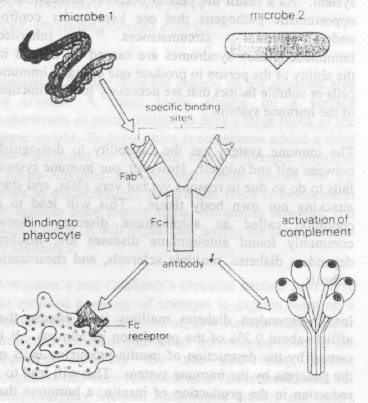
Figure 6. Antibody structure and functions.
Antibodies carry out three major functions. First, they
can directly neutralize foreign pathogens. Second, antibodies can activate
complement proteins. Third, antibodies can enhance the efficiency of phagocytosis.
Cytotoxic T-lymphocytes are capable of destroying viral infected cells
while the helper T-lymphocytes secrete number of soluble factors that regulate
the functions of both B-lymphocytes and cytotoxic T-lymphocytes.
Acquired immune system does not function independently
of innate immunity. Cells of the phagocytic system play an important role
in activation of the acquired immune system. Likewise, soluble factors
produced by the acquired immune system have been shown to enhance the activity
of the phagocytes. Therefore, interplay between the acquired and innate
immune system is necessary for the effective elimination of the foreign
invader.
Like any other system the immune system too can become defective. This leads to various disorders or diseases. The disorders of the immune system are of three types.
Immunedeficiency syndromes
Autoimmunity
Hypersensitivity
Immunedeficiency syndromes are of two types, acquired
and inherited. Acquired immunedeficiency syndrome is caused by a virus
called human immunedeficiency virus 1 and 2 (HIV-1 and HIV-2). These viruses
can selectively destroy the helper T-lymphocytes that would effectively
reduce the efficiency of the specific immune system. As a result the person
becomes susceptible to opportunistic pathogens that are kept under control
under normal circumstances. Inherited immunedeficiency syndromes are caused
by defects in the ability of the person to produce one or many immune cells
or soluble factors that are necessary for the function of the immune system.
The immune system has the capability to distinguish between
self and nonself. However, our immune system fails to do so due to reasons
yet not very clear, and start attacking our own body tissue. This will
lead to a condition called an autoimmune disease. Some commonly found autoimmune
diseases are, insulin-dependent diabetes, multiple sclerosis, and rheumatoid
arthritis.
Insulin-dependent diabetes mellitus is a disease that
afflicts about 0.2% of the population of humans. It is caused by the destruction
of insulin-producing cells of the pancreas by the immune system. This will
lead to a reduction in the production of insulin, a hormone that plays
an important role in regulating the blood sugar level.
Multiple sclerosis is a disease that effects the central nervous system. In this disease the immune system mounts an immune response against the nerve cells resulting in numerous neurological dysfunctions.
Rheumatoid arthritis is a common autoimmune disorder,
most often effecting individuals that are between 40 and 60 years of age.
The major symptom of the disease is chronic inflammation (swelling) of
the joints.
Function of the immune system is to defend the body against
harmful pathogens. However our immune system sometimes mounts a massive
immune response against harmless foreign agents such as dust, mites, pollen,
etc., This condition is referred to as allergy or hypersensitivity.
Study of the immune system is called immunology and the
goal of the immunologists is to understand the intricate mechanisms that
are involved in defense of our body. This would help us to design specific
therapeutic strategies to treat disorders of the immune system as well
as to manipulate our immune system to enhance its efficiency. One such
example is vaccination whose goal is to induce protective immunity and
immunological memory against potential pathogens. Vaccination remains to
be one of the most effective methods of disease prevention today and is
responsible for the marked reduction of infant mortality seen in recent
years. Despite this progress, more than 5 million infants worldwide continue
to die from various diseases. Therefore, new and promising vaccination
strategies have to be developed in the future.
Although, the field of immunology has grown by many folds
over the recent years much work remains to be done. The modern day immunologist
will have to pay a great deal of attention towards finding cures to diseases
such as AIDS, various autoimmune diseases, and allergy that continues to
inflict a heavy death toll on the human populations worldwide. n