

Dr Dorothy Crowfoot Hodgkin
(1910-1994)
Chemist, Crystallographer, Humanitarian
by Wageesha Senaratne
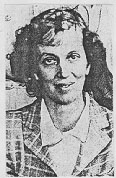 Dorothy
Crowfoot Hodgkin was an outstanding Scientist, great humanist and above
all a splendid human being. Among her peers in the scientific community
there would have been others who were respected as much as Dorothy Hodgkin
was, but perhaps none who was loved more than she was.
Dorothy
Crowfoot Hodgkin was an outstanding Scientist, great humanist and above
all a splendid human being. Among her peers in the scientific community
there would have been others who were respected as much as Dorothy Hodgkin
was, but perhaps none who was loved more than she was. Dorothy Cowfoot was born on May 12th 1910 in Cairo. She
had most of her secondary education in Beccles, Suffolk, England and subsequently
joined Sommerville College at Oxford in 1928.
At that time when very few women studied science she took
her basic degree in chemistry While studying in the department of mineralogy
and crystallography, she employed the physical science of X-ray crystallography
to aid her in determining the structural arrangement of atoms in simple
salts and minerals such as thallium dialkyl - halides . This was the first
of what would be many X-ray studies.
In 1933 Miss.Crowfoot began working with J.D.Bernarl on
her doctorate at Cambridge. During her research Miss.Crowfoot was able
to determine the structural layout of atoms and the over all molecular
shape of numerous molecules. This information contributed to molecular
biological activity. It was then that she was involved, along with Bernal
recording the first X-ray diffraction pattern from a protein (pepsin) crystal.
This marked the beginning of macromolecular crystallography which dominates
structural biology today.
In 1934 upon her return to Oxford University she crystallized
and X-ray photographed insulin. This was a major achievement since she
completed the crystallization and photographs on her own. This analysis
was completed at a time when crystal structures of even simple molecules
was a great challenge. While working at Oxford University she was barred
from research meetings of the faculty Chemistry Club because she was a
woman. Later her talent and perseverance prevailed and she won over the
students and faculty members.
In 1937 she obtained her doctorate from Cambridge University.
Also in this year she married Dr.Thomas Hodgkin . Between 1942 and 1949
Dorothy Hodgkin began work on structural analysis of penicillin. After
the discovery of penicillin some of the best chemists were trying to determine
its chemical composition , when she amazed them all by using X-ray analysis,
but not chemistry to determine its structural arrangement. While completing
her penicillin research, Dr.Hodgkin was named a fellow of the Royal Society
in 1947.
Between 1948 and 1956 she continued to study at Oxford
University and Cambridge University. She became a fellow and a chemistry
tutor at Somerville at Oxford. As a tutor she encouraged and guided her
students towards interesting results with crystal structures. One of her
pupils who became well known not for her work in chemistry but for her
political work was Margaret Thatcher.
In 1955 she took her first X-ray diffraction photos of
cyanocobalamin crystals, more commonly known as vitamin B-12. This organic
molecule was four times larger than penicillin and until this point normal
chemical methods had revealed little about the structure of the central
part of this molecule. Dr.Hodgkin concluded that vitamin B -12 is a porphyrin,
a type of molecule related to chlorophyll, but with a cobalt center. Dr.Hodgkin
and her colleagues found that the molecule was spherical in form, contained
chemical features not seen before, and had a unique chemical structure.
It was later determined that this molecule was not the naturally active
vitamin and in 1961 they determined the structure of the natural vitamin.
This discovery later allowed for the vitamin to be synthesized and used
in the treatment and prevention of pernicious anemia.
In 1956 she received the royal medal. In 1958 she became
a member of the American Academy of Arts and Sciences. In 1964 she was
awarded the Nobel Prize for Chemistry. This was awarded for her research
on the structure of vitamin B-12 and she became the 3rd woman to ever win
the nobel prize in chemistry. The other two were Madam Curie and her daughter
Irene Joliot-Curie.
In 1965, Queen Elizabeth II conferred on her the Order
of Merit. This is Britain's highest royal order. Dr.Hodgkin was the first
woman to be bestowed this honour since Florence Nightingale.
In 1969 Dr.Hodgkin completed the deciphering of the three
dimensional structure of the protein insulin. This discovery led to an
understanding of how it helps to lessen the symptoms of diabetes. This
research nearly took 34 years to be completed.
In 1970 she was elected the Chancellor of Bristol University
. She supported the establishment of the Hodgkin Scholarship which aided
students from 3rd world countries and founded Hodgkin House which accomodated
overseas students. Both were named for her late husband who was a specialist
in African Studies. From 1972 to 1978 Dr.Hodgkin was President of the International
Union of Crystallography. In 1976 she became a member of the USSR Academy
of Sciences. In 1977 she officially retired but continued to work on her
causes for world peace.
She has always been a champion of world peace and disarmament. Not only had she been a major contributor within her own field of expertise, she tried to promote international goodwill and understanding between all of the people throughout the world. She has been described
by colleagues as being a "warm, simple, affectionate, and caring" human being.
In 1982 she was awarded the Lomonosov Gold Medal because
of her high standing within the Soviet Scientific Community and later in
1987 she was awarded the Lenin Peace Prize for her commitment for the Soviet
cause and her efforts towards easing tension between the East and the West.
In 1988 she became a honorary fellow at the Bristol University.
Dr.Hodgkin travelled extensively and touched every possible
corner of the world throughout her life despite her lifelong struggles
with rheumatoid arthritis that did not respond to treatment. This eventualy
crippled her hands and feet, but despite these she continued to travel
and participate in her causes until the very end. In July of 1994, Dr.Dorothy
Crowfoot Hodgkin died from stroke at home in Shipston-on -Stour , England.
It is difficult to adequately describe her legendary achievement
but still harder to describe her personality in a few words. To her students
and her colleagues, she was a teacher, mother, friend and guide, rolled
into one.
Of Mahathma Gandhi, Einstein said thus: "Generations to come, it may be , will hardly believe that a man like him in flesh and blood, ever walked upon this earth." As a student of chemistry may I borrow the very same words to express my sentiments of and respect for Dorothy Hodgkin.
.