
|
GLOBAL ECONOMY & INTERNATIONAL BUSINESS |

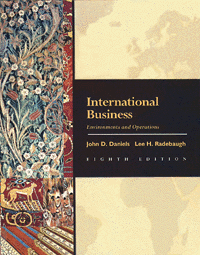
TABLE OF CONTENTS
About the Class . . . . . . . . . . . . . . . . . . . . . . . . . . . . . . . .2
Module Objectives . . . . . . . . . . . . . . . . . . . . . . . . . . . . . 4
Learning Outcomes . . . . . . . . . . . . . . . . . . . . . . . . . . . . .6
Module Content . . . . . . . . . . . . . . . . . . . . . . . . . . . . . . . .7
Class Structure . . . . . . . . . . . . . . . . . . . . . . . . . . . . . . . . 8
Guidelines for Success in this Course . . . . . . . . . . . . . . .9
Class Participation . . . . . . . . . . . . . . . . . . . . . . . . . . . . .11
Instructional Materials . . . . . . . . . . . . . . . . . . . . . . . . . 14
Student Assignments. . . . . . . . . . . . . . . . . . . . . . . . . . .16
Student Evaluation . . . . . . . . . . . . . . . . . . . . . . . . . . . . 18
Format for Assignments . . . . . . . . . . . . . . . . . . . . . . . .19
Late Work . . . . . . . . . . . . . . . . . . . . . . . . . . . . . . . . . . .20
Office Hours . . . . . . . . . . . . . . . . . . . . . . . . . . . . . . . . .21
ABOUT THE CLASS
International business is one of the most fascinating fields
of study in business and economics. The growth of the field has
reflected the growth of international business itself in the last
two decades. Not only has world merchandise trade increased, but
capital flows, in terms of both direct and indirect investment,
has grown as well. More and more firms have undertaken business
abroad in growing numbers and varieties of operational forms.
Thus international business has grown in both magnitude and complexity,
and consequently has risen in importance in the world economy.
The purpose of this module is to survey the major differences
in business environments that firms encounter when engaging in
international business, differences that can influence the way
business is conducted. This module is intended to be an introductory
course. This module also deals with the differences in traditional
business functions that firms encounter abroad.
Understanding the international business environment is an essential
prerequisite for making successful business decisions. This module
uses an economic framework to explore the environment, focusing
mainly on economic factors, but considering cultural, legal, political
and technological dimensions as well. Concepts and information
that a business can use to analyze changes in demand, technology,
costs and competitive rivalry that affect its growth and profitability
in its own particular market(s) are studied. In particular, this
module examines the implications of the increased openness and
globalization economies, the reasons for and effects of government
interventions to promote competition, enterprise and environmental
protection, the factors influencing economic growth, inflation,
unemployment, changes in exchange rates and interest rates, business
cycles and their implications for business decisions.
In the near future, everyone will be exposed to some aspect of
international business. Students in this module will receive a
working understanding of the concepts and procedures of international
business in today's environment, and its inter-relationship with
other business functions. As a result of the class, Excel students
whose primary interests lie in other business disciplines will
come away with the foundation to understand how international
business relates to their primary area of interest.
Those interested in pursuing a career in international business will acquire a sound basis for further study. Not only will successful students have a thorough understanding of international business, but also improved skills that are required by employers today in all fields.
MODULE OBJECTIVES
The internationalization of the world economy has significantly affected today's U.S. industries. A major force underlying this world trend has been the rapid, sustained growth of international business. This course provides students with international competence to face the challenges of global business games. This course is designed to give you an introduction to international business and the global economy. We will examine the reasons why international business has become so important. We will also explore the critical factors a business may encounter in international business; especially those that may not be present, or perhaps not be so critical, in a wholly domestic business.
The objective of this course is to familiarize students with the
environment in which international companies operate. Thus, participants
should acquire awareness of, and an appreciation for, the diversity
and complexity of the international environment. More specifically,
the successful completion of this course should enable them to
understand and analyze environmental problems which challenge
management. While the emphasis of the course is on analysis, students
will acquaint themselves with the special terms, concepts, and
institutions encountered in international business.
This course should be of interest to nearly all students of business
administration. No matter how small (or large) the business enterprise,
the successful manager must take account of international and
national environmental dimensions when making decisions. These
dimensions are economic, political, and social in nature. Hence,
this course is about markets (the economic dimension), power (the
political dimension), and culture (the social dimension) under
conditions of global interdependence. The nature of and interrelationships
among all these dimensions--international, national, economic,
political, and social--are crucial for management decision-making.
These objectives can only be achieved through a joint effort.
I will work to stimulate your interest and learning in these areas,
but you will be expected to display initiative and a program of
self-study and group-study as well. In that sense, a complementary
objective of the course is to provide you with an environment
that will encourage and reward your own intellectual effort, while
simultaneously maintaining rigorous standards that identify those
who are motivated to pursue excellence in their own educational
preparation for a business career.
In order to achieve these objectives you will demonstrate:
1. An understanding of the differences between conducting business
domestically and internationally.
2. An understanding of the major international trade theories
and their
relevance on today's business environment
3. Effective written and oral communication skills that are
crucial to
implement trade across countries.
4. Ability to apply concepts learned in class with the real world.
5. Ability to engage in constructive criticism and collaborative
decisions
making within a group.
6. Demonstrate critical thinking and problem solving abilities.
LEARNING OUTCOMES
Upon successful completion of this course, the student will be able to:
o Explain the major motives of companies for engaging in international business.
o Be aware of cultural differences and realize to adapt yourself accordingly.
o Describe why country risk assessment is vital to international business.
o Assess the transformation process from central planning to market economy and how it affects international business.
o Understand the concepts of multilateral treaties which affect international business.
o Learn to analyze and evaluate a company's foreign exchange risks.
o Compare different methods of exporting.
o Strengthen his or her interests in international business and realize that its study is important to their career development.
o Tie in the materials which they have learned in other courses to international business.
o Know when a concept or technique must be modified or discarded for international environments.
o Compare various ways of organizing international operations with a company.
o Summarize the various ways of selling your product abroad.
o Distinguish between tangible and intangible trade barriers.
o Explain the terms quota, duty and ad valorem.
o Describe how NAFTA and WTO reduce trade barriers.
o Explain the different risks of hard and soft currencies.
o Summarize the main differences between capitalistic and socialistic
systems.
Module Content
The module will present information from the following areas:
Introduction: the political/legal, economic, social/cultural,
and technological dimensions to the business environment; the
role of economic analysis in understanding the business environment.
Living standards and economic growth.
The market system: objectives, constraints and maximization; demand; input decisions and costs; markets - competitive, monopolistic, and oligopolistic.
Government regulation of firms and markets: reasons for government intervention; competition policies; technology and industrial policies; environmental policies.
The macroeconomic environment: inflation and employment; monetary and fiscal policies.
The international environment: international trade; multinational corporations; trade policies, the balance of payments and exchange rates.
Class Structure
Discussion and student work is the primary mode of instruction.
You'll read and write material, and the Instructor will provide
some background material through informal lecture. Formal and
informal writing assignments as well as presentations will help
you integrate, synthesize, and present material. There will be
frequent in-class writing assignments, quizzes, and collaborative
activities. On occasion, short video segments will be used to
augment the lecture and to stimulate class discussion.
Guidelines for Success in this Course
This section is intended as a supplement to the information contained above. It was designed to assist students in "how to take" this course.
I. Excel Instructor's Perspective on Education
The main purpose of education is to teach students to think
effectively. As you interact with the course content, students
should learn general intellectual skills, such as observing, classifying,
analyzing, and synthesizing. In this way, instruction is intended
to help students gain intellectual autonomy. Some key assumptions
held by EXCEL instructors about education are that: 1) active
learning is more effective than passive learning, 2) critical
thinking skills are just as important as content acquisition,
3) demanding mental effort is painful in the short run but highly
satisfying in the long run, and 4) abilities and skills acquired
in the classroom will transfer to the "real work
world".
II. Time Management
A general rule of thumb is that study and preparation time should take between one and two hours for every meeting hour.
III. Using the Textbook
Read the entire assigned textbook chapter of Daniels & Radebaugh, including beginning and ending cases. Use the special features of the text to aid in your understanding of the material (e.g., maps, outlines, glossary of terms, etc.).
IV. Using the World Wide Web
An exciting learning experience from this course is the opportunity
to make wide use of the information sources available on the World
Wide Web. While it is possible to successfully complete the course
without accessing the Web, all students are encouraged to explore
the many features available through this medium.
V. Class Preparation
An important aspect of this course involves the preparation for each class session. The following steps are recommended:
1. Read the entire chapter
2. Complete the Chapter questions
3. Take an active learning approach to the class by being prepared
to
participate in any discussion and by taking good notes.
VI. Exam Preparation
If you read the chapters come to class ready to participate, and review your chapter and class notes before the exam, you should do well on the exams. The exams are intended to test knowledge acquisition, comprehension and application. Test material will be from the chapter readings and from any material covered in class. Previous experience has indicated that it is highly unlikely to score well on the exams without attending every class.
CLASS PARTICIPATION
A significant portion of the grade in this class is derived
from the participation of the individual student in classroom
discussion. There are several reasons for the emphasis on participation.
The most direct reason, of course, is the use of this vehicle
for the instructor to assess the level of understanding of course
material. The most important aspect of participation, though,
revolves around the fact that full, participative discussion allows
students to develop a better comprehension of partially understood
material. This will occur if students will ask questions of the
instructor or of classmates during class discussions. A further
benefit to be derived is the practice the student will get in
informal oral communications and in the use of one's peers to
refine concepts and solve problems.
The greatest benefits will be obtained from class discussions
when class members come to class prepared for the discussion.
The unprepared student may find that classmates or the instructor
will be discussing unfamiliar concepts, and there may not be another
convenient opportunity for a clarifying discussion.
Many students are reluctant to enter fully into a classroom discussion
because of an innate shyness or a fear that other students will
belittle the discussant. The fact is that, if any student has
a question or needs clarification on one or more points, there
are probably several other students who also would like to ask
the question but are too reticent. In the very rare instance in
which a student needs explanation on a point that is well understood
by everyone else in the classroom, the student should remember
that the purpose for being in the class is that of obtaining as
much knowledge as possible and that classmates, in addition to
the instructor, are really there to be as helpful as possible.
Those students who have not become comfortable with freewheeling
classroom discussion will probably have to do some preparation
to get started with the process. One of the best ways to get started
is to write out a question or a comment on the topic for discussion
during the next class period and, as soon as the class begins,
ask the question or make the comment. The material for these contributions
is readily available from reading the assigned text material or
the general literature of business before the class meeting. Any
subject of interest to the student and relevant to the topic at
hand is appropriate and the contribution will be welcomed by the
instructor. A little practice with this preparation process will
usually put the student at ease in discussion situations and allow
both a fuller classroom discussion and a better understanding
by the individual.
Please be advised there is no way that a student who is not present
can participate in the discussion. Further, while simple class
attendance will not provide maximum benefit for the student, just
being present during a discussion yields a finite probability
that some of the discussion will be remembered.
Any relevant contribution that clearly demonstrates preparation
on the part of the student will impact your participation evaluation.
The contribution must have some bearing on the topic under discussion,
but a great deal of latitude is given. "Preparation"
means that the student has read the assigned material and given
some serious thought to the concepts under discussion. This may
be shown by appropriate reference to the assigned text material
or to some outside reading, such as the Wall Street Journal, which
shows deliberate consideration.
Those contributions that are of such quality as to make a significant
difference to the discussion will merit additional consideration
in the assessment of the participation score. This level can be
obtained by providing "on-the-spot" comparisons of prepared
material with comments offered by other students, by showing how
the topic can be expanded beyond that given in the text, or by
other methods of showing excellent grasp of the material and a
willingness to use the class discussion to improve the learning
process.
Other than those rules required to allow an orderly discussion
which can be heard by all participants, the discussion formats
will be as informal as possible.
INSTRUCTIONAL MATERIALS
TEXTBOOK(S) REQUIRED:
Daniels, John D., and Lee H. Radebaugh. International Business: Environments and Operations, 8th ed. Reading, Mass.: Addison-Wesley Publishing Co., Inc., 1998.
Recommended Readings:
The Wall Street Journal, Dow Jones,N. Y., N.Y. or BusinessWeek.
Czinkota, R. C., Ilkka A. Ronkainen, Michael H. Moffett, and
Eugene O. Moynihan,
(1995) Global Business. Fort Worth, TX: The Dryden Press, Harcourt
Brace College Publishers.
Punnett, Betty Jane and David A. Ricks (1992). International
Business. Boston, MA:
PWS-Kent Publishing Company.
Puffer, Sheila. Management across Cultures: Insights from Fiction
and Practice (1998)
Blackwell Business Publishers.
Wartick,Steven and Wood,Donna J. (1998)International Business
and Society
Blackwell Publishers.
Grosse, R. & Kujawa, D. (1992). International Business:
Theory and Managerial
Applications (2nd ed.) IL: Irwin.
Litka, M. (1991). International dimensions of the Legal Environment
of Business. MA:
PWS-Kent Publishing Company.
In order to go beyond the classroom limit, students are encouraged
to read the international business sections of major business
periodicals, such as Far Eastern Economic Review, Business Week,
Forbes, Fortune, and the Wall Street Journal.
OTHER READING MATERIALS:
Dictionary - Reference Manual (Writing Handbook)
Readings and handouts distributed periodically throughout the module.
AUDIO-VISUAL MATERIALS: May be provided by instructor.
TOOL(S) AND EQUIPMENT:
3 1/2" computer disk for computer assignments.
STUDENT ASSIGNMENTS
Week One
1. Discussion of syllabus
2. Discussion of course goals
3. Read Daniels & Radebaugh, Chapters 1-3.
4. Quiz - Chapters 1-3
Week Two
- Revised (3/25/00)
1. Read Daniels & Radebaugh, Chapters 4-5.
2. Capital & Currency Quiz - North & South America
5. Quiz - Chapters 1-4
6. Read the case - "The Cashew" on p. 227. Answer the
questions at the end of the case. Your response should total 300-750
words.
Week Three
1. Read Daniels & Radebaugh, Chapters 7-9
2. For Chapters 7-9, select and answer three of the "Discussion
Questions"
provided by the Instructor. Your responses should be 1-3 pages
for each question. Your responses should be 1-3 pages for each
question.
3. Capital & Currency Quiz
4. Quiz - Chapters 7-9
5.Enculturation Teams: Enculturation teams will be formed from
the members of the class. Each enculturation team will be expected
to prepare a presentation to the class regarding the culture of
two nations of the world with particular emphasis on doing private
business within that culture.
Week Four
1. Read Daniels & Radebaugh, Chapters
7-9
2. Capital & Currency Quiz - Turkey, Israel, Saudi Arabia,
India, Pakistan, Japan, The Philippines, Malaysia, Indonesia,
China, South Korea, Taiwan, Jordan, Laos, Cambodia, Thailand,
Myanmar, Oman, Nepal, Iran, Iraq
3. Quiz - Chapters 7-9
4. Currency Exchange Reports -
Rockett - Italy
Redden - Japan
Mister - Australia
Scott - India
Johnson - Canada
Pegram - France
Bond - Germany
Taylor - South Africa
Kent - Switzerland
Sturghill - Hong Kong
5. Case - Cran Chile p. 363 (Answer all
questions)
PLEASE BE PRESENT AND PREPARED
Week Five
1. Read Daniels & Radebaugh, Chapters 13, 16, and 21
2. For Chapters 13, 16, and 21 select and answer three of the
"Discussion Questions" provided by the Instructor. Your
responses should be 1-3 pages for each question.
3. Capital & Currency Quiz
4. Quiz - Chapters 13, 16, and 21.
5. Final Assignment: Group Presentation on countries:
Prepare a 8-15 page typed summary of the country information for your presentation in the class. Include in your presentation information on: land area and neighboring countries, population and race(s), language, history, GNP, GNP per capita, foreign trade (exports and imports; amounts and with whom), currency and exchange rate to U.S. dollars, major industries and products, comparative advantage, economic system, culture classification, current business issues, political risk, representative companies, corruption/bribery practices and any other facts relevant to business activities. Each presentation should not exceed 15 minutes. Each group should consist of 3-5 persons.
STUDENT EVALUATION
A major requirement in this course is that students read the
assigned text in preparation for each class. Other requirements
include the completion of 3-5 quizzes, homework assignments, a
final project, and individual case write-ups. Each quiz will be
limited to material covered since the previous one. Material for
the exams will come from the following sources: 1) the text readings
from Daniels & Radebaugh, 2) class lecture, 3) class discussion,
and 4) any in-class handouts, exercises, or videos. Your lowest
quiz grade can be dropped at the end of the module. Most of these
quizzes will be given at the end of the class periods, and are
designed to summarize our intensive group discussions. As an aside,
previous experience has indicated that it is highly unlikely to
score well on the quizzes without attending every class. Additionally,
you'll also participate in several in-class writing exercises.
In order to earn a passing grade in BUAD 350, you must attend,
participate, and successfully complete all assignments. Your final
grade for the course will be mathematically computed from the
point total for all evaluated assignments as follows.
Class Participation (20% of grade)
Quizzes (20% of grade).
Exercises (30% of grade).
Final Assignment (30% of grade)
FORMAT FOR ASSIGNMENTS
Unless you are directed otherwise, all writing work to be done outside of class will be word-processed and printed on high-quality paper. Remember to back up all of your work, and plan ahead because mechanical difficulties and long waiting lines develop at campus computer facilities. These problems won't suffice as excuses for late work.
The format requirements of each individual assignment depend on
what kind of document you're composing. As a rule, use plenty
of white space, ample margins, and boldface, underlining, italics,
headings, and other devices to highlight the organization of your
texts. If you're unsure about these issues early in the semester,
turn in "hard copies" of assignments double-spaced,
left-justified, 12-point type, with top, bottom, and right margins
of "1" inch, left margin "1 1/2" inch. We'll
discuss format issues in class, and I'll always be ready to take
questions.
Late Work
Keeping deadlines an important part of a businessperson's life. We will operate as "real world" businesses do; each assignment will have a specific deadline. Our course is so compressed (5 weeks), that it's extremely important to keep up. Your work is to be on time, all the time. Be advised that instructors are not required to accept or evaluate late work. In other words, late work may not be accepted, unless prior arrangements have been made which involves your (1) contacting me before the assignment is due by means of formal memo (either hard or electronic copy), explaining the reason for the delay, and (2) your proposing in the memo a reasonable deadline (less than one week), which you then keep. The memo stands as a contract between you and me. Failure to keep the new deadline breaks the contract, and I won't accept your work. Use this option no more than once during the module. Oral presentations, in-class assignments, and quizzes are obviously excluded from this option; they're always due on the assigned date.
OFFICE HOURS
I expect you to take advantage of my office hours for one-on-one conferences. You can either schedule an appointment or drop in during my hours. I like it when you have specific issues you want to work on (e.g., to talk over ideas for a paper, to review an outline, to plan research, to revise a draft, etc.) If my office hours conflict with your class or work schedule, I'll try my utmost to meet with you at different times. You have my office phone number and e-mail address, so you should always be able to reach me or get a message to me. I will always reply.
Technology is playing an increasingly important role in organizations.
We will be utilizing technology (e-mail, electronic presentations,
World Wide Web) throughout the course. E-mail is the very reliable
way to get in touch with me. The web page will frequently be updated
with material relevant for class discussion and assignments. You
are responsible for checking it regularly to make sure you are
up-to-date.