 |
RudolfSteiner |
|
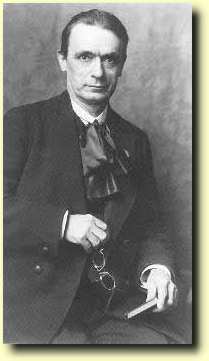
Rudolf Steiner ( 1861-1925 ) was born in Austria, son of a railway official. He was educated at the Realschule (College for Science) and later at the Technical College in Vienna. He also studied philosophy, literature, medicine and psychology, and in 1891 submitted his Ph.D. thesis at Rostock University. The content of this later appeared in his book, "The Philosophy of Freedom" (1894). As a scientist, artist and philosopher, looking at the problems facing the 20th century, Steiner saw that science, religion and art had taken separate paths. Science was becoming coldly factual, art too personal and religion too often academic. He realised that if a new and positive culture was to arise, then science, art and spiritual experience must be renewed and brought together again. Where their special qualities affect and help each other positively, science becomes morally creative, art universal, and spiritual experience more real. In such a way, social life, based on the individual's concern for the welfare of others, would develop in a beneficial manner.
Through his own clairvoyant and spiritual insight, and with a disciplined
research into the `spiritual' nature of man and the universe, Rudolf Steiner
spent the last 25 years of his life bringing a new understanding of man
to the world.
In response to requests from his contemporaries he also gave new impulses from his experiences of Anthroposophy to those working in the artistic realms of drama, speech and movement, architecture, sculpture, painting and music, as well as in education, the sciences, medicine, agriculture, astronomy, economics, politics and sociology. |
| Return to top |