
The Politics of Fiction
by Marny Requa
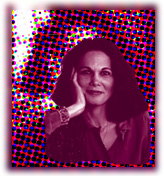 I had a slightly eerie feeling when I
went to meet Julia Alvarez in her hotel room. It was a sunny San
Francisco day, and, as I went up to the front desk, I imagined her in
her room waiting for me. Only a month earlier, I had read an excerpt
from her new novel ¡Yo! - a compilation of stories about
the life of a writer from the perspective of the people who drop in
and out of her life. One chapter, titled "The Stalker," describes a
demented man, feigning to be a reporter, who traps the writer in her
hotel room. I am not a man - nor am I obsessive - but I couldn't help
making the comparison.
I had a slightly eerie feeling when I
went to meet Julia Alvarez in her hotel room. It was a sunny San
Francisco day, and, as I went up to the front desk, I imagined her in
her room waiting for me. Only a month earlier, I had read an excerpt
from her new novel ¡Yo! - a compilation of stories about
the life of a writer from the perspective of the people who drop in
and out of her life. One chapter, titled "The Stalker," describes a
demented man, feigning to be a reporter, who traps the writer in her
hotel room. I am not a man - nor am I obsessive - but I couldn't help
making the comparison.
Alvarez' most recognized novel is How the Garcia Girls Lost Their Accents. She is also the author of two books of poetry and In the Time of the Butterflies - historical fiction about the lives of the three infamous Mirabal sisters, who were killed in the early 1960s as members of the underground during the Dominican Republic dictatorship. Alvarez came to the United States from the D.R. with her family when she was 10. She now teaches English at Middlebury College in Vermont.
M.R. What was it like when you came to the United States?
J.A. When we got to Queens, it was really a shock to go from a totally Latino, familiar Caribbean world into this very cold and kind of forbidding one in which we didn't speak the language. I didn't grow up with a tradition of writing or reading books at all. People were always telling stories but it wasn't a tradition of literary ... reading a book or doing something solitary like that. Coming to this country I discovered books, I discovered that it was a way to enter into a portable homeland that you could carry around in your head. You didn't have to suffer what was going on around you. I found in books a place to go. I became interested in language because I was learning a language intentionally at the age of 10. I was wondering, "Why is it that word and not another?" which any writer has to do with their language. I always say I came to English late but to the profession early. By high school I was pretty set: That's what I want to do, be a writer.
M.R. Did you have culture shock returning to the Dominican Republic as you were growing up?
J.A. The culture here had an effect on me - at the time this country was coming undone with protests and flower children and drugs. Here I was back in the Dominican Republic and I wouldn't keep my mouth shut. I had my own ideas and I had my own politics, and it just didn't gel anymore with the family. I didn't quite feel I ever belonged in this North American culture and I always had this nostalgia that when I went back I'd belong, and then I found out I didn't belong there either.
M.R. Was it a source of inspiration to have a foot
in
both cultures?
J.A. I only came to that later. [Then], it was a burden because I felt torn. I wanted to be part of the other. It was a time when the model for the immigrant was that you came and you became an American and you cut off your ties and that was that. My parents had that frame of mind, because they were so afraid, and they were "Learn your English" and "Become one of them," and that left out so much. Now I see the richness. Part of what I want to do with my work is that complexity, that richness. I don't want it to be simplistic and either/or.
M.R. Regarding In the Time of the Butterflies, you have said that you wanted to bring the tragic, historic events of the dictatorship in the D.R. to the consciousness of people in the United States. In general, do you look at yourself as being a teacher through your work, or is it a way to express yourself?
J.A. I write to find out what I'm thinking. I write to find out who I am. I write to understand things. Of course there's an edge, especially once you're doing it professionally. You realize that you've got readers who are along with you on a voyage of trying to understand things. So you also feel a responsibility to them.
M.R. What language was spoken in your home as a child?
J.A. My sisters and I were in school, so a combination is what we spoke at home. Spanish with the parents and English with us - not even English. Spanglish. It would be "Where did you put my secadora? " I'm talking to Sandra Cisneros and I say "Ayy, Sandra, pobrecita, did you see that ...?"
M.R. You write about the lives of girls very intensely. Does that stem from your childhood?
J.A. You use a story line to get at some truth of the human heart that doesn't just have to do with that specific ethnicity or gender, although that's the way that people get involved in it. The experience of women - especially women of color - has always interested me. I didn't know how to put an experience together being who I was. There were no books like that. When I went to college, we read a little Jane Austin and Emily Dickinson. Like that was really going to help me, a Latina woman. I love Jane Austin, I love Emily Dickinson, but I thought I had to write like them in order to be a writer in English. I didn't know you could put amorcito in a story in English. I didn't know you could do that.
M.R. Do you write for a certain audience?
J.A. I am aware of a responsibility to other people who are reading me, but I think the way that I am responsible to them is by listening closely to myself, as I move through the world. The things that catch my attention are the things that require of me a way of making meaning of them. I love what Chekhov said, that the writer's not there to solve the problem, but to state the problem correctly. Often I think of women like me, my sisters, women of two cultures, or women that are held very marginal, and that haven't had books that would reflect their experience.
M.R. Do you find that this type of reader is different than who you're marketed to?
J.A. I am greedy for readers. I bristle when people say I'm just a writer for Latinos, like some sort of sociological thing, like to say Faulkner's just a writer for white Southerner men, because he was a white Southern man. That's again the autobiographical fallacy, just tethering yourself to your little bunch. But of course I hope I would appeal to and want to be read by Latinos, because a lot of my characters are out of my experience, which is our experience. I haven't felt that I'm targeted to one population - it's only when people label me in ways that seem to cubbyhole or pigeonhole or ghettoize me.
M.R. Does this come up when you're on book tours?
J.A. It comes across in not very straightforward ways, as a compliment which insults you: "You're such a good Latina writer." And that could mean a very positive thing - you're Latina and you're a good writer - but it depends on where it's coming from and who's saying it.
M.R. You have a strong following of young white women, liberal-arts college types. Books like yours and Alice Walker's and Sandra Cisneros' have become a staple to read in "multicultural environments." What do you think about being included in these sort of curricula?
J.A. What does scare me is that they're reading me and saying "Here's a Latina writer and this is the way that Latinos think," because there's such a variety of Latinos, different colors, coming from different backgrounds.
M.R. Not to mention dozens of countries of origin.
J.A. A lot of my Chicana friends, they never had the experience of immigration. Their experience of being Chicana in this country is different from someone who doesn't know the language or someone who's come to work in a factory and is illegal. That is like if you were to read Faulkner and say, "All right, this is the way that a Southern white man thinks." Or here, let's read Yeats and this is the Irishman's opinion, and then we phone up Yeats, and we say "What do you think?" because he's going to be for us the authoritative (Irish voice).
M.R. It's the infamous Catch-22. You, for example, want to be respected as an artist in your own right.
J.A. But I don't want to deny my roots. And your own Latino population, sometimes they give you a hard time if you're published by a mainstream publisher, because then you've sold out.
M.R. Your publisher handles many Latino writers, correct?
J.A. Susan Berkholtz, my agent, represents Sandra Cisneros, Ana Castillo, Denise Chavez. She really fought a lot of battles when none of us were getting published.
M.R. Do you consider yourself part of a movement or more of an independent writer?
J.A. I would call it almost our own North American Boom. They called it the Latin American Boom with the Magical Realists [in the 1970s]. There's a real flourishing. For one thing they're getting published and they're getting into the book stores. There's more of a presence. But I'm also weary: Is this the current fad and then the doors are going to shut?
M.R. You used many different perspectives and viewpoints in ¡Yo! Were there certain characters that you felt the closest too?
J.A. The father's blessing at the end is something that I could give myself We all grow beyond it, but there's a way which we all want the blessing of our antepasados. Especially from a Latino culture, you are a bead on a string. You don't think of yourself separately, of me and my feelings and who I really am. I'm also Alvarez and my abuelito and my abuelita. To feel that blessing coming down from the past, even though I broke the rules of what I should have been as a woman in my culture, it made me feel good - at least on paper. And I very much was moved by the stalker. Even though he was doing the wrong thing, the need to tell his story and have it be told to the woman's face. Those damaged souls that need to be listened to and that were all terrified of and are running away from.
M.R. Does it scare you to be interviewed alone in a hotel room? (I had to ask.)
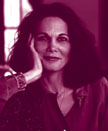 J.A. No, no, no. Part of it is that
it surprised me that I could do it. What dark place in my soul feels
that same kind of broken-ness and wants to be listened to? I've been
able to make a career at it and have people listen, but what would it
be like if it hadn't happened? That's one of your worst fears as a
writer, especially as you get older and older and the publishing
world seems to be turning in another direction. Maybe I'm just going
to be this old lady, this 70-year-old with all these manuscripts.
J.A. No, no, no. Part of it is that
it surprised me that I could do it. What dark place in my soul feels
that same kind of broken-ness and wants to be listened to? I've been
able to make a career at it and have people listen, but what would it
be like if it hadn't happened? That's one of your worst fears as a
writer, especially as you get older and older and the publishing
world seems to be turning in another direction. Maybe I'm just going
to be this old lady, this 70-year-old with all these manuscripts.
M.R. Do you see fiction moving in a different direction? What do you see as its future?
J.A. I wonder about the future of the book, but I have faith in the future of narrative. It seems to be something that we need to do to understand who we are. The random things in our lives, memory puts together as a narrative of what's happened to us, which might not really have happened, but it's what we remember. And it's also what we've constructed out of what happened, out of which we tell ourselves the story of who we are. I think that the need to make meaning through telling stories will continue.
Marny Requa is a founder of Might magazine, and lives in San Francisco. She is also a contributor to Bay Area publications and has worked on various books published on social issues.
![[Back]](arrleft.gif)
![[Home]](homebut.gif)
![[Forward]](arrright.gif)