 j=1,2,...128 (2.1)
Optimizing ECG Signal Sampling Frequency for T-Wave Alternans Detection
L Burattini, W Zareba, JP Couderc, JA Konecki, AJ Moss
University of Rochester, Rochester, NY
Abstract
Computer detection of microvolt T-wave alternans (TWA) is an non-invasive method to identify patients at high risk for ventricular arrhythmias. Since TWA is a transient phenomenon, there is the need for continuous long-term TWA analysis in Holter ECG recordings. TWA detection, usually detected in ECGs sampled at 1000 samples per second (sps), is computationally demanding. We determined the ability of our correlation method (CM) to identify TWA in ECGs sampled at lower frequencies. TWA was identified in 39 long QT syndrome patients, whose ECGs were originally acquired at 1000 sps, and then resampled at 100, 250, 500, and 750 sps. Results obtained at different sampling conditions were compared. We found that TWA can be effectively detected with the CM using sampling frequencies as low as 250 sps. Such sampling frequency seems to be optimal since it provides high accuracy of TWA measurements and substantial saving of computational time.
Computerized analysis of microvolt TWA in digital ECG recordings has been proposed as an effective non-invasive method to identify patients at high risk for ventricular arrhythmias [1-4]. ECG tracings with visible TWA show that TWA is usually a non-stationary, transient phenomenon. Recently, we developed a new time-domain correlation method [5-7] that, differently from other techniques, is able to detect TWA episodes involving as few as 7 consecutive beats. Given the dynamic nature of the TWA signal, there is the need for continuous long-term TWA analysis in Holter ECG recordings. The correlation method [5-7], as well as other TWA-detection techniques [1-4], have been tested in ECGs sampled at high sampling frequencies, usually 1000 samples per second (sps), that makes TWA analysis computationally very demanding. A reduction in the sampling frequency of the ECG tracings would allow for a significant saving in processing time and facilitate TWA analysis in long-term Holter recordings. However, there is no data confirming that computer TWA detection in ECGs sampled at lower frequencies is as effective as in ECGs sampled at 1000 sps.
This study aimed to determine the ability of the correlation method to identify and quantify TWA episodes in ECG recordings sampled at frequencies lower than 1000 sps. The digital ECGs, originally acquired at 1000 sps in long QT syndrome patients, were used to test the feasibility of TWA quantification at lower sampling frequencies.
We analyzed TWA in 39 patients with congenital long QT syndrome (mean age: 23± 16 years, mean QTc=0.51
±0.05 sec). In each patient, a three-channel (X,Y, and Z) digital Holter ECG recording was obtained using Altair Disc recorders (Burdick Inc., Milton, WI) that sampled the ECG signal at 1000 sps. A series of 128 consecutive sinus beats recorded in resting conditions was used to detect and quantify TWA.The analysis of TWA in Holter ECG recordings (without pacing or exercise-induced tachycardia) requires preprocessing of the ECG signal.
This preprocessing, which was developed by our group as part of the correlation method algorithm, consists of the following steps [6-7]. First, the ECG signal is filtered with a low-pass filter (cut-off frequency: 60 Hz) to reduce the effect of background noise. Then, the R peaks are detected and the stability of the heart rate is tested (standard deviation of RR < 10% mean RR). This test was designed to exclude ECGs with large RR variations, since the morphology of the T wave may be affected by a sudden change in heart rate. Next, ECG tracings with stable RR undergo baseline removal (using a third order spline interpolation). Finally, T-wave windowing (using our empirical formulae: window onset at 60, 100, and 150 msec from the R peaks for RR>0.6, 0.6£ RR<1.1, and RR³ 1.1 sec, respectively; window length:
 ms.), T-wave synchronization (using a match filter), and respiratory modulation removal (using a stop-band filter with cut-off frequencies: 0.14 and 0.35 cycles per beat) are performed [6].
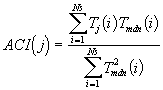
Our TWA analysis by the correlation method (CM) is based on the definition of an alternans correlation index (ACI) for each consecutive T wave (Tj) [5-7]:
j=1,2,...128 (2.1)
where Ns is the number of samples in each T wave, and Tmdn is the median T wave computed using 128 T waves available in each ECG tracing.
TWA is detected when the value of ACI oscillates around one in the case of monophasic TWA and around zero in the case of biphasic TWA, in at least 7 consecutive beats.
Since a value of ACI is computed for each individual T wave and identifies alternating T waves, the correlation method allows the determination of the total number of alternating beats (NCM) in the ECG segment. It is possible to show that an estimation of the TWA amplitude corresponding to each alternating beat ‘j’ can be obtained using the formula:
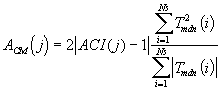 j=1,2,...128 (2.2)
For those beats detected as non alternating, ACM(j)=0.
By averaging all the ACM(j)>0, it is possible to obtain an overall estimation of the TWA amplitude (ACM; in m V) in the ECG segment. TWA activity can also be globally described by the TWA overall magnitude (MAGCM; in m V), defined as the product of the TWA amplitude and duration (MAGCM=NCMACM).
The resampling process was performed by using a polyphase implementation and an antialiasing low-pass FIR filtering of the 1000 sps ECG signal. The filter was designed using a FIR with the Kaiser window. The resampling process was set to obtain the following sampling frequency of the ECG recordings: 100, 250, 500 and 750 sps.
The absolute values of TWA parameters (including ACI, NCM, ACM, MAGCM) obtained from resampled ECGs of the same patients were used to determine the magnitude and significance of their correlation with respective values obtained originally from 1000 sps sampled ECG. Regression analysis was used to test the significance of the studied correlations. The t-test was used to compare the results of TWA analysis at different sampling frequencies. It was assumed that values of TWA parameters should not differ between studied sampling frequencies, and therefore very stringent p value (>0.75) for t-test comparisons was required to confirm the clinical effectiveness of TWA analysis with different sampling frequencies.
Using standard 1000 sps digital ECG recordings, TWA was identified in 17 (44%) long QT syndrome patients. The correlation analyses between TWA parameters obtained from original and resampled ECGs were performed by grouping together all patients and all ECG leads.
Figures 1-4 show the regression plots for ACI values obtained from 1000 sps ECGs and from ECGs resampled at 100, 250, 500, and 750 sps, respectively. Similar plots were obtained using all other TWA parameters.
Table 1 summarizes the values of the correlation coefficients between TWA parameters measured at the original and reduced sampling frequencies. Regression analyses demonstrated that all correlation coefficients were statistically significant (p<0.001). Although all correlation coefficients were high (r>0.90), it would be expected that they should reach a 0.99 value since the TWA analyses were done using the same ECG signals for all sampling frequencies.
The 0.99 values of correlation coefficients were observed when TWA analyses were performed using ECGs sampled at 250, 500, and 750 sps, but not when ECGs were sampled 100 sps. Especially the ACI parameter, which determines the accuracy of the TWA detection, had a correlation coefficient at 100 sps = 0.93, inferior in comparison to coefficients at 250-750 sps.
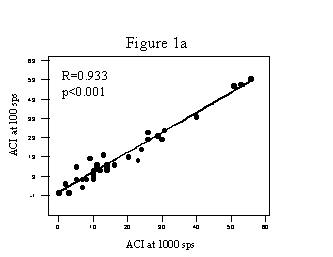
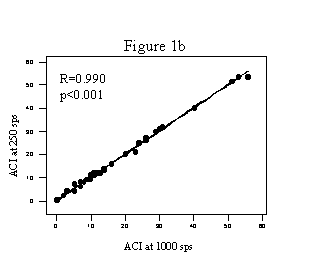
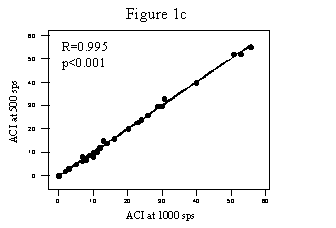
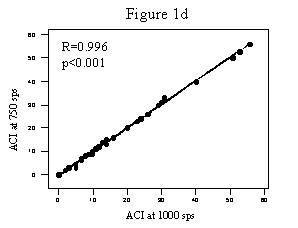
Figure 1. Regression plots of the alternans correlation index (ACI) measured with a sampling frequency of 1000 sps vs. 100 (Figure 1a), 250 (Figure 1b), 500 (Figure 1c) and 750 sps (Figure 1d).
R - correlation coefficient
Table 1. Correlation coefficients for TWA comparison between original (1000 sps) and reduced sampling frequencies (100, 250, 500 and 750 sps). All values are significant (p<0.001).
|
SF (sps): |
100 |
250 |
500 |
750 |
|
ACI |
0.933 |
0.990 |
0.995 |
0.996 |
|
NCM |
0.918 |
0.998 |
0.997 |
0.998 |
|
ACM |
0.979 |
0.998 |
0.999 |
0.999 |
|
MAGCM |
0.987 |
0.997 |
0.999 |
0.999 |
SF- sampling frequency;
ACI- alternans correlation index.
NCM, ACM, MAGCM - TWA duration, amplitude, and magnitude, respectively.
Table 2. Mean ± standard deviation of the TWA parameters computed using the original (1000 sps) and reduced (100, 250, 500, 750 sps) sampling frequencies.
|
FS (sps): |
NCM |
ACM (m V) |
MAGCM (m V) |
|
100 |
60± 22* |
29± 16* |
1625± 977* |
|
250 |
63± 20 |
26± 16 |
1524± 973 |
|
500 |
65± 20 |
27± 16 |
1579± 947 |
|
750 |
64± 19 |
26± 16 |
1534± 959 |
|
1000 |
63± 19 |
26± 16 |
1534± 955 |
NCM, ACM, MAGCM- TWA duration, amplitude and magnitude, respectively.
SF - sampling frequency.
*- p value less that 0.75.
These observations are confirmed by the data shown in Table 2, where we quantitatively compared the values of the TWA parameters obtained at the original and reduced sampling frequencies. There were very negligible (p=0.82-0.99) differences in TWA parameters when comparing results from original ECGs and ECGs resampled at 250, 500, and 750 sps. Significant differences (p<0.75) were observed between TWA parameters measured at 100 sps and 1000 sps. These results suggest that ECG sampling frequency at 100 sps seems to be too low for accurately measuring TWA in digital ECGs, whereas the sampling frequencies of 250 sps and above provide statistically equivalent results of TWA analysis. Thus, a sampling frequency of 250 sps seems to be an optimum tradeoff between accuracy in the TWA detection and quantification and the saving of processing time.
Our time-domain correlation method for the analysis of microvolt TWA in ECG recordings acquired during sinus rhythm opens the possibility of TWA identification and quantification in digital ECG Holter recordings. The major benefit of this method is that it allows for detection of very short (consisting of as few as 7 beats) episodes of TWA. ECG recordings with visible forms of TWA show that this phenomenon is often non-stationary or transient, and that the duration of a TWA episode can vary from few beats to few hundreds of beats. As a consequence of the transient nature of the TWA phenomenon, a continuous long-term TWA analysis in Holter ECG recordings seems appropriate. However, TWA analysis is, at the present time, computationally very demanding, and consequently restricted to relatively short ECG segments (usually 128 beats). Independently of the used technique (spectral method, complex demodulation method, or correlation method), the time needed to perform a TWA analysis is dependent of various factors: length of the ECG recording, length of the repolarization segment, and sampling frequency. Since the ultimate clinical goal is to analyze long-term ECGs for TWA detection, and since we cannot change the repolarization segment duration (that is specific for each ECG tracing), reducing the sampling frequency of the ECG signal seems to be a practical approach to enable less time-consuming computer processing.
The correlation method and the other techniques have been tested on ECG sampled at high frequencies [1-7]. In this study, we analyzed TWA in ECG recordings originally sampled at 1000 sps and then resampled at lower frequencies (100, 250, 500, and 750 sps), and we determined the ability of the correlation method to correctly identify and quantify TWA at lower sampling frequencies. The digital ECG recordings of long QT syndrome patients were used, since they are particularly prone to develop TWA [8].
Our study showed that ECGs sampled at 250, 500, 750, and 1000 sps yield very similar results of TWA analysis with our correlation method. When comparing TWA parameters in ECGs sampled at 1000 sps to those in ECGs resampled at 250, 500, and 750 sps correlation coefficients showed very high values (R>0.99). The mean values of TWA parameters were almost identical for sampling frequencies of 250-1000 sps. Lower correlation coefficients and more evident differences were observed when TWA parameters obtained from ECGs acquired at 100 sps were compared to those obtained at 1000 sps sampling frequency. These observations suggest that a sampling frequency of 100 sps is too low for accurate TWA detection and quantification. Therefore standard amplitude modulated tape recorders, with a sampling frequency usually not exceeding 128 sps, may provide limited accuracy when applied for TWA analysis. Our study further extends the observations of Nearing and coworkers [9] who demonstrated that digital and frequency modulated Holter recorders have better frequency response than amplitude modulated recorders and they are preferable for TWA detection in ambulatory Holter monitoring.
In conclusion, we demonstrated that the correlation method can be used to detect TWA in ECGs with sampling frequencies as low as 250 sps without compromising the accuracy of testing. The 250 sps sampling frequency seems to be optimal, since it provides very high accuracy in TWA identification, and substantial saving of processing time.
References
Address for correspondence.
Laura Burattini
via Bille’ 16
63023 Fermo (AP)
Italia
e-mail: [email protected]