
Computer Detection of Non-Stationary T Wave Alternans using a New Correlation Method.
L. Burattini, W. Zareba, J.P. Couderc, E.L. Titlebaum, A.J. Moss
University of Rochester, Rochester, New York
Abstract
Detection of microvolt T wave alternans (TWA) is a non-invasive method to identify patients at risk for sudden cardiac death. ECGs show that visible TWA is often non-stationary. Thus, we developed a new correlation method (CM) for TWA detection, and we tested CM�s ability to detect non-stationary TWA in comparison with accepted spectral method (SM). In a simulation study CM and SM were used to evaluate stationary and non-stationary TWA of different amplitude. Other simulated conditions included: background noise, poor synchronization and windowing of the T waves; and amplitude respiration modulation of the T wave.
In our comparison of CM and SM, we found that only CM was able to detect non-stationary TWA. CM was more robust to a poor synchronization and windowing of T waves, but affected more by high amplitude modulation than SM. Both CM and SM detected TWA in the presence of background noise.
In recent years the presence of low amplitude T wave alternans (i.e. beat-to-beat alternation of the T wave) has been found to be associated with propensity to ventricular fibrillation [1-3]. Thus, quantification of T wave alternans (TWA) provides a non-invasive and clinically useful marker of sudden cardiac death risk.
Electrocardiographic tracings show that TWA may often be a non-stationary phenomenon. In such cases spectral analysis of TWA seems to have limited use due to the inability of power spectrum density to detect non-stationary characteristics of signals. Thus, the purpose of this study was to develop a new time domain correlation method (CM) for TWA detection and to design a simulation testing CM ability to detect and measure non-stationary TWA in comparison with accepted spectral method (SM) [2-3,5]. The study also examined the influence of the following factors, often affecting real ECG recordings: background noise, poor T-wave synchronization and windowing, and amplitude respiration modulation of the T wave.
TWA was simulated using a sequences of 128 consecutive T waves. Each T wave was simulated using a cycle of a sinus wave, sampled at 1000 Hz, and 200 msec long. The amplitude of the T wave was changed on every-other-beat basis to simulate TWA.
Four different simulations were performed:
I) The first simulation analyzed the case of stationary (i.e. time-constant) vs. non-stationary (i.e. time-varying) TWA. Three different TWA conditions were considered: a stationary 128-beat long TWA with constant amplitude of 100 m V (s1); a 64-beat long TWA with amplitude of 200 m V (s2); and two 32-beat long segments with TWA amplitude of 200 m V (s3).
II) The second simulation tested TWA detection in the presence of background noise. TWA was stationary, while the maximal amplitude of the white uniform noise added to the T waves was varying from 0 to 300 m V.
III) In the third simulation the T waves were poorly synchronized. TWA amplitude was stationary, while a random phase, used to simulate a time shift among the T waves, was varying from 0 to 0.1p (corresponding to a time shift varying from 0 to 100 msec).
IV) The fourth simulation tested the effects of respiration modulation on stationary TWA detection. The period of the simulated respiratory modulation was fixed at 4 beats. The amplitude of the modulation varied from 0 to 100 m V.
Simulations II, III, and IV were performed with a value of the TWA amplitude of 200 m V and 10 m V, to simulate high and low TWA levels respectively.
All simulations were performed twice, with and without the inclusion of the ST segment in the T wave windows. The ST segment was simulated adding 50 msec of zero padding in front of the T waves.
CM and SM were used to detect and measure TWA in all the above-described simulated conditions.
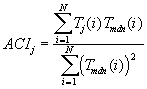
The median T wave (Tmdn) was computed from the 128 T waves available. Then, an alternans correlation index (ACIj) was computed to measure morphological changes of each of the consecutive Tj waves in comparison to Tmdn.

 j=1:128 (2.1)
ACIj was defined as the ratio of the maximum value of the cross-correlation function of Tj and Tmdn, over the maximum value of the auto-correlation function of Tmdn. Thus, a value of ACIj greater than 1 indicated that Tj was �larger� than Tmdn, while a value of ACIj smaller than 1 indicated that Tj was �smaller� than Tmdn. Fig. 1 shows an example of alternating values of ACIj, indicating the presence of TWA.
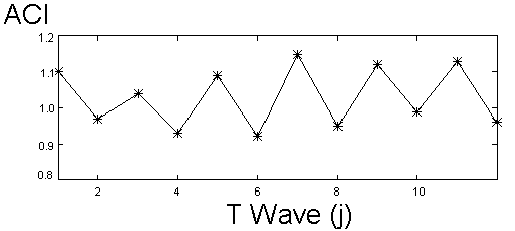 Fig.1: Example of TWA detected by CM
Tj was classified as alternating when it belonged to a string of at least 7 T waves whose ACIj were alternating.
Since CM tracked T waves in time (i.e. gave a value of the alternans correlation index for each of the consecutive T wave), it was able to detect short-time T wave amplitude changes, as well as the number (nseg) and the length (lseg) of alternating segments in the series of beats, and the number percent (N%) of alternating T waves.
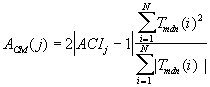
It can be proved that TWA amplitude (ACM) can be estimated using the formula:
 (2.2)
(2.2)
According to Formula (2.2), TWA was distributed along the whole T wave length, and thus ACM usually provided an underestimation of the actual TWA amplitude.
2.3 Spectral method
A detailed description of the spectral method was previously reported in literature [2-3,5]. TWA estimation by SM was based on the analysis of the cumulative spectrum, computed as the sum of the power spectrum estimations of each corresponding sample in the T-wave windows. The peak of the cumulative spectrum at 0.5 cycle per beat, called alternans peak (AP), is considered a direct measure of TWA. TWA detection is statistically significant when the alternans ratio (AR), defined as , is greater than 3. Mean (m
noise) and standard deviation (s
noise) of spectral noise are estimated from a predefined noise window. SM also underestimates (ASM) the TWA amplitude, since TWA is supposed to be uniform along all samples in the T-wave window.
, is greater than 3. Mean (m
noise) and standard deviation (s
noise) of spectral noise are estimated from a predefined noise window. SM also underestimates (ASM) the TWA amplitude, since TWA is supposed to be uniform along all samples in the T-wave window.
2.4 Comparison of CM and SM
Given a certain simulated TWA amplitude (ATWA), a measure of CM and SM ability to detect TWA was provided by the values of the relative error ( , i=CM, SM) and of the maximal error (MEi, i=CM, SM). REi represented the deviation percent of Ai from ATWA, while MEi was defined as the maximal deviation of Ai, values measured during a specific simulation, from Ai value measured under ideal recording conditions (i.e. stationary TWA, absence of noise and respiration modulation, perfect T wave windowing and synchronization).
All TWA-amplitude values were expressed in m Volt, unless differently indicated, with a resolution of .5 m Volt.
Under the ideal recording conditions, CM and SM gave the results shown in Table 1. Both CM and SM underestimated ATWA, but RECM was systematically smaller than RESM. In addition, ACM and RECM were independent of the presence of the ST segment in the analysis, while ASM and RESM were not. Thus, CM proved to be more robust than SM to a poor T-wave windowing.
Table 1: TWA detection under ideal recording conditions.
|
ATWA |
ACM |
ASM |
RECM |
RESM |
|
|
T |
200 |
150 |
100 |
25% |
50% |
|
10 |
7.5 |
50 |
25% |
50% |
|
|
T+ST |
200 |
150 |
90 |
25% |
55% |
|
10 |
7.5 |
4.5 |
25% |
55% |
For simplicity, only results of the simulations in which the ST segment was included in the analysis are reported. Similar results were obtained when only T wave was analyzed.
The results of the simulation relative to the detection of stationary vs. non-stationary TWA, are shown in Table 2 and Fig.2. CM detected one alternating segment of 128-beat long, one alternating segment 65-beat long, and two alternating segments each 33-beat long, when simulations s1, s2, and s3, respectively, were performed. RECM varied from 25% to 29% for s1 to s3. SM did not give any information about the localization of the alternating T waves in the series. No significant difference was observed among the values of ASM relative to the three different stationarity conditions. The presence of non-stationary characteristics in the TWA signal resulted in an significant RESM increase (from 55% to 78%), and in a strong AR decrease (from ~108 to ~102).
Table 2: Detection of stationary vs. non-stationary TWA.
|
ATWA |
N% |
ACM |
ASM |
RECM |
RESM |
|||
|
s1 |
100 |
100% |
75 |
45 |
25% |
55% |
||
|
s2 |
200 |
50% |
148 |
45 |
26% |
78% |
||
|
s3 |
200 |
50% |
143 |
44 |
29% |
78% |
||
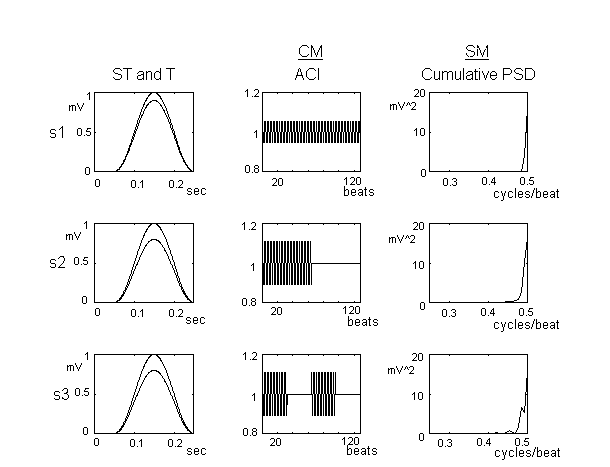
Fig.2: Stationary (s1) and non-stationary (s2,s3) TWA.
The results of TWA simulation in the presence of background noise are shown in Table 3. CM detected TWA with a RECM of 25-26%, and a MECM of 5 and 0 m Volt for ATWA of 200 and 10 m Volt respectively. SM detected TWA with a RESM of 55%, and a MECM of 2.5 (ATWA=200m Volt) and 0 m Volt (ATWA =10 m Volt). In addition, AR decreased strongly (from ~108 to 102) with increasing noise amplitude.
Table 3: TWA detection in the presence of noise.
|
ATWA |
ACM |
ASM |
RECM |
RESM |
MECM |
MESM |
|
200 |
149± 1.5 |
90± 1 |
26% |
55% |
5 |
2.5 |
|
10 |
7.5± 0 |
4.5± 0 |
25% |
55% |
0.0 |
0.0 |
The results of the simulation designed to test the influence of a poor T-wave synchronization on TWA estimation are shown in Table 4 and Fig. 3. For ATWA of 200 m Volt, both CM and SM detected TWA: RECM (25%) was less than RESM (55%); MECM and MESM were comparable (1.5 m Volt); and AR strongly decreased (from ~108 to ~101) with increasing time-shift among the T waves. For ATWA of 10 m V, only CM was able to detect TWA for any value of the time shift. N%, in fact, was always greater than 80%, clearly indicating the presence of TWA. On the contrary, AR randomly assumed values less than 3 after a time-shift of about 20 msec, making TWA detection by SM impossible. This phenomenon explains the extremely high value of RESM (72%)
Table 4: TWA detection in the presence of poor synchronization.
|
ATWA |
ACM |
ASM |
RECM |
RESM |
MECM |
MESM |
|
|
200 |
150± .5 |
89.5± .5 |
25% |
55% |
1.5 |
1.5 |
|
|
10 |
8± 1 |
3± 3.5 |
20% |
72% |
3.5 |
10.5 |
|
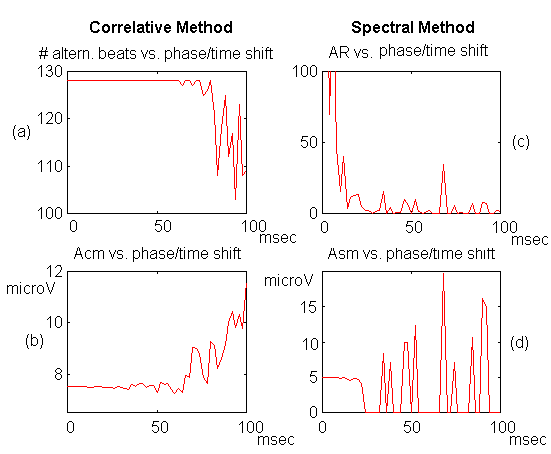
Fig. 3: TWA detection in the presence of poor synchronization of the T waves (ATWA=10 m Volt).
The results of simulation of TWA in the presence of respiration modulation are shown if Table 5 and Fig. 4. CM, as well as SM, detected TWA for ATWA of 200 m Volt. For this case, RECM (23%) was greater than RESM (54%), and MESM was less than MECM of about 3.5 m Volt. For ATWA of 10 m Volt, CM was able to detect TWA only as long as the amplitude of the respiration modulation was less than twice ATWA. This limitation of CM caused the RECM to be very high (85%). SM detected TWA for any value of the amplitude of the respiration modulation. RESM was 54%.
Table 5: TWA detection in the presence of respiration modulation.
|
ATWA |
ACM |
ASM |
RECM |
RESM |
MECM |
MESM |
||
|
200 |
154± 2.5 |
92± 1.5 |
23% |
54% |
8 |
4.5 |
||
|
10 |
1.5± 3 |
4.5± 0 |
84% |
54% |
7.5 |
0 |
||
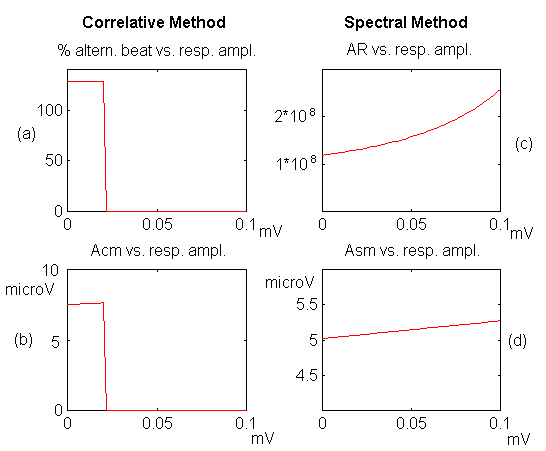
Fig. 4: 10 m V TWA detection in the presence of respiration modulation of the T waves (ATWA=10 m Volt).
4 Discussion and conclusions.
Table 1 shows that both CM and SM underestimated TWA amplitude, since they assumed TWA being distributed along the entire length of the T wave. Nevertheless, in the studied conditions, RECM was always smaller than RES, proving that CM estimated TWA amplitude more accurately than SM.
The results of our simulation study proves that SM is not adequate for detecting non-stationary TWA. In fact, an accurate estimation of the power spectrum requires a relatively large number of beats (64-128) during which stationarity is assumed. In addition, AR strongly decreases with increasing frequency components, and SM might become unable to detect TWA (AR<3). CM is more appropriate in case of non-stationary TWA since it is able to detect TWA in as few as seven beats (where seven was arbitrary fixed). In addition, ACM, but not ASM, was independent of the presence of the ST segment in the T wave window, at least as long as the ST segment was at 0 Volt. Consequently, we can conclude that SM requires more precision in determining the limits of the T wave window (onset and offset of the T wave).
Both CM and SM were able to detected TWA in the presence of noise, but CM is still to be preferred for the following reasons: AR strongly decreased with increasing noise, RECM was independent upon the ST segment, and REC was smaller than RES.
We have also proved that CM detects TWA with more accuracy than SM in the presence of poor synchronization, especially for low amplitude TWA. In fact, AR strongly decreased with increasing time-shift, and became soon so small (<3) that SM could not detect TWA any longer. Fig. 2 shows that SM failure does not seem to follow a specific rule, but might happen randomly.
SM is more appropriate than CM in detecting TWA only in the presence of high amplitude respiration modulation. In fact our simulations proved that CM is able to detect TWA only as long as the respiration amplitude is smaller than twice TWA amplitude. This one is a limitation of CM that may be overcome by using Badilini�s [4] algorithm for removing the respiration modulation effects from the ECG. Spectral analysis, on the other hand, is able to distinguish among different frequency components, making SM able to detect TWA independently of respiration modulation amplitude.
In conclusion, this simulation study showed CM ability to detect non-stationary TWA, but also the need for processing real ECGs before applying TWA detection algorithms. Noise can be reduced using a low pass filter (cut-off frequency: 60 Hz). The problem of T-wave synchronization is usually overcome by using paced ECGs (condition often unacceptable) and by robust synchronization of R peaks [2-3]. Respiration modulation effects can be significantly reduced using a phase amplitude modulation model, as shown by Badilini [4]. Appropriate reduction of these undesirable conditions would permit satisfactory detection of TWA, especially by the CM technique.
References
[1] Zareba W, Moss AJ, Le Cessie S, Hall WJ. T Wave Alternans in Idiopathic Long QT Syndrome. JACC 1994; 23:1541-6.
[2] Rosenbaum DS, Jackson LE, Smith JM et al. Electrical Alternans and Vulnerability to Ventricular Arrhythmias. N Engl J Med 1994, 330:235-41.
[3] Smith JM, Clancy EA, Valeri CR et al. Electrical Alternans and Cardiac Electrical Instability. Circulation 1988, 77:110-121.
[4] Badilini F. Time and Frequency Analysis of ST Segment Dislacement in Ambulatory ECG Recordings. Doctoral Thesis, University of Rochester, 1994
[5] Rosembaum D, Albrecht P, Cohen RJ, "Predicting Sudden Cardiac Death from T Wave Alternans of Surface Electrocardiogram: Promises and Pitfalls". J Cardiovasc Electrophysiol 1996; 7(11):1095-111.
Adress for correspondence:
Laura Burattini,
Heart Research, University of Rochester
601 Elmwood Ave, Box 653
Rochester NY 14642