RULES
OF
ELECTRIC WHEELCHAIR
RUGBY LEAGUE
Section I - General
1.1 Rugby League Rules
1.2 Safety Equipment
1.3 Tennis Ball
1.4 Officials
1.5 Authority of Referee
1.6 Cards - Red and Yellow
2.1 Court Size
2.2 Halfway Line
2.3 Dead Ball Line
24 Quarter Line
2.5 Try Line
2.6 In Goal Area
Section 3 - Duration of Play
3.1 Normal Playing Time
3.2 Time Outs
3.3 Extra Time
Section 4 - Teams
4.1 Team Size
4.2 Numbering of Team
4.3 Player Restrictions
4.4 Substitutions
Section 5 - Commencement of Play
5.1 Coin Toss
5.2 Team Starting Positions
5.3 The Kick Off
Section6 - Play in Motion
6.1 Gaining Possession
6.2 Passing
63 Tackling
6.4 Play the Ball
6.5 Marking
66 Kicking in General Play
Section 7 - Scoring
7.1 Scoring a Try
7.2 Points for a Try
7.3 Points for a Goal
1.0 General
1.1
Rules of Rugby League are to be used where Wheelchair Rugby League rules do not apply.
1.2
Each player MUST wear a seatbelt and footplates and safety equipment at their own discretion.
1.3
A tennis ball is used. However it is only used:
* To start play
* When kicking through during play.
* When kicking for goal
* In scrums
1.4
There will be 1 referee and 2 touch judges. The touch judges are to assist the referee where necessary in all aspects of the game. When each tackle is made, touch judges should stand on the line of touch, in line with 'the mark'.
1.5
The referee shall have complete authority while the game is in progress. Any protests can only go through the team captains. The referee can also order non-playing persons away from the playing areas if they are being disruptive or trying to influence the touch judges.
1.6
The referee shall carry a yellow card and a red card during matches. The yellow card for warning players who continue to infringe against the rules and a red card to send off players.
2.0FIELD OF PLAY
2.1
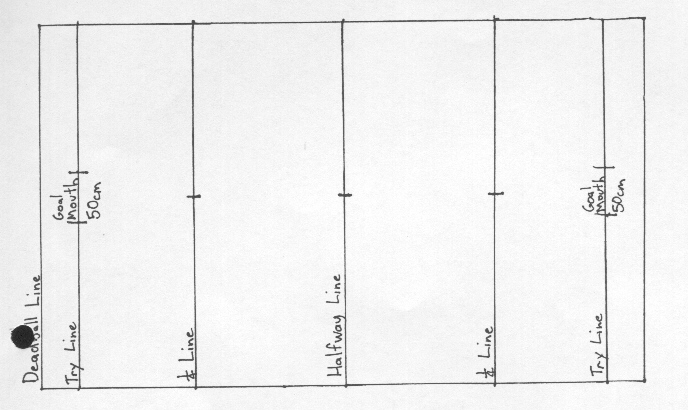
Electric Wheelchair Rugby League is played indoors on a court with a surface area approximately that of a basketball/netball court. (refer diagram 1 )
2.2
The court is divided into four equal quarters, with the middle line to be called the Halfway Line and this line will be marked at the centre.
2.3
The lines at either end of the court will be known as the Dead Ball Line.
2.4
The line halfway between the Halfway Line and the Dead Ball Line will be known as the Quarter Line and will be marked at the centre.
2.5
A line called the Try Line will be marked approximately 2 metres in from the Dead Ball Line and will be marked at the centre..
2.6
The area of the field between the Try Line and the Dead Ball Line will be known as the In-Goal Area.
2.7
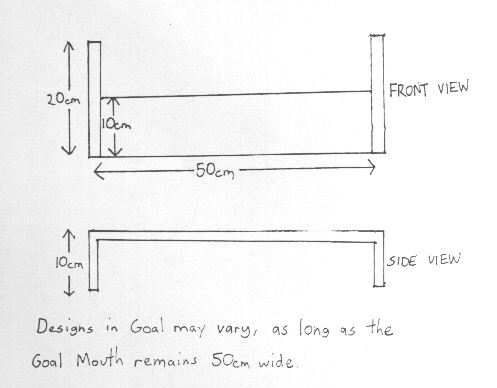
The goal posts (refer to diagram 2) are to be moveable and are only placed on the field when a goal is being attempted.
3.0DURATION OF GAME
3.1
The game is divided into 2 x 10 minute halves with 5 minutes for halftime.
3.2
Time Outs
3.2.1
Each team may call two time outs in any half of a game. Three time outs per half are permitted in finals. A time out is a break of play of thirty seconds duration.
3.2.2
A time out can only be called during a stoppage of play. A stoppage of play is when there is a change over of possession, or when the ball has gone out of play. A tackle is not considered a stoppage of play.
3.2.3
The central umpire may call an indefinite time out should a player sustain an injury requiring treatment - or for a matter of safety. No substitution of players - other than the injured player may occur at this time.
3.3
Each half will conclude when the timekeeper signals time. The umpire will then end play when the next tackle is completed.
3.4
Extra Time
Should scores in a finals match be level at the completion of two halves of normal time, then Extra Time, being two by five minute halves shall be played following a two minute break.
3.4.1
Following the first half of extra time, there will be a one minute break - and teams shall change ends.
3.4.2
Each team may call one time out during extra time but only due to a breakdown of a wheelchair.
4.0TEAMS
4.1
A team shall consist of five players on the field plus 1 substitute who may be interchanged throughout the game.
4.2
Each team shall be individually numbered from 1 to 6. This number needs to be able to be seen at all times.
4.3
All players are permitted in all areas of the court.
4.4
Team substitutions may occur during any timeout or at half time; or at the break of play prior to a period of extra time; or at half time of extra time.
5.0COMMENCEMENT OF PLAY
5.1
The umpire shall toss a coin and the team winning the toss has the option of choosing whether to kick off or receive the ball. The losing team will choose the direction of their attack.
5.2All team members on the team kicking off must be behind the centre line at the commencement of play. All team members on the receiving team must be behind the quarter line at the commencement of play.
5.3
The Kick Off
5.3.1
Play is started by the ball (tennis ball) being rolled from the centre of the halfway line to at least the quarter line. The team "kicking off' must not be closer than 1 metre to the ball until it has crossed the quarter line. The receiving team must be behind that quarter line until the ball has crossed the quarter line.
5.3.2
If the ball passes over the dead ball line from the kick off there is a quarter line tap.
5.3.3
If the ball fails to reach the quarter line from the kick off, a penalty will be awarded against the "kick off team" (see penalties)
5.3.4
If the ball is touched by the receiving team before the ball has crossed the quarter line, a penalty will be awarded to the "kick off team" (see penalties).
5.3.5 If the ball crosses the sideline (finds touch) af[er reaching the quarter line, and does not touch any person or wheelchair, then a scrum occurs (see scrum rule).
6.0PLAY IN MOTION
6.1
A player is said to be in possession when the ball has touched any part of their chair or body. A player is also in possession if the ball rolls under the chair or footplates.
6.2 Passing
6.2.1 During the run of play, the person in possession may pass the ball to another team member by calling out that players number. In turn, that player claims possession by calling "got it" then play continues.
6.2.2 If a player fails to call "got it" it is a "knock on" (see glossary). A 'knock on' also occurs if two or more players call 'got it', when the wrong player calls 'got it' and if a player calls their own number. (for knock on refer to change over and scrum rules.)
6.2.3
The receiving player must be behind or in line with the player passing the ball for the pass to be legal. If the receiving player is in front of the player passing the ball, a "forward pass" has occurred. (see penalties)
6.3
Tackling
6.3.1 Ifa player in possession is touched on their body or any part of their chair by an opponent or any opponents chair, that player is deemed to be 'tackled'.
Players who tackle with their feet cannot tackle with their hands and players who tackle with their hands cannot tackle with their feet. However, anyone may use their chair to tackle.
6.4
Play the Ball
6.4.1
A tackled player must 'play the ball' from where they have been tackled. They must stay on 'the mark' (where they were tackled) or return to 'the mark' if they have overrun the mark. Linesman need to position themselves aRer each tackle so as to indicate the line of 'the mark'. Once on 'the mark', the player must wait for the referee to signal 'play the ball'. To do so that player must
I pass the ball to a team member; or
II take a 'tap'.
6.4.2
If the tackled player is 'unmarked' after the referee has said 'play the ball', that player can call out 'tap' and play on. '
6.4.3
A tackled player cannot 'tap' the ball in the opposition quarter of the field. This rule is exempt only in the case of a penalty being awarded.
6.4.4
A player has a 5 second time limit after the referee says 'Play the Ball' to play on.
6.5
Marking
6.5.1
Opposing players whilst marking in the 'play the ball' must face square on to goal lines, so too must the player in possession (ie players must be face to face and square on to each others chairs and not more than 30cm from each other).
6.5.2
During the 'play the ball' the defending team must be behind the referee who will stand at least 3 wheelchair lengths away from the front of the tackled player.
6.6
Kicking in General Play
6.6.1 During play, one player from the attacking team may carry the ball (a tennis ball) on any tackle only after the referee has been notified. To kick the ball, a playermust call 'kick' immediately before the kick and must call 'got it' when possession of the ball has been regathered (see glossary).
6.6.2
If the ball is kicked downwards it must come into contact with the ground before it is regathered.
6.6.3
If the ball passes over the 'dead ball' line from a kick through without the opposing team touching it, there is a quarter line tap.
6.6.4
If the ball is kicked through in the in-goal area and is touched on the 'full' by a defender, there is a quarter line tap.
6.6.5
If the ball goes dead in goal, as in 6.6.3 and 6.6.4 then players must wait for the referee to be at the quarter line before the tap to restart play can be taken.
6.6.6
If the defending team gain possession from a kick through, the first tackle made shall be counted as the first of six.
6.6.7
Ifa player is tackled in goal, there is a 'goal line dropout' (a goal line kick) from the centre of the try line. The ball must be rolled.
7.0SCORING
7.1
A try is scored by a player in possession getting at least one wheel over the opposing try line without being tackled.
7.2
After a try is scored (worth 4 points) a player kicks for goal. This attempt is taken from the halfway line, in line with where the try was scored.
7.3
The attempt at goal (worth 2 points) is deemed to be successful if the ball (rolled or thrown) passes through the goal mouth. The goal mouth is 50 cm wide. The goal posts are removed during play.
7.4
The team that has just scored kicks off from the halfway line to recommence play.
8.0THE CHANGEOVER
8.1
The 'changeover' is when possession of the ball is given to the opposing team.
This occurs when:
* A team is tackled six times without losing possession.
* A player goes into touch on the 5th or 6th tackle.
* When a knock-on occurs on the 5th or 6th tackle.
* The ball is kicked into touch on the 5th or 6th tackle.
9.0THE SCRUM
9.1
A 'scrum' is formed by 2 opposing players (the hookers) facing the opposite teams goal line. They must be directly beside each other but 50 cm apart (eg Player 1 's from wheels must be aligned with Player 2's rear wheels and vice versa). The referee bounces the ball between the two hookers. The hookers must be sitting up straight with arms and hands on their arm rests. The hookers and their chairs must remain stationary until the ball has hit the floor. After the bounce hookers will attempt to touch the ball with their chair, arm or body. The first hooker to do so will be indicated by the referee to have gained possession of the ball. The hooker in possession must remain stationary and pass the ball without being tackled. The opposing hooker cannot tackle in the 'scram'.
9.2
During the scram, players not involved must remain stationary and at least 3 wheelchair lengths behind the 'scram'.
9.3
A scram occurs when:
* A player in possession goes into touch before the 5th tackle has been called.
* The ball is kicked into touch from the kick-off or a goal line drop out after crossing the quarter line.
* The ball is kicked into touch before the 5th tackle has been called.
* A player regaining possession from a kick through does not call 'got it'.
* The ball is passed forward and 'got it' has not been called.
* There is a 'knock-on' before the 5th tackle has been called.
* A player does not say 'kick' before kicking the ball in general play.
10.0THE PENALTY
10.1
A penalty will be awarded against the offending team when the following occurs:
10.2
When a penalty occurs, the non-offending team can:
I Kick for goal from where the penalty was given.
II Kick for touch (rolled or thrown) and take a tap.
III Take a tap.
10.3
Ramming or rough play may result in a player being sent from the field for a period of 3 minutes (sin bin). Consistent breaches of the rules by any player may result in being sent off for the remainder of the game. A player who is in the sin bin, or has been sent off, cannot be replaced during that time.
10.4
Where an offence occurs, the referee may allow play to continue if in his opinion it is to the advantage of the team infringed against.
GLOSSARY
Kicking Rolling or throwing the ball (tennis ball) during play.
Dead Ball When the ball crosses over the dead ball line without any player making contact.
Tap
When an attacking player in possession of the ball is unmarked aerer a tackle they may play on by saying 'tap' except when in opposition quarter.
Kick Through An attacking player asks for the ball (tennis ball) from the referee to make an attempt to improve field position.
Method: The player holding the ball once being called by number and saying 'got it; (ie has 'possession') may throw the ball in any direction, but must say 'kick' before doing so. To regain possession of the ball attacking players must commence their attempt to do so from a position behind the player who kicks through. Any player on the field must say 'got it' when making the first contact with the ball to gain possession (ie players in either attacking or opposing team).
Kick for Touch During Play:
Another method of attempting to improve field position.
Method: An attacking player asks for the ball from the referee. Usually bah is kicked forward towards one of the side lines. The ball must bounce in field of play prior to reaching side line. (refer to scrum rules)
After a penalty is awarded.
The team to whom the penalty is awarded, may attempt to gain further field position by kicking the ball forward over the side line.
Tackled
Being touched by a defending player with his chair, hand or feet (but not both).
Goal Line Dropout
A kick from the centre of the try line in the direction of the opposition try line. The ball must cross over the kicking team's quarter line before any attempt to gain possession by either team. If the ball fails to reach the quarter line it is apenalty. If the ball goes into touch after crossing the quarter line without contact being made by any player a scrum
OcCurS.
Play the Ball
Off Side
Passing the ball or tapping the ball after a tackle to restart play.
Marker A defensive player who positions themself in front of the tackled player during the play the ball.
A Pass Calling the number of a team member who has to call 'got it' during the run of play.
Possession of 'the ball' is given to the opposing team.
Change Over Try
Is when a player in possession has at least one wheel over the defending goal line without being tackled.
Shepherding
When one player in possession put one of their own players between themselves and an opposing player, so as to hinder an attempted tackle.
Field
Standard sized basketball court.
Forward Pass
When the player receiving the ball is in front of the player passing and the pass is completed.
(a) From the Kick Off
When any member of the team of the player kicking off is in front of that player they are deemed off side, also any player of the receiving team who is in front of their quarter line from the kick off is also deemed to be off side.
(b) During Play
When any member of the defending team (except the marker) is not behind the referee at the play the ball they are deemed off side.
(c) Kick Through
Knock On When any player from the attacking team is in front of the person kicking through and touches the ball before 'the kicker' is in front of the ball, they are deemed off side.
Goal Passing of the ball through the goal mouth.
'Got it'Statement used to claim possession of the ball.
'Kick'Statement used when kicking through. Occurs:
(a) If a player fails to call 'got it' when their number is called.
(b) If two or more player call 'got it' (c) If a player calls their own number. Results in:
(a) A serum is it occurs before the 5th tackle has been called.
(b) A changeover if it occurs at'rer the 5th tackle has been called.
August, 1996
You Are Visitor Number Since 1 June, 1998