August, 1996
RULES OF
ELECTRIC WHEELCHAIR
HOCKEY
SECTION 1 - FIELD OF PLAY
1.1 Court Size
1.2 Playing Areas
1.3 Goal/Shooting Circle
1.3.1 Goal Square
1.4 Centre Circle
1.5 Goal Cage
1.6 Penalty Spot
SECTION 2 - DURATION OF GAME
2.1 Normal Playing Times
2.2 Time Outs
2.3 End of Half
2.4 Extra Time
SECTION 3 - TEAMS
3.1 Team Size
3.2 On Field Positions
3.3 Off Side
SECTION 4 - COMMENCEMENT OF PLAY
4.1 Toss of Coin
4.2 Nominating Team Positions
4.3 Player Positions at Start of Play
4.4 Centre Face Off
4.5 Umpire to Start Play
4.6 Restart of Play
SECTION 5 - SCORING
5.1 Legal Goal
5.2 Own Goal
5.3 Illegal Goal
5.4 Throwing Stick to Prevent Goal
5.5 Penalty Hit For Goal
5.6 Penalty Goals in Finals
SECTION 6 - FREE HITS
6.1 When Awarded
6.1.1 Dangerous Play
6.1.2 Ball Above Knee Height
6.1.3 Dangerous Driving of Wheelchair
6.1.4 Throwing Stick
6.1.5 Shepherding Outside of Court
6.1.6 Interfering with Opponent
6.1.7 Handling or Kicking Ball
6.1.8 Offside
6.1.9 Unsportsmanlike Conduct
6.1.10 Time Wasting
6. I. 11 Goal Square entering - defensive team 6.1.12 Goal Square entering - attacking team 6.1.13 Yellow or Red card
6.2 Awarding a Penalty Hit
6.3 Three Metre Clearance
6.4 Three Metre Penalty Hit
6.5 Free Hit to Defender
6.6 Advantage Rule
SECTION 7 - BALL OUT OF PLAY
7.1 Outside of Designated Playing Area
7.2 Restart Play
7.2.1 From Sideline
7.2.2 From Goal Line
7.3 Comer Hit
7.4 Dead Ball
7.5 Dead Ball Hit-Out
SECTION 8 - EQUIPMENT USED
8.1 Authority for Use
8.2 Hockey Stick\T Stick
8.3 Hockey Bail
8.4 Goal Cage
APPENDICES.
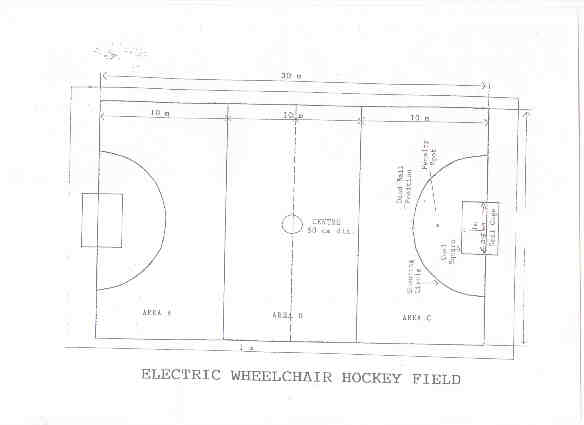
Diagram 1. Diagram of Hockey Court with Markings
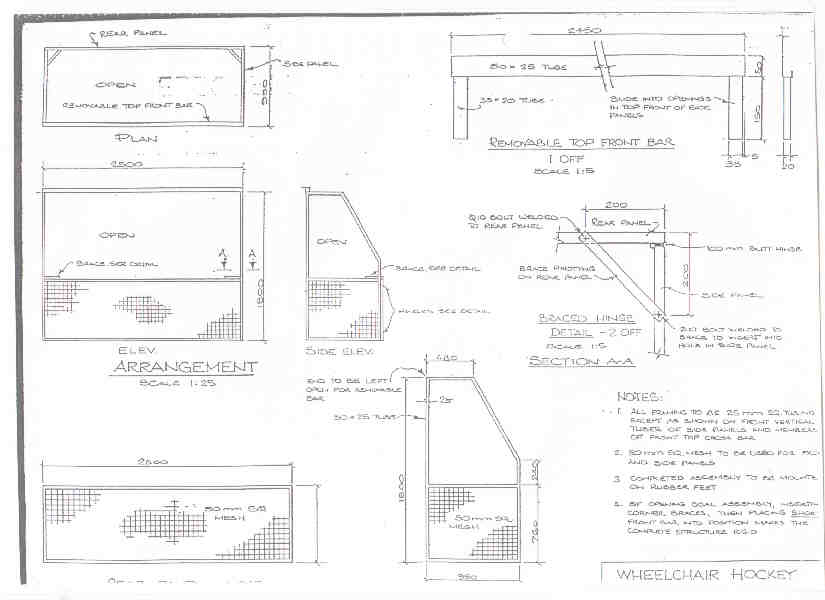
Diagram 2. Specifications for Goal Cage
1.0 FIELD OF PLAY
1.1
Electric Wheelchair Hockey is played indoors on a court with a surface area approximately that of a basketballxnetbail court. (refer to diagram 1 )
1.2
The playing area is divided into three areas of equal size and shall also be marked with a centre line.
1.3
At the centre of each end (known as the goal line) - a half circle of five metres diameter will be marked on the court, known as the shooting circle.
1.3.1 Within the shooting circle there is a goal square. This square is marked one metre from the goal line. This square is a goal keeper's area only. No other player, part of a chair or stick may enter this goal square.
1.4 A circle of sixty centimetres diameter shall be marked in the centre of the court
1.5 A goal cage of prescribed specifications (refer diagram 2) will be located centrally on the goal line with the leading sides in contact with the outer edge of the goal line.
1.6 A penalty spot will be marked at a point three metres from the goal line in the centre of the shooting circle
2.0 DURATION OF GAME
2.1 The game is divided into 2 x 10 minute halves with 2 minutes for halftime.
2.2 Time Outs
2.2.1 Each team may call two time outs in any half of a game. Three time outs per half are permitted in finals. A time out is a break of play of thirty seconds duration and can only be called during a stoppage of play - e.g. Dead ball, ball out of bounds etc.
2.2.2 A time out can only be called during a stoppage of play.
2.2.3 The central umpire may call an indefinite time out should a player sustain an injury requiring treatment - or for a matter of safety. No substitution of players - other than the injured player may occur at this time.
2.3 Each half will conclude when the timekeeper signals time. The umpire will then end play..
2.4 Extra Time
2.4.1 Should scores in a final match be level at the completion of two halves of normal time, then Extra Time, being two by five minute halves shall be played following a two minute break. Following the first half of extra time, there will be a one minute break - and teams shall change ends.
2.4.2 Each team may call one time out during extra time but only due to a breakdown of a wheelchair.
3.0 TEAMS
3.1 Size
3.1.1 A team shall consist of five players on the field plus 1 substitute who may be interchanged throughout the game.
3.2 Positions
3.2.1 Each team shall include a centre player who is restricted to area B as shown in diagram 1.
3.2.2.
Each team shall have a ler and right wing player. These players are restricted to areas A & B as shown in diagram 1.
3.2.3
Each team will include two defenders - one of whom is nominated as the goalkeeper. Defenders are restricted to area C as shown in diagram 1. Goal keeper to wear a coloured bib.
3.2.4
Team substitutions or positional changes may occur during any timeout or at half time; or at the break of play prior to a period of extra time, or at half time of extra time.
3.3
Off side
3.3.1
An attacking players wheels or hockey sticks are not permitted to cross the goal square line or goal cage.
3.3.2
A player may take a flee hit or a comer hit whilst that players wheelchair is outside of the defined area of the court providing that the player taking the hit would not be off side should he enter the playing area at the point where the flee hit or comer is to be taken.
3.3.3
Providing the ball remains within the playing area. And the area that the ball is in would not make the player off-side a player may cross the side line to control or strike the ball.
4.0
COMMENCEMENT OF PLAY
4.1
The umpire shall toss a coin and the team winning the toss has the right to select their direction of attack.
4.2
The Captain or Coach of each team is to inform the umpire of team positions and their nominated goal-keeper prior to play commencing, or when team positions alter during the game.
4.3
All team members and their equipment must be behind the centre line at the commencement of play.
4.4
The ball is placed in the middle of the centre circle and both centre players face of by positioning their sticks around the centre circle. At no stage until the umpire signals to commence play may any part of the players stick or wheelchair be within or on the centre circle.
4.5
Play will commence when the central umpire blows his whistle, at which time player may compete for possession of the ball.
4.6
Restart of Play
4.6.1
After any stoppage of play, eg. Dead ball - flee hit, play will recommence by the umpire blowing his whistle.
5.0
SCORING
5.1
Should the ball go legally into the goal cage - a goal will be awarded to the attacking team.
5.2
Should either the goal keeper or defender hit the ball within the shooting circle, and it crosses the goal line into the goal cage, a goal shall be awarded provided the ball is not declared a dead ball.
5.3
A goal shall not be scored if;
(a)
The ball is struck from the outside fo the shooting circle and does not reflect, rebound from, or come into contact with a defender, his wheelchair or stick before crossing the goal line into the goal cage.
(b)
The ball is struck by an attacking player and passes across the goal line at a level higher than 600mm (24 inches). Goal cage to be marked at this height.
(C)
The ball is struck by an attacking player who enters the goal square of the defensive team, with chair or stick.
5.4Should a defending player throw his stick at a ball in a deliberate attempt to prevent the ball crossing the goal line into the goal cage, and, in the opinion of the umpire, a goal would have been scored had it not been impeded, a goal shall be awared to the attacking team.
5.5
Penalty Hit for Goal
5.5.1
- Ben a penalty is awarded to the attacking team - only one defender (the goal keeper) is permitted within the shooting circle - and that player must remain in the goal square until the ball is struck.
5.5.2
Other players must remain outside of the shooting circle until the ball is struck.
5.5.3
A player taking a penalty must take a direct shot at goal from the penalty spot and unless a goal is scored or a dead ball results, play will continue.
5.5.4
The player taking the penalty shot shall not touch the ball again until it has been touched by another player, the goal keeper, goal post, crosses the sideline or goal line.
5.5. 5
Immediately after a penalty shot is taken the defending team may play the ball if the ball is not declared dead.
5.6
Penalty Shoot-Out in Finals
5.6.1
In the event of a finals match being drawn after normal and extra time, the match shall be decided by the taking of penalty shots.
5.6.2
During a penalty shoot-out only direct shots at goal are permitted.
5.6.3
A penalty shoot-out will be conducted as follows;
5.6.3 i
The Coach/Captain of each team shall nominate to the umpire a goal keeper, plus three penalty takers who will each take a single penalty shot on an alternative team basis. A coin toss shall decide which team shoots first. The goal keeper may be chosen from any team member, but he will not take a penalty shot.
5.6.3 ii Each penalty taker must have played during the match and not sent off for the duration of the match.
5.6.3 iii Following the six penalty shots, the team with the highest number of goals will be declared the winner.
5.6.3 iv Should scores remain equal after six penalty shots, single penalty shots will be taken alternatively by the same penalty takers from each team. One shot from a player of each team is considered a round.
5.6.3 v The first to win a single round shall be declared the winner.
5.6.3 vi During a penalty shootout, all players other than the goal keeper and the penalty taker will be restricted to area B.
6.0 FREE HITS
6.1
A free hit is awarded to a team where specified in these rules or when a player from the opposing team commits any of the following offences;-
6.1.1 Dangerous play, such as raising a stick above knee height in the vicinity of other players -
from either team where contact may result.
6.1.2 Lifting the ball above 600mm(24 inches) in general play.
6.1.3 Dangerous wheelchair driving - such as charging or causing a collision. Should a collision
occur, a player operating a wheelchair in reverse shall be considered at fault.
6.1.4 Throwing a stick at the ball ~ another player - or official - or in an attempt to disrupt play.
(refer section 5.4 - throw stick to prevent goal.)
6.1.5 Shepherding outside of the boundary of the court.
6.1.6 Interfering with an opponent, his stick, wheelchair or other equipment.
6.1.7
Handling or kicking the ball, or deliberately guiding the ball other than by use of the stick or wheelchair. (Where a ball is accidentally hit or deliberately guided onto a footplate and is not dislodged within reasonable time - a face off between two opposing players will occur.)
6.1.8 Being out of the allocated area as described in section 3.2.
6.1.9 Unsportsmanlike conduct, for example, arguing with an umpire or lines person, or using
obscene, offensive or threatening language.
6.1.10 Deliberately wasting time, for example, failing to return from a time out within reasonable time, knocking a ball away or refusing to return a ball to a player taking a free hit, or a defender hitting a ball from a dead ball hitout directly back to the goalkeeper.
6.1.11 Ifa player from the defensive team enters into the goal square. If the ball is within the shooting circle at the time, a penalty shot will be awarded to the attacking team.
6.1.12 If a player from the attacking team enters in the goal square. If the ball is within the shooting circle at the time a dead ball hit out will be awarded to the defensive team.
6.1.13 Is shown a yellow or red card. For card use refer to Goveming Rules.
6.2 An attacking player awarded a free hit within the shooting circle shall take a penalty hit.
6.3 No opposing player is permitted to be within three metres of a player taking a free hit until the ball has been struck.
6.4 Should an attacking player be awarded a flee hit outside of the shooting circle and be awarded a three metre penalty which would move the ball to a point inside of the shooting circle, a normal free hit will still be taken. However the ball shall not be positioned within three metres of the goal line.
6.5 A defending player awarded a free hit within the shooting circle shall take a dead ball hitout.
6.6
Advantage Rule
6.6.1
Where an offence occurs, the umpire may allow play to continue if in his opinion it is to the advantage of the team infringed against.
6.6.2
Where an offence occurs in a place other than where the ball is being played the umpire may;
(a) Allow play to continue if it is to the advantage of the team infringed against; or
(b) Award a free hit from where the ball was being played at the time or the offence; or
(c) Award a free hit from the point where the offence occurred if it is to the advantage of the team infringed against.
7.0 BALL OUT OF PLAY
A bail is out of play when it has passed outside of the lines of the designated playing area.
7.2 To Restart Play
7.2.1
From the Sideline
When the bail has passed over the sideline - a free hit is taken by an opponent of the player who last toucked the baii before it passed over the sideline.
7.2.2 From the Goaline
When a bail has passed over the goai line and a goai has not been scored;-
7.2.2 i If the bail was last hit by an attacking player, then a defender takes a dead bail hitout.
7.2.2 ii If the bail was last hit by a defender, the attacking team will be awared a flee hit from the comer.
7.2.3
When a situation arises where the ttmpire is unable to decide which team has the hit. The bail is placed on the ground as near as possible to the spot where the situation occurrred but no closer than 3 metres to the goai. Any one player from each side who is ailowed to be in the area can take the hit, after which normai roles apply. Wheelchair and equipment shail be no closer tham 30cm from the bail and ail other players must be 3 metres away. Play will commence when the umpire blows the whistle at which time the players may compete for possession of the bail.
7.3 Comer Hit
7.3.1 When a comer hit is taken, the goal keeper must be in the goal square, and the other
defender and attacker must remain out of the shooting circle until the ball has been struck.
7.4 Dead Ball
7.4.1
A dead bail is awarded to the defending team if the bail is made dead within the goal square. The ball can only be made dead within the 1 metre goai square. A dead ball occurs when the bail is deflected within an arc of 180 degrees with chair or stick of the goal keeper. The umpire or lines person shall declare balls to be dead. If the ball is made dead and then rolls or bounces out of the goai square if is still a dead bail.
7.4.2
If the goalkeeper gains possession of the bail outside of the goal square he/she has the option to either;
(a) Return the ball to play; or
(b) Take it back into the square and making it dead. (Dead bail hit out.)
7.5 Dead Ball Hitout
7.5.1 When a dead ball has been called by the umpire or lines person, the game will restart with
a defender taking a free hit from the top centre of the goal circle.
7.5.2
From a dead ball hitout both attackers must be behind the half back line. E--QUIPMENT
8.0
The following equipment has been authorised for use in electric wheelchair hockey.
8.1
8.2
Stick
(a)
A unihoc stick, which may be fitted with a wrist or hand grip, shortened to a
suitable length, drilled with holes along the shaft and face to lessen the weight, but
may not be lengthened beyond the standard, 760mm shar length. Regulation size
head.
(b) T-Stick - specially designed for player who cannot use their arms.
8.3
Ball
8.3.1
A unihoc ball of SOFT composition - 227 mm circumference with 26 holes.
This is the preferred ball for competition, or
8.3.2
A unihoc ball of HARD composition - 233 mm circumference with 25 holes.
8.4
Goal Cage
8.4.1
Goal cages of prescribed specification as shown in diagram 2.
You Are Visitor Number Since 1 June, 1998