
![]() |
|||||||||||||
| Hydroacoustic! | |||||||||||||
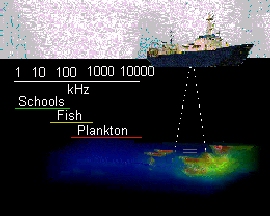
| The prospection of fish scholol of commercial importance have been monitored using hydroacoustic for long time around the world. However acoustic has a signifficant but still rather history of application in zooplankton studies. We have been recording the deep scattering layer with a single beam echosounder SIMRAD EY-200 and collecting organisms with an Isaacs Kidd mid-water trawl and zooplankton using a Bongo net and opening and closing plankton nets. With this echosounders we are able to detect organisms of different sizes according to the target strength ranging from macrozooplankton like euphausiids to lsmall pelagic fish like sardine and anchovy.. |
|||||||||||||
![]() |
|||||||||||||
![]() |
|||||||||||||
| This is a display of our echosounder Simrad EY-200 showing a dense deep scattering layer over the continental shelf of Punta Eugenia, Baja California Sur, Mexico. This scattering layer is composed swarms of the red crab Pleuroncodes planipes (red bars), zooplankton (mainly euphausiids like Nyctiphanes simplex and Nematoscelis difficilis (green bars) and fish's schools (anchovy Engraulis mordax and sardine Sardinops sagax). | |||||||||||||
| Back to: Research in Mexico along the west coast of Baja California Summary of the SIMSUP program RV El Puma |
|||||||||||||