Michael A. Kadish, Esq.
123 Elm Street
Anytown, U.S.A. 00010
June 5, 1995
I received your letter concerning your intentions to attempt to stage an authentic Noh Drama. I commend your choice to put such a difficult play in your Ethnic Arts Series. I must warn you, however, that this is going to be rather difficult for a number of reasons. If you wish to make this legitimate and refuse to quit, then keep reading and good luck. Otherwise, I understand your second thoughts.
The first problem you are going to have is the setup. While the actual assembly of the set and stage is not your responsibility, you must assist your set designer. First, I am afraid that you cannot perform your Noh play, or any other Noh play, for that matter, in your auditorium. The Noh stage has not changed since about 1615, and it is very complicated. A Noh performance is probably the most symbolic and exact performance in the world. Everything, from the tone of an actors voice, to the a gesture in the smallest degree is meaningful. The only liberties we can possibly take is with the dimensions, but even these must stay moderate. (Bowers-1956 329-331.)
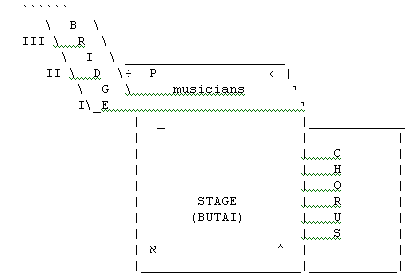
Essentially, the set consists of two major blocks connected by a long wooden bridge. The first of the two blocks is behind the curtain and is unseen to the audience. The bridge is made of solid pine, although oak can be used. The blocks are made of cypress. Lacquer and other materials are applied to the blocks to cause them to give off a thick shine.
One end of the bridge has the Mirror Room or the KAGAMI NO MA. This is comparable to a green room and a dressing room combined. At the opening of the Mirror Room is the curtain. Along the bridge are three pine trees, whose titles go backwards in numerical order, and which symbolize heaven, earth, and man. The second stage is a large square, with the back right corner cut off. The second stage is for the chorus and is added on the right.
All together the stage looks something like this:
`````` CURTAIN
PINE TREES
RESPECTIVELY
POSITION OF STAGE HAND
SHITE PILLAR or SHITEBASHIRA
GAZING PILLAR or METSUKEBASHIRA
FLUTE PILLAR or WAKIBASHIRA
FUEBASHIRA
SLIT DOOR or HURRY DOOR
In front of the trees there is a large border that separates the audience from the stage. It is comprised of the pine trees, and a wide garden of gravel and plants. There by no means are any guidelines or rules on actual plants to be used, but I would suggest a symbolic mixture of roses and banzai.
The musicians' spot is also known as the rear stage. It is on this wall, called the pine drop, that a backdrop is used. In answer to the question you raised in your letter, yes, this is the only backdrop ever used in Noh drama. (This points out that mimes are a good choice for actors, by the way.) Every time the sole backdrop is a lone pine tree, however, you guys certainly have your work cut out for you for a while with the rest of the regular set design.
By the way, I forgot to mention it, but the reason you can't use the proscenium stage in the auditorium is the location of the audience. The audience at a Noh drama sits in an approximate semicircle from the bridge, going all the way to the other wall. (Bowers-1956 329-331.)
Another thing. Since you are the director, you have another technical problem. I don't know if, for instance, you have ever directed on an arena stage, but in case you don't know, there the terms upstage and stage left aren't used. In the case of an arena, the stage is viewed as a clock and the appropriate times are the stage directions. For example, actors are told to walk seven o'clock, or fall twelve o'clock. In the case of Noh drama, however, it is more difficult. You are obviously to use the Japanese titles. Although the bashiras are used as guidepoints, stage right is called wakibashira and stage left is metsukebashira. The terms stage left and stage right are not used in the Japanese theater. I realize you want this done properly, but no one would feel insulted if the names were pronounced in English, i.e., gazing pillar, flute pillar, etc., or even less. (Gassner-1967 137-139.)
You are going to have to face another problem, this being costumes. Not only are they hard to make, but all parts are symbolic. A kimono represents sick persons. A mask is lifted to show crying. Costumes are rich in color and in design, and are based on the feudalistic clothing centuries ago. In addition to thick white makeup that all the actors must wear, the two main characters must also wear or carry heavy wooden masks. (Gassner-1967 179-180.)
You will not really have to worry about stage props. The only stage props that actors ever carry are either masks or fan. The fan, as is every iota of every aspect of Noh, is symbolic. A fan can symbolize anything from the blowing of the wind, to the moon, or just about any other aspect of nature. The waving of the fan also can represent mild human emotion or responses. (Tyler-1972 173.)
It has come to my attention that since this is a multi-cultural festival, you are going to need to make interesting programs to complete the event. Here are a few little facts and reminders you should include to spice the program up and to inform your audience. First, and this is important, be sure, that you point out that from time to time the chorus utters the characters' lines. In the event that an audience member is paying attention and does not already know of Noh, he or she will be completely lost without this information.
Explain too, that Zen Buddhism combined with Shintoism are the main influences on the Noh theater. Zen Buddhism believes in no physical reality, just emotional enlightenment. This accounts for the few characters and bare stage. You must also mention all parts of the stage, as I've already explained. Mention too that the theater is supposed to be a house within a house, with an audience sitting on three sides. Mention the one scene background. (Wickham-1985 26-27.)
Be sure to mention that the actors are exclusively male. Point out the different types of characters and the five different types of plays. Tell that there are only two or three characters in every play--the shite, the main character; the waki, who is the second character; and the priest, a third person narrator.
The audience may miss another subtle but important difference between Western drama and Noh drama unless it is pointed out to them. Whereas in an American play, a page is performed in about one minute, in a Japanese Noh drama, one page can easily last for fifteen minutes. (Bert-1991 405-406.)
Just for fun, I'd like to point out another problem you will encounter. This problem is the inclusion of puns. These incredibly easy, but incredibly annoying, puns will reveal themselves every ten minutes or so. "There is Noh point." "We have Noh script." "We are Noh actors." "You are Nohbody." I am sure you have already perceived this, and I'm sure you have already uttered one of these, but in my opinion these jokes get incredibly annoying incredibly fast.
Probably your major problem is going to be the audience. I am sure you have considered this problem for your Italian opera night, but the Noh play is very slow--much too slow for the average Westerner. They will fall asleep in about ten minutes. They will not follow these snail speed dialogue, nor will they understand the significance of the symbols. In addition, they will wonder about the stage attendants and will have no clue as to the plots unless you deal with them in advance. The average Westerner will certainly not understand or appreciate the shrill and sudden notes of the chorus. (Bowers-1956 329-331.)
Consequently, you must be prepared with ways to counter this problem. First, we must deal with the translation. It's entirely up to you whether you wish to perform this play in English or Japanese. If you choose to perform the play in Japanese, see if you can have a screen or some flashcards for simultaneous translation. If the play is in English, the actors should try to integrate modern Western hand motions with those of the Japanese.
Another ace up our sleeve is the kyugin. There are two different types of kyugin. One is a comic monologue; the other is best likened to a short skit that mimics and spoofs the Noh. As in ancient Greece, these short comedic routines are to be installed between the serious Noh plays. An average night of Noh in Japan is five plays long, with seven kyugins. This would come in handy in your show. I would put a poignant skit version first. These are generally like two minute fairy tales. At the end of the play, I would put a stand-up routine or the monologue by one of the actors. The kyugin are only supposed to be performed by the actors in the actual Noh. (Ridgeway-1915 326-334.)
Still, the audience is going to have a hard time understanding. After the first kyugin, put the hero of the kyugin, or whoever is left on stage at the end of it and who is not the priest, to explain a little bit about the stage and rituals. Make sure he points out about the assistants in the back and their invisibility to the audience and that the chorus will say some of the characters thoughts and lines. I've heard from a teacher that the Japanese viewer has been trained to ignore the assistants and chorus as a Westerner would ignore an actor or actress suddenly breaking into song.
I must apologize that I do not have a copy of a kyugin to send to you. If I could I would, but they probably have one in the libraries where you are in Los Angeles.
Luckily, you have chosen to do a play about women. This is a good choice. There are five different types of Noh plays. you picked the other one that would have a genuine following outside the Japanese community. Be sure to point out that the play is about women. The other four types of plays are about gods, plays about warriors, miscellaneous plays usually involving mad persons or spirits, and plays about demons and other supernatural beings.
I just remembered one more thing. If you have ever read Shakespeare, you will remember that the only stage directions he gives are exuent and enter. Similarly, there are very vague descriptions of stage direction in Noh drama scripts as well. I would suggest that more Westernized dances be interwoven in the many dances which appear in the Noh play. I realize this will turn off a portion of your audience, but it will keep even an even larger number of them awake. On the other hand, I wouldn't go overboard on this one. The dances must be slow, so let's keep out break dancing and fly girls.
In conclusion, I highly support and again applaud your choice of including a Noh drama. Rarely performed for the general public in Western countries, such dramas provide an excellent source of culture and art for the theater going public.
Always keep in mind that the simplicity and concise writing of a Noh drama are its key elements. The performance must also retain and reflect this precision. Your actors must have skills over and above their speaking voices. Of possible greater importance, they must be able to communicate through graceful, nonverbal actions their state of mind and their emotions.
Similarly, the starkness of the set must be maintained. This allows the viewer to use his or her imagination to further develop the scene. I highly recommend that you follow my suggestions in these matters.
Again, I wish you success in your endeavor. Please not hesitate to contact me again when further questions arise. My 800 phone number is NOH-DRAMA.
Sincerely yours,
1. Bert, Norman A. Theatre Alive!. Colorado Springs, Colorado: Meriwether Publishing, Ltd., 1991.
2. Bowers, Faubion. Japanese Theatre. New York: Hermitage House, 1952.
3. Bowers, Faubion. Theatre in the East. New York: Thomas Nelson and Sons, 1956.
4. Gascoigne, Bamber. World Theatre: An Illustrated History. Boston: Little, Brown, and Co., 1968.
5. Gassner, John. A Treasury of the Theatre. New York: Simon and Schuster, 1967.
6. Ridgeway, William. The Dramas and Dramatic Dances of Non-European Races in Special Reference to the Origin of Greek Tragedy. New York: Benjamin Bloom, 1915.
7. Tyler, Royall. Various Scripts. New York: Simon and Schuster, 1972.
8. Wickham, Glynne. A History of the Theatre. Cambridge: Cambridge University Press, 1985.

