 Of course, their problems are more than just a complaint that they can't associate with either of their parents. The problems are more dealing with what society determines them to be; and then reconciling themselves between the two cultures.
Michael Kadish
Education in a Multicultural Society
Julia A. von Gries
Multicultural Education strives to educate all students of the cultures around of them, and tries to make the students more understanding of the same cultures. It tries to a lesser extant to bring students closer to their roots, but more to educate the students about the various roots. The underlying assumption of Multicultural Education is that there are differences among the students' behaviors that need to be explained so that each child will be comfortable with other beliefs, histories, and attitudes surrounding them. This may or may not work, but a larger problem arises when a student of mixed ancestry. The offspring of joined ancestries are not shunned by today's society, for the most part, but multiculturalism is backed into a corner, and really doesn't deal with the situation properly, or tell us how to deal with the individual students.
It would be an incredible feat if a multi-educational class could teach that both, or all of a given student's multiple cultures should be respected equally. Assuming however, that the child is absent during any of the days that one of the cultures are taught, or that the child is not attentive to every word taught about the cultures, or that simply they are not taught equally in the class, the student now believes part of his family superior to a different part. In general however, the Multicultural approach to a child with mixed ethnicity is a bit fuzzy.
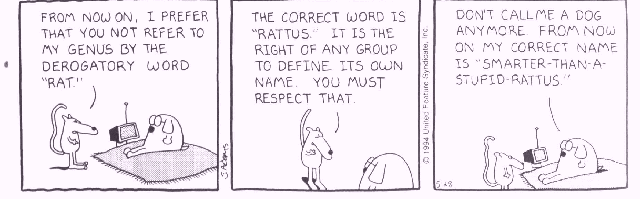
For one thing, there is not a name for most multi-racial individuals. The term "mulatto" is for from politically correct. The term "multiracial" could, of course, fit, but that is a rather all encompassing word for anybody with parents of different races, be it Black\Hispanic, White\Black, Black\Asian, Indian\Asian, etc. Perhaps it may be due solely to their lack of title that they do not receive significant recognition. The question of a name is dangerous. If a group doesn't have one, than they will not be as easily addressed. On the other hand, once they make a name for themselves, then in doing so, both (or all) of the cultures are discarded for the sake of the new one. As this new name is applied, the focus of their cultural acceptance is no longer that of their parents, but that of being the mix between the two genders.
Of course, their problems are more than just a complaint that they can't associate with either of their parents. The problems are more dealing with what society determines them to be; and then reconciling themselves between the two cultures.
It's very hard to find, in this PC age, an answer as to what percent of a person's lineage a person must be to be considered a member of that minority. It is an uncomfortable question, and it is just assumed that you either consider yourself in that group, or you don't. For example, the UNCF, on its applications does not ask you of your African ancestry. It is assumed that to apply to the United Negro College Fund, you will in fact be "Negro."
Some might say that as compensation for a time when "a single drop of black blood made you black," any African ancestry, at all should today qualify you as deserving of any of the benefits given to a minority. With Native Americans, this is the case, any known ancestor from a Native American tribe, regardless of the number of generations back, will allow this offspring any benefits offered. Blacks, it seems, because of the old notion of "one drop of black blood," also are obviously given this benefit.
One might wishfully think that this is compensation for how a partially black ancestry made these parents suffer. Given that any black ancestor allowed the person to be a slave, there many were cases similar to those of Eliza, an eighteen year-old girl, who, being 1/64th black, (one great great great great grand parent) was sold as a slave in Lexington in 1844. I remember in drama class, studying Showboat, how important the concept of "black blood" was. In what I thought was the only creative scene, a couple who's about to be arrested for being intermarried, as she is half black, decides to creatively get around the law. When they heard the officer was coming, he sliced her arm, drank some of the blood, and when the officer came, he said that anybody could now swear that he "had more than a drop of black blood in" him.
So, it seems that society is doing the right thing by letting any descendant gain the benefits of being a member of a certain minority group, because people who were negatively affected by those conditions in years past are now allowed some benefit. However, what that means is, we are not giving these people benefit because their parents suffered, but because had they been in previous times, they would have been similarly mistreated. This is shown perfectly by the case of Hispanics. The way to qualify as Hispanic is not to claim ancestry, but to have an Hispanic last name.
This brings a little reality to the situation. One can often tell, simply by looks, that a person has black ancestry if that person is even 1/4th black. Asians, who also have definitive features can be often identified a few generations down the line. An Hispanic who, besides stereotypes, can not be identified only by appearance, would only be mistreated after hearing that he was a Mr. Gonzalez.
It might seem that Native Americans prove to be an exception. They don't have a unique physical difference except perhaps darker features that, in my limited experience, are not much darker than a suntan. However, it must be remembered that not too long ago, even the descendants of Native Americans were generally kept on reservations.
This still sounds positive. We are giving these people benefits because they would have been mistreated. The problem comes in when the person does not choose to be known as a member of that ethnic group. A person with obviously darker pigmentation, or even the curled hair, is still black, no matter how many white ancestors they have. 
If a persons eyes slant, they are Asian. If a person's last name is Rodriguez, they are Hispanic. They may no longer be enslaved or encamped, but society still puts them into the associated grouping.

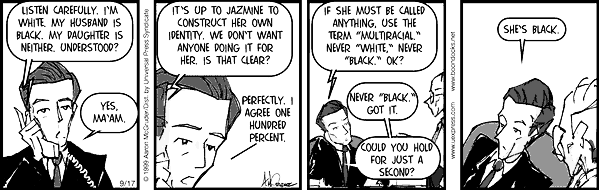
Society already places them in the ethnic group, but the function of multiculturalism is to teach that there isn't a superior, or dominant group, and therefore the child must live in both worlds at once.
This cannot be easy to live through. A culture dictates the way people live. Two given cultures will, at one point, conflict. With my various classes in multicultural education, I have Societies and Cultures in World History by Patricia O'Brien, Global Perspectives for Educators by Carlos F. Diaz, Byron G. Massialas, and John A. Xanthopulos, Making Schooling Multicultural Campus and Classroom by Carl A. Grant and Mary Louise Gomez, Multicultural Education Issues and Perspectives by James and Cherry Banks and of course, Multiethnic Education by Banks. None of these books mentioned students with mixed heritages and how they should be dealt with. We are given various groups, and taught how to deal with them. Mixed ancestry is not an issue. There are books and groups like My Shoe that deal with these people, with literature available, but it seems to be irrelevant in the realms of multiculturalism.
That means multiculturalism is focused on the pre-existing cultures of the students, the home environment of the child. A child is a given ethnicity. Either the child picks one, or society picks, but it seems there is a need to give a child a culture that starts with a capital letter. Each child, by multicultural education, then belongs in a grouping, and then there are ways that the various groups are to be taught. Grey area is negligible. This is to me, just another example that multicultural education strives for segregation.

