Circus Mirrors
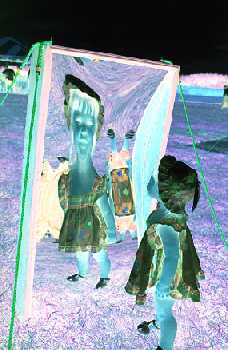
"Whenever you see a mirror--it's only human-- you want to look at yourself. But here you can't. You look at the position in space where the mirror will say, 'You are here, and you are you,' you look, craning, twisting, but nothing works, because Lavoisier's mirrors, whether concave, or convex, disappoint you, mock you. You step back, find yourself for a moment, but move a little and you are lost. The catroptic theater was contrived to take away your identity and make you feel unsure not only of yourself but also the very objects standing between you and the mirrors.
As if to say: You are not the pendulum or even near it. And you feel uncertain, not only about yourself, but also about the objects set there between you and another mirror.
Granted, physics can explain how and why a concave mirror collects the light from an object --in this case, an alembic in a copper holder -- then returns the rays in such a way that you see the object not within the mirror but outside it, ghostlike, upsidown in midair, and if you shift ever slightly, the image, evanescent disappears.
"Then suddenly I saw myself upside down in a mirror.
"Intolerable.
"What was Lavoisier trying to say, and what were the designers of the Conservatoire hinting at?
We've known about the magic of mirrors since the Middle Ages, since Alhazen.
Was it worth the trouble of going through the Encyclop�die, the Enlightenment, and the Revolution to be able to state that merely curving a mirror's surface can plunge a man into an imagined world?"
-- Umberto Eco, Foucalt's Pendulum, p.11-2
Return to list.
Return to home page.