
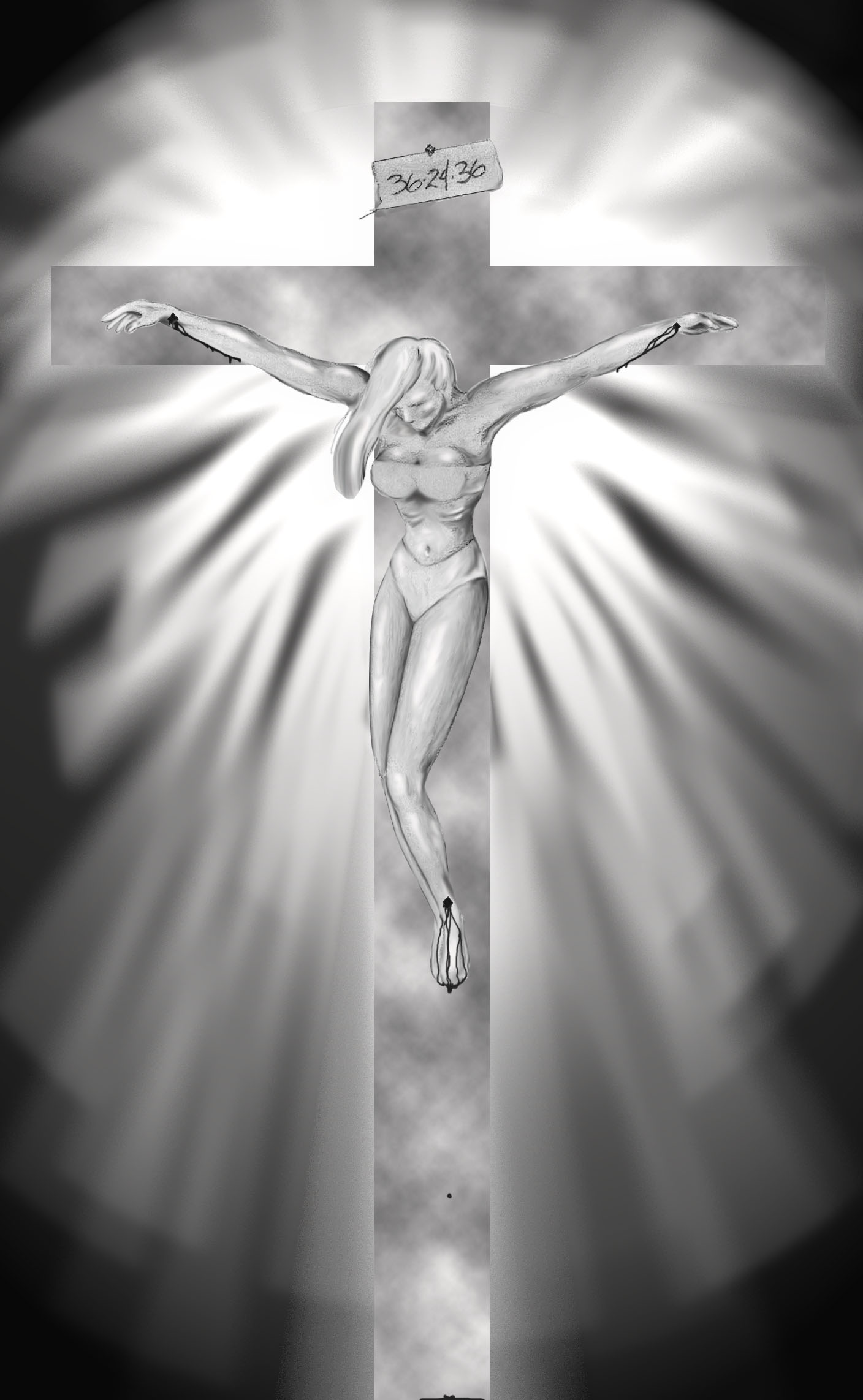
Pinup Girl
Charcoal/Digital Editing
�1999 Bernadette Yarnot
|
"You can trace the tightening curves of the 20th-century female ideal by weighing the White Rock girl (the logo of that beverage company): In 1894 its sprite was 5'4" and weighed 140; in 1947 she was slimmed down to 125 pounds; by 1970 she was 5'8" and 118." (1) "Today she [the White Rock girl] is 5 feet 10 inches tall and weighs 110 pounds." (2) |
"The body mass index (BMI) expresses the relationship between a person's weight and height. The body mass index is calculated as weight in kilograms, divided by height in meters squared: weight(kg)/height(meters)^2" (3) A kilogram is 2.2 pounds and a meter is 3.28 feet. Using the conversion above, the White Rock girl had a BMI of 24.07 in 1894. In 1970, her BMI was 17.97, and in 1994 her BMI had dropped to 15.81. The BMI studies I saw generally set "normal" weight between 20 and 24. |
|
"Garner, Garfinkel, Schwartz & Thompson (1980), have found that the average size of idealized woman (as portrayed by models), has become progressively thinner and has stabilized at 13-19% below physically expected weight." (4) |
We are caught in a set of unrealistic expectations. Though conversions such as the one above are available, few people will actually perform them. What is set as medically ideal may not be what is perceived as medically ideal. For instance, when "normal" is set between 20 and 24, many people will assume that 20 is at the low end, without realizing that many of the people they see in magazines and movies are below that. |
|
"Indeed, our female ideal violates the anthropomorphic reality of the average female body. The ideal female weight, represented by actresses, models, and Miss Americas, has progressively decreased to that of the thinnest 5-10% of American women. Consequently, 90-95% of American women feel that they don't �measure up.' Societies have never been kind to deviants, but in America a statistical deviation has been normalized, leading millions of women to believe they are abnormal." (5) |
The perception of the Hollywood body is normal is the result of constant attention being paid to every move made in that industry. Tabloids scream headlines about weight-loss and how certain celebrities (who are always female) have gained weight. Alicia Silverstone and Kate Winslet have been targets of the press for gaining a few pounds, (6) and we seem to find this sort of personal attack perfectly normal, despite the fact that they are probably closer to "normal" than other celebrities such as Ally MacBeal. Hollywood is like Washington D.C. in that people who live there tend to get caught up in the lifestyle to the point where they forget that the world outside of Hollywood is different. It differs from the nation's capital in that it is continuously exporting its values in the forms of movies and television shows. In Hollywood, to survive in the industry, females have to lose weight, exercise, have cosmetic surgery and spend hours a day on makeup. For them, this is normal. For a teenaged girl who wants to go into architecture, this should not be normal or necessary, yet she is told it is by every beauty ad and article about someone (gasp!) gaining weight. |
|
"Over the years, the ideal figure for a woman has changed, from eras that accentuate the differences from the male body to those that minimize them. In this century alone we have seen rapid shifts from the Lillian Russell/Marilyn Monroe standard, which was voluptuous and curvaceous, to the 1920s Flapper/1960s Twiggy standard, which was unisex slim, to today's odd hybrid: full breasted but narrow-hipped." (7) |
When The Avengers came out, I recall reading an article about Uma Thurman that said how lucky she was to have the perfect feminine body, with large breasts and narrow hips. Narrow hips? Feminine? Several million years of evolution say that females should have large hips, but popular culture says that they should not. Who will be believed? When girls are presented with impossible goals to meet, and then told that they must meet them to be accepted in our society, it is hardly surprising that they should turn to eating disorders to fulfill those goals. "When unnatural thinness became attractive, girls did unnatural things to be thin." (8) |
back *** forward
which way are you going?
(1)Peacock, Mary. The Cult of Thinness.
(2)Pipher, Mary. Reviving Ophelia: Saving the Selves of Adolescent Girls (USA: Ballantine Books, 1994) p. 183-84.
(3)Mealformation and your Body Mass Index
(4)About Face.
(5)Seid, Roberta P. "Too 'Close to the Bone': The Historical Context for Women's Obsession with Slenderness." Feminist Perspectives on Eating Disorders. Fallon, Patricia, et al., eds. (New York: The Guilford Press, 1994) p. 8.
(6)Mudgett, Heather. Eating Disorders and Body Image in the Media.
(7)Tavris, Carol. The Mismeasure of Women. (USA: Simon & Schuster, 1992) p. 30.
(8)Pipher, 184.