
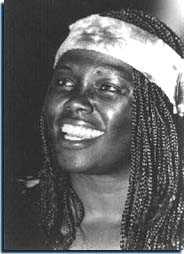
Wangari Maathai
This woman is an environmentalist, feministist, political activist, and a pacifist. Read on to learn more.
Source: Marc MichealsonSocial Problems, Vol. 41, No.4, November 1994.
Source: Maathai, Wangari, Letter to donors, January 22, 1998.

I first met Wangari Maathai at a college reunion that I attended with my mother at Benedictine College (then, Mount St. Scholastica) in Atchison, Kansas. I think that I was about ten years old at the time. There was a low murmur in the room as old friends and roommates were catching up on their lives. My mother walked me over to a woman who was wearing brilliant African colors and introduced me. "Katie, this is Mary Jo Wangari, a classmate of mine." Politely, I shook her hand and went on to meet others.
Later my mother told me that I had just met one of the most influential women in Kenya and in Africa. She didn't explain much else.....I was only ten. I had no concept of the political, ecological and social struggles that the African nations faced.
Throughout the years my family received packages and letters regarding Wangari Maathai and her work. As the chairman of the National Council of Women of Kenya, Maathai created the Green Belt Movement (GBM). The goals of which are to prevent the deserts of Africa from expanding into fertile land by planting trees; to promote environment concervation and rational land use; to reclaim land and replensih soil by planting trees; and to give employment opportunities to the rural women of Africa.So far GBM has only been established in Kenya, but Maathai's movement is being set up in Botswana, Burundi, Ethiopia, Lesotho, Malawi, Somalia, Sudan, Swaziland, Tanzania UR, Uganda, Zambia, and Zimbabwe. In it's first fifteen years GBM is responsible for planting 10 million trees and employing 50,000 women.
In America, we champion women like Wangari Maathai, but in Kenya, she is shunned. She was married and had three children with a parliamentarian who later divorced her. He used the grounds that she was "too educated, too strong, too successful, too stubborn, and too hard to control."
Maathai's GBM is a strong, successful organization that maintains a non-confrontational strategy as to try to co-exist along side an increasinly hostile government. Fot the first few years of its existence, Maathai kept a low profile in the political arena. But when, in 1989, the Kenyan government announced that there was a plan to build a $200 million 60-story high skyscraper with a 30-foot statue of President Moi in front of it in Nairobi's Uhuru Park, she could stay silent no longer. She filed suit with the High Court of Kenya, and lobbied internationally. Greatly annoyed by the actions of Maathai, President Moi publically said that she and her supporters had "insects in their heads," and "wondered why the women of Kenya had not taken any steps to ostracize their 'wayward' colleague."In the end, Wangari was triumphant against her opposition. But not without cost. GBM was forced to move out of its government-owned office and the organization began to be harassed at the grassroots level. In an attempt to make ammends, Maathai issued apologies and conciliatory statements for her actions.
Even though she realized the potential backlash of her activism, she continued to press on, especially in the political and human rights arena. Maathai co-founded the Forum for the Restoration of Democracy (FORD). And in January of 1992, she was arrested for supposed "rumour-mongering."
But being arrested was the least of her worries. After the presidential election of 1992, in which President Moi defeated his Democratic Party opposition, the political climate for Maathai grew darker. In 1993 she was forced into hiding for two months because of numerous death threats and repeated intimidation.
Amazingly enough, nothing dismays this woman. In 1997, she announced her cadidacy for a parliamentary seat on an independent ticket. Like with everything she does, Maathai faced challenges with this campaign.- Efforts were made to keep her from being cleared by the Electoral Commission. On the morning if the nomination, the guidelines for the presidential candidates suddenly disappeared from her living room and were never to be found.
- On nomination day when she presented both the identity and the electors cards to the Chairman of the Electoral Commission, both cards disappeared. After much search, they were finally discovered to be underneath the chairman's seat! He claimed that he had no idea how they came to be there.
- To the surprise of Maathai, even though a respectable publication, the Daily Nation was present at her nomination, the next day's headline proclaimed that she had not been cleared.
- Many times during her campain, the Daily Nation incorrectly reported that she had withdrawn from the race. Only a few of these errors were cleared upon their recognition.
- Finally, on December 29, 1997, as voters went to cast their votes, the BBC and the Daily Nation both wrongly reported that Maathai had withdrawn her candidacy in favor of Mr. Mwai Kibaki of the DP.
Maathai has since contacted laywers and is preparing to sue the BBC and the Daily Nation for making a false statement an deceiving voters. Never, in the history of Kenyan elections has a candidate ever been withdrawn by a third party. As of January 22, 1998, court proceedings have not begun, but the legal investigation continues.
As a little girl, I couldn't have known that I was meeing such a great person, but now I see that Wangari Maathai is truly an example of an extraordinary woman. Her efforts to change her country of Kenya ecologically, politically, and socially are being realized as she continues her progressive work.
 Links to other sites on the Web
 Here's a brief biography on Wangari.
This is a wonderful page with great quotes.
This will take you to Katie's home.
"The myth of male superiority can only be demolished with shining examples of female achievement against which nobody could argue intelligently."
-Wangari Maathai
Don't be shy, sign my guestbook!See who's signed
� 1997 [email protected]
This page hosted by  Get your own Free Home Page