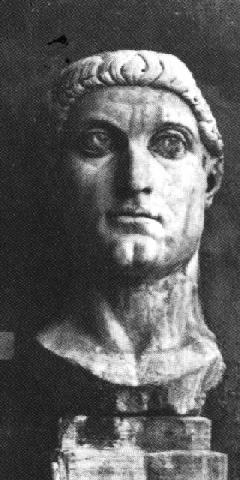
The Life Of Constantine
Constantine was born Flavius Valerius Constantinus at
Nis, in what is now Serbia, son of the commander Constantius Chlorus and Helena.
Constantius became co-emperor in 305. Constantine, who had shown military talent in the
East, joined his father in Britain in 306. He was popular with the troops, who proclaimed
him emperor when Constantius died later the same year. Over the next two decades, however,
Constantine had to fight his rivals for the throne, and he was not declared sole ruler
until 324.
Following the example of his father, Constantine in his early life was
a solar henotheist, believing that the Roman sun god, Sol, was the visible manifestation
of an invisible Supreme God, who was the principle behind the universe. This god was
thought to be the companion of the Roman emperor. Constantine's adherence to this faith is
evident from his claim of having had a vision of the sun god in 310 while in a grove of
Apollo in Gaul. In 312, on the eve of a battle against Maxentius, his rival in Italy,
Constantine is reported to have dreamed that Christ appeared to him and told him to
inscribe the first two letters of his name Chi and Rho on the shields of his troops. The
next day he is said to have seen a cross superimposed on the sun and the words "in
this sign you will be the victor". Constantine then defeated Maxentius at the Battle
of the Milvian Bridge, near Rome. The Senate hailed the victor as savior of the Roman
people. Thus, Constantine, who had been a pagan solar worshiper, now looked upon the
Christian deity as a bringer of victory. Persecution of the Christians was ended, and
Constantine's co-emperor, Licinius, joined him in issuing the Edict of Milan, which
mandated toleration of Christians in the Roman Empire. As guardian of Constantine's
favored religion, the church was then given legal rights and large financial donations.
It was a great thing for the Church that the emperor of Rome should
give it liberty; and Constantine, after sending forth the laws which put an end to the
persecution, went on to make other laws in favour of the Christians. But he did not
himself become a Christian all at once, although he built many churches and gave rich
presents to others, and although he was fond of keeping company with bishops, and of
conversing with them about religion. Licinius, the emperor of the East, who had joined
with Constantine in his first laws, afterwards quarrelled with him, and persecuted the
eastern Christians cruelly, but Constantine defeated him in battle, and the whole empire
was once more united under one head.
After his victory over Licinius, Constantine declared himself a
Christian, which he had not done before; and he used to attend the services of the Church
very regularly, and to stand all the time that the bishops were preaching, however long
their sermons might be. He used even himself to write a kind of discourses something like
sermons, and he read them aloud in the palace to all his court; but he really knew very
little of Christian doctrine, although he was very fond of talking part in disputes about
it. And, although he professed to be a Christian, he had not yet been made a member of
Christ by baptism, for in those days, people had so high a notion of the grace of baptism
that many of them put off their baptism until they supposed that they were on their
deathbed, for fear lest they should sin after being baptized, and so should lose the
benefit of the sacrament.
Constantine had many other faults besides his unwillingness to take on
himself the duties of a baptized Christian; and, although we are bound to thank God for
having turned his heart to favour the Church, we must not be blind to the emperor's
faults. Yet, with all these faults, he really believed the Gospel, and meant to do what he
could for the truth.
It took a long time to put down heathenism; for it
would not have been safe or wise to force people to become Christians before they had come
to see the falsehood of their old religion. Constantine, therefore, only made laws against
some of its worst practices, and forbade any sacrifices to be offered in the name of the
empire; but he did not hinder the heathens from sacrificing on their own account if they
liked.
Soon after professing himself a Christian, the emperor began to build a
new capital in the East. There had been a town called Byzantium on the spot before; but
the new city was far grander, and he gave it the name of Constantinople, which means the
City of Constantine. It was meant to be altogether Christian,--unlike Rome, which was full
of temples of heathen gods. And the emperors, from this time, usually lived at
Constantinople, or at some other place in the East.