
Reconstruction marked a new era for the South. Recently freed blacks tested the limits of their freedom by daring to reach for what only a few years prior had been beyond imagination.
An ex-slave, Blanche Kelso Bruce, was representing Mississippi in the United States Senate. In Louisiana a black man, Pinckney B.S. Pinchback sat in the governor's mansion. A black man occupied a seat on the state supreme court in South Carolina. Blacks were superintendents of education, judges, state treasurers, solicitors and major generals of militia. Blacks and whites attended the same schools while an interracial board ran the University of South Carolina. As one author put it, "There had never been and age like this one before and there would never be one again (Bennett, p. 185)."
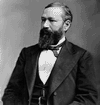
PS Pickney Pinchback, Black governor of Louisiana
But what seemed like a dream to blacks who now tasted the sweetness of freedom was a bitter nightmare to the whites of the New South. They had lost everything. Once opulent plantations lay in ruins. The wealth of the South seemed depleted. And the fault of this all lay at the doorsteps of their former slaves. Their coveted throne of white superiority was being eroded by what they saw as "ungrateful wretches" who desired a seat at their side. Thus to these angry souls, the most notorious crime of Reconstruction was its attempt at equality. Southern historian F.B. Simkins stated as much: |
The worst crime of which they have been adjudged guilty was the violation of the American caste system. The crime of crimes was to encourage Negroes in voting, office-holding, and other functions of the Negro is execrated even more savagely as with the passing years race prejudices continue to mount�Attempts to make Reconstruction governments reputable and honest have been treated with scorn, and the efforts of the Negroes to approach the white man's standards of civilization are adjudged more reprehensible than the behavior of the more ignorant and corrupt. Social equality and Negroism have not a chance to be respectable. (Simkins) |
It was this idea of equality, this attempt at true democracy, which southern whites rebelled against. |
To maintain their dominance these white rallied together to strip blacks from any offices of power and prevent others from gaining such positions. They first attempted to do so by declaring black politicians either ignorant or corrupt. |
With regards to ignorance southern whites seemed to discount the fact that most politicians of the age were without formal education. In fact, during the era of Jacksonian Democracy, formal education was actually frowned upon in favor of more humble upbringings. Yet there were indeed a significant number of educated black politicians. Ten of the twenty-two blacks who served in Congress had attended college; five were lawyers. |
As to corruption, this was inherent in whites and blacks of both the Republican and Democratic parties. In Mississippi of example, there were only two thefts on the state level. In one case a black man was accused of stealing books from the state library. In the second case a white man misappropriated $7,000.00. An evaluation of the true motives of these southern whites is best described as follows: |
Not corruption but honesty, not ignorance but brilliance horrified racists during the Reconstruction era. If there was anything Southern whites feared more than bad Negro government, it was good Negro government. If there was anything they feared more than an ignorant Negro, it was a brilliant one. (Bennett, p. 202) |
To the white south, disfranchisement of black politicians was essential to their empowerment. |
To aid in this endeavor however, these whites realized that the power base of black politicians had to be neutralized. This lay in the black masses and the black vote. Whites sought to disfranchise blacks of the vote by a variety of means. Some set up polling places far away from black communities. Those who attempted to reach them found roads conveniently blocked or ferries out of repair. These polling places were often changed without warning or notice. Stuffing of ballots was so common that one smug Democrat stated, "black Republicans may outvote us, but we can outcount them (Franklin, p. 333)" |
Others established laws which discriminated against illiterate blacks or those who had been slaves at one time. Every southern state had its own method. And when these did not work, the South resorted to violence as a legitimate tactic. General John McEnery of Louisiana stated, "We shall carry the next election if we have to ride saddle-deep in blood to do it (Bennett, p. 213)." |
Even newspapers called for violence to help the cause of white supremacy and black disfranchisement. A South Carolinian newspaper stated, "We must render this a white man's government or convert the land into a Negro's cemetery (Bennet, p. 213)." One historian saw it all in the following manner: |
The South universally hailed the disfranchisement of the Negro as a constructive at of statesmanship. Negroes were viewed as aliens, whose ignorance, poverty, and racial inferiority were incompatible with logical and orderly processes of government�The framers of the new suffrage laws�were committed to the complete and permanent disfranchisement of the Negro�(Franklin, p. 341) |
The battle of the ballot was probably the most important war fought by whites for supremacy of the New South. |
Besides the area of politics, blacks who served as soldiers or civil servants also became targets of the white South. Such an instance can be seen in an attack on a black postmaster and his family in Lake City, South Carolina. At one o'clock in the morning an angry mob of whites set the post office afire while the postmaster and his family slept inside. Shooting into the house, the mob killed both the man and his infant child whose bodies were cremated within the burning building. His wife and remaining children, who suffered a multitude of gun wounds, managed to survive the attack. Such heinous acts were a common matter in the New South. It began as an attack on those blacks who held reins of power and soon grew to include all blacks who could contribute to this feeling of white inferiority. |
This was disfranchisement and the rebuilding of white supremacy. But this was only the beginning. Like a fearful slave master of a large plantation, the whites of the South sought to completely nullify all aspects of black power or assertions of humanity. Thus was born the New South's peculiar institution |
Back to KAMMAASI Black Politics Page

