
and Disfranchisement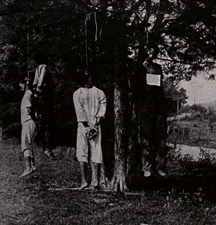
Lynching of Black men
Courtesy of The Black Book No one is exactly certain where James Crow originated. Some say he was an unknown soldier. Others claim he was a Cincinnati, Ohio or South Carolinian slave. Some even believe that the Crow came from the simile, black as a crow. Regardless of his source, all knew his presence. By 1838, Jim Crow had become a synonym for the comic life blacks lived in the New South.
Jim Crow was born out of the need to empower the idea of white supremacy. It was the legal as well as mental reinforcement needed to disfranchise blacks of both their power as well as dignity. What started as a few laws aimed at "keeping blacks in their place" soon came to permeate all aspects of society. Restrooms were made separate: one for whites and another for blacks. Riding cars were segregated, restaurants were segregated and even cemeteries were segregated. This mania and need to give teeth to white supremacy crossed the lines of sanity as even prostitutes were segregated and looking glasses were reserved for separate races. All of this came from the feelings of inferiority and insecurity which the whites of the New South harbored in their souls.
A black author made the following comment of the times: |
The extraordinary thing about the wall that fear built is that it is of so recent an origin. There were no separate but equal privies in slavery time. Nor, as C. Vann Woodward has shown in his excellent book, The Strange Career of Jim Crow, were there separate but equal rest rooms for a considerable period thereafter (Bennet, p. 222). |
The writer attempts to convey the message that Jim Crow was a consequence of the fear that grew within the white South sometime after Reconstruction. He goes on to state the following: |
So long as Negroes were slaves, so long as they posed no threat to the political and economic supremacy of whites, men were content to live with them on terms of relative intimacy. But when the slave became a citizen, when he got a ballot in his hot hand and a wrench and pencil and paper---well, something had to be done with him. (Bennet, p. 222) |
It was from this mind state that Jim Crow was given birth and reign in the New South. |
Many blacks however did nto accept this status quo. Some protested against these discriminatory laws but to no avail. Even the Supreme Court of the United States sought to uphold these edicts. Other blacks asked for fairness under Jim Crow. They resigned themselves to the idea of separation but spoke openly of the absence of equality. One such case was that of a group of black men in Texas. |
At a convention in 1883 these black men listed a host of grievances held against the state pertaining to the absence of equality under the law. These grievances included inequality under the miscegenation law, the public school system, the treatment of black convicts, the patronage of public facilities and the jury system. With regards to one of these grievances the convention stated the following: |
We would also state that we do not contend for the privilege of riding in the car with whites, but for the right of riding in cars equally as good, and for the mutual right of riding in their car if they have a separate one, whenever they are permitted to ride in ours if we have a separate one. (Frazier, p. 169) |
This passage clearly illustrates that many blacks simply attempted to gain equality under the law rather than seek integration. |
But to whites, equality was too much of a threat to their rule. Blacks had to be broken and humiliated, beaten and utterly subjugated. Lerone Bennett summed up life under Jim Crow with the following passage: |
To work from sun up to sun down for a whole year and to end up owing the man $400 for the privilege of working; to do this year after year and to sink deeper and deeper into debt; to be chained to the land by bills at the plantation store;�to bring forth a boy child and to be told one night that four thousand people are roasting him slowly over a hot fire and leisurely cutting off his fingers and toes; to be powerless and curse one's self for cowardice; to be conditioned by dirt and fear and shame and signs;�to be a plaything of judges and courts and policemen; to be black in a white fire and to believe finally in one's own unworthiness;�to not know where to go and what to do to stay the whip and the rope and the chain; to give in finally; to bow, to scrape, to grin; and to hate one's self for one's servility and weakness and blackness---all this was a Kafkian nightmare which continued for days and nights and years. (Bennet, p. 238) |
This is what it meant to be black under Jim Crow. This was the result its creators sought. |
Along with these Jim Crow laws came the most golden law of the south: miscegenation. If the white man suffered from an inferiority complex and a fear of black power, nothing concerned him more than his most precious commodity: the white woman. To the white southerner, the white woman was the pinnacle of virtue. After he had placed her on a pedestal during the ante-bellum South, while he incidentally frequented the slave quarters, she had become something of an idol. She was to be worshipped for she was his key to power. Nothing frightened him more than the thought of losing her to black men whom he was certain lusted after her. Anything would be done to separate the two. As one South Carolinian stated, "'Whenever the Constitution comes between me and the virtue of the white women of the South, I say to hell with the Constitution (Bennett, p. 221).'" |
The equation was simple: the protection of white culture, including white women, demanded black subjugation. And this was to be accomplished by any means necessary. For when disfranchisement and Jim Crow was not enough, the white man resorted to what worked best----violence. |
Back to KAMMAASI Black Politics Page

