
Egyptian History:
Famous Faces and Achievements
I. FAMOUS FACES
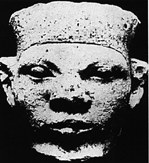 | Narmer or Aha was called Menes by the Greeks. Regarded as the founder of Dynastic Egypt, he led an army from Upper Egypt in the south to conquer Lower Kemet in the north around 3200BC. Upon victory Narmer united Upper and Lower Kemet into one nation. One of Narmer's first tasks was to build a city on his newly conquered lands. Here he was met with a difficult task as the Delta region was covered by an immense swamp. To remedy this situation, Narmer drained the swamp by actually diverting the course of the Nile River. Upon this new land he built a city which he named Men-Nefer:The Good Place. This city served as the capital of Kemet for several centuries. An Arab traveler writing as late as the Middle Ages reported the city "stretching a day's journey in every direction." The Greeks would rename Men-Nefer "Memphis," a name that even today honors this king who lived nearly 5,000 years ago.(Photo and Information courtesy of African Origins of Civilization by Cheikh Anta Diop and 365 Days of Black History) |
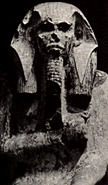 | Zoser, a king of Kemet's Third Dynasty (2630BC), is responsible for the erection of the world's first large building structure, the Step Pyramid of Saqqara. Along with the pyramid was built a large stone complex. The architectural designs of this site would set the standard in Kemet for the next 3,000 years. (Photo and Information courtesy of Ancient Egypt) |
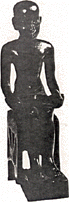 | Imhotep was the royal advisor to King Zoser during the Third Dynasty of Kemet. Regarded as the world's first recorded multi-genius, Imhotep was an architect, astronomer, philosopher, poet and physician. As an architect he was responsible for designing the Step Pyramid and the Saqqara Complex. During his lifetime he was given a host of titles, among them:Chancellor of the King of Lower Kemet, the First after the King of Upper Kemet, High Priest of Heliopolis and Administrator of the Great Palace. As a physcian, Imhotep is believed to have been the author of the Edwin Smith Papyrus in which more than 90 anatomical terms and 48 injuries are described. This is well over 2,200 years before the Western Father of Medicine Hippocrates is born. Some 2,000 years after his death, Imhotep was deified by the inhabitants of Kemet and was known later as Asclepius, God of Medicine, to the Greeks. His very name, Im-Hotep, translates as the Prince of Peace. As a philosopher and poet, Imhotep's most remembered phrase is: "Eat, drink, and be merry for tomorrow we shall die."(Photo and Information courtesy of Nile Valley Contributions to Civilization by Anthony Browder) |
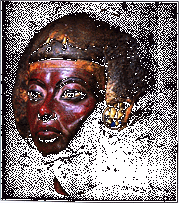 | Queen Tiye is regarded as one of the most influential Queens ever to rule Kemet. Of common Egyptian birth, she married the King Amenhotep III who ruled during the New Kingdom Dynasties around 1391BC. Queen Tiye held the title of "Great Royal Wife" and acted upon it following the end of her husband's reign. It was Tiye who held sway over Egypt during the reign of her three sons Amenhotep IV (Akhenaton), Smenkhare, and the famous child king Tut-ankh-amen. For nearly half of a century, Tiye governed Kemet, regulated her trade, and protected her borders. During this time, she was believed to be the standard of beauty in the ancient world.(Photo and Information courtesy of Ancient Egypt by Time Life Books and African Women in Antiquity ed. by Ivan Van Sertima) |
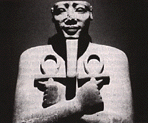 | Senwosert I was a 12th Dynasty King of Egytp (1897BC). Also known as Kepre Kare Senwosret I, he was known to the Greeks as Kekrops and Sesostris. Interestingly enough Herodotus, Greece's Father of History, reported that Greece had once been conquered by a king named Sesostris. Greek mythology also indicated that the legendary founder of Athens was an Egyptian named Kekrops. (Photo and Information courtesy of Ancient Egypt by Time Life Books and Nile Valley Contributions by Anthony T. Browder) |
II. ACCOMPLISHMENTS AND ACHIEVEMENTS
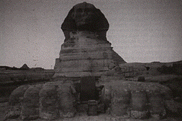 | The Sphinx is probably one of the most fascinating and oldest of Nile Valley structures. At a lenghth of 240 feet and a height of 66 feet, it has a shoulder span of 38 feet, a head that is almost 14 feet wide, and according to historian Anthony T. Browder, "a 7-foot smile." Originally called the Her-em-akhet, the immense statue represents a mixture of artistry, architecture, spiritual mystery, and awe. Symbolically the lion portion of the statue represents the animal nature and raw chaotic power within mankind. The human head represents the intelligence needed to ascend above the animal power and use it wisely to rule and bring order to chaos. A short distance from the statue is the Temple of Her-em-Akhet. Astronomically aligned, on the vernal and autumnal equinoxes, one can watch the setting sun trace the outline of the statue's head. And thus the Her-em-Akhet is Heru of the Horizon. Originally thought to have been constructed around 2500BC, recent theories, proposed by non-traditional Egyptologist Anthony West, propose dates as far back as 5,000 to 7,000BC. This would make the Her-em-Akhet the oldest known structure of its type on Earth and push back Nile Valley cultural complexes back several thousand years earlier than believed. (Photo and Information courtesy of Ancient Egypt by Time Life Books and Nile Valley Contributions by Anthony T. Browder) |
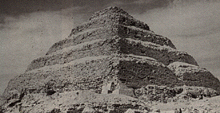 | The Step Pyramid of Saqqara was built around 2630BC for the Third Dynasty King Zoser. Its architect was the legendary Imhotep. The first construct of its type in the known world at the time, the pyramid rises to a height of 197 feet in a series of six box-like steps. This created a tiered monument that symbolically represented a stairway to the heavens. The completed structure was encased in polished limestone which caused it to glisten in the sun. Over time this limestone was stolen by looters and invaders. Along with an immense stone complex, the step pyramid of Saqqara stands as one of Africa's earliest and greatest achievements. (Photo and Information courtesy of Ancient Egypt) |
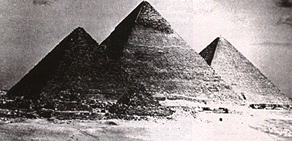
Pictured here are the Pyramids of Giza. The Great Pyramid of Khufu (extreme right), the Pyramid of Khafre (center) and the Pyramid of Menkaure (left). In the extreme foreground are the three pyramids of the queens. The most famous of these is the Great Pyramid, the largest, oldest and only remaining of the Seven Wonders of the World. At its original height it rose some 481 feet, in 201 stair-stepped tiers. The limestone that covered it made the pyramid glisten like gold in the sun. And at its apex it was capped with a jet black pyramidion. Composed of over 2.5 million bricks, the structure was designed to meet a host of astronomical and mathematical constants. Dividing the perimeter of its base by twice its height yields 3.1428, a close approximation to "PI." How and why the great structures were built is still a source of controversy. (Photo and Information courtesy of Ancient Egypt and Life of the Ancient Egyptians) |
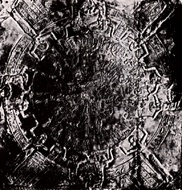 | The Zodiac of Dendera gives a brief glimpse into aspects of Nile Valley astronomy, astrology, agriculture and calendar making. The inner circle of figures, which move counter clockwise like the stars, shows the astrological signs of the zodiac circling around the North Pole, which is symbolized by the deity Anpu. The outer circle of figures represents the 36 decans (ten day weeks) of the Egyptian year. Thus one had a circle (36 * 10 = 360 degrees). The twelve figures outside the circle represent the 12 months of the year and their arms, the 24 hours of the day. It was in this manner that the 12 signs of the zodiac, which regulated agriculture, were created. Each sign was associated with a decan and was called one of "the watchers of the hours." The word "hour" derives from the deity Heru or Horus. Thus the signs of the zodiac were also "the watchers of Heru/Horus" and hence the origin of the word "Horoscope." (Photo and Information courtesy of Man, God and Civilization by John G. Jackson and Ancient Egypt) |
For More on the Nile Valley see the Following:
