
Africoid Populations
In Early Asia
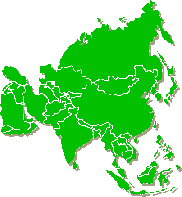
The words "Black Asia" may be misleading. While some of the populations might indicate Africans in the ancient Diaspora migrating to parts of Asia, most populations of Asia deemed "Black" or (in old parlance) "Negroid," are not African in a modern sense at all. Rather they are examples of peoples who have inhabited Asia for tens of thousands of years but have retained or re-developed features more similar to that of Africans. For a host of political and social reasons, they were deemed with such titles as "Black" or "Negroid" in the common era. Due to a social and political link between themselves and more modern day Africans, there are at times associations--though it should be understood such associations have nothing to do with actual genetic or cultural similarities to Africans. Yet, since the question often persists as to who these people are, and the political "racial social construct" history they share with black Africans, they are mentioned here.
|
Africoid Populations in Western Asia? Possibly, But Nothing Conclusive
Sumeria has been regarded as the formative cultural influence of early West Asia. The region it occupies is known also as Mesopotamia, the present day region of Iraq. In Biblical records it is the land of Shinar along the Tigris and Euphrates rivers. Sumeria set the stage for the later civilizations of Chaldea and Babylon with which it is frequently linked. The peoples of the area are generally described as Semitic---a term which can have varying meanings. But were there any Africoid populations among these early inhabitants? In thier own writings some early Sumerians refer to themselves as "the black-heads." This reference is usually thought to indicate hair color. But as the inhabitants of the region were mostly black-haired, this seems unlikely. In truth we cannot know for certain what references to "black-heads" meant; any conclusion is pure conjecture. There are the accounts of eyewitnesses such as the Hebrews. According to Hebraic lore, Noah had three sons: Shem, Japeth and Ham. These eponymous characters are said to give birth to several nations. Ham is said to have four sons: Cush (Nubia), Mizraim (Egypt), Punt (Eritrea or Somalia) and Canaan. Cush was said to be the father of Nimrod, who grew to be a mighty warrior on the earth. It was written in Gen. (10:8-13) "Like Nimrod, a mighty hunter before the Lord." The first centers of his kingdom were said to be Babylon, Erech, Akkad and Calneh, in Shinar. From that land he went to Assyria, where he built Nineveh, Rehoboth Ir, Calah and
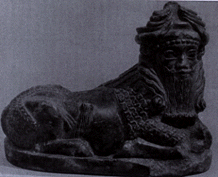
Resen, which is between Nineveh and Calah. Of course however, this is Biblical folklore and there is no way it can be ascertained. It could simply be that the Hebrews were mistaken and were making statements of peoples and places the actual writers of these texts would have been far removed from. There is no certainty that Kush as in Nubia and Kish as relates to Western Asia are related. In 1928 the Field Museum and Oxford University conducted extensive joint excavations in northern Sumer. They found that 8 of the earliest crania from the region were "hyperdolichocephalic" or "long-headed," a trait typically but not exclusively identified with Africoid types, as well as broad nosed. They regarded these crania as "Eurafrican," a mixture of African/Caucasian features, and linked them to types found in the "desert west of the Nile in Paleolithic times." Typical for the time, they recorded "no Negroid types" present, despite evidence for so-called "semi- Negroid traits." However no evidence since these early finds has been able to corroborate such a claim. What does this tell us altogether? The evidence is far from conclusive, however it is interesting. While there is certainly no assertion that the Sumerians were homogeneously Africoid in appearance or even majority so, it would not seem so improbable to suspect that Black types---possible migrants from the Nilotic region---may have been in the area in earliest times. Pictured above is a statue of an Akkadian ruler depicted as a sphinx. He is believed to be the great Naram-Sin, grandson of Sargon. Naram-Sin ruled virtually all of West Asia for 37 years (2270-2233BC). While Sargon does not seem to boast any Africoid features, Naram-Sin's flattish nose and atypical Semitic features has caused interest into his background--though such evidence is certainly spurious at best and up to varied interpretation. (Photo and Information courtesy of Biblical Concordance, Mesopotamian Art and African Presence in Early Asia ed. by Ivan Van Sertima) |
Africoid Populations in Phoenecia?
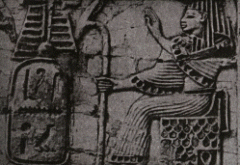
Ancient Phoenecia was a powerful sea power in ancient times trading with ports some believe as far away as West Africa. Located in modern day Syria, Phoenecia is the home to the infamous Hyksos who overrun Egypt and rule from 1783-1550BC. After throwing off Hyksos domination, the Egyptians make the region a vassal state and begin a strong period indoctrination. Phoenician princes are captured and sent to learn in Egypt to make them more loyal subjects. Not surprisingly modern anthropologists digging in the region remark that Phoenecia looks more Egyptian at times than Egypt. Such a relationship would have no doubt brought Egyptians into the region as well. What is more, Hebraic folklore associates Phoenecia with other kingdoms in Africa. The sons of the mythical Ham are Cush (Nubia), Mizraim (Egypt), Punt (Eritrea or Somalia) and lastly Canaan, home of Phoenecia. This rather odd identification of Phoenecia with Africa's most famous ancient kingdoms has often baffled historians and archaeologists. The Egyptians often depict the Phoenecians as yellowish or even white indicating they were lighter than themselves, often closer to Semitic types. But at certain times Phoenecians are depicted as reddish-brown like the Egyptian depict themselves. It is not improbable to suppose that Phoenecia held within its borders an Africoid population that intermixed with the larger Semitic populace, perhaps remnants of Nilotic migrants into the region during its time as an Egyptian vassal state. The picture above is an artifact from ancient Phoenecia. It shows obvious Egyptian influence and the figure seated, reportedly a royal Phoenecian figure, shows Africoid features. However most other Phoenician architecture show typically Western Asian peoples. (Photo and Information courtesy of Black Spark, White Fire by Michael Poe) |
Africoid Populations in Arabia
French archaeologist Francois Lenormant wrote, We may perceive the remembrance of a powerful empire founded by the Cushites in very early ages, apparently including the whole of Arabia Felix, and not only Yemen proper. Whether Lenormant's claims are as far reaching as he states is unknown. Arabia has long housed a significant African population, particularly in the far south. How long these Blacks inhabited the Arabian peninsula is unknown. The African-Arabian connection should not be surprising as the distance between the East African horn and Southern Arabia is minimal. In fact recent linguistic study indicates that the Semitic languages of Arabia and the Middle East may well be a branch of a larger Ethiopian language group. It is also well known that this Eastern Horn-Arabian route was used for millennia by the earliest homonid migrants who later populated Asia. At least by 1,000BC Ethiopia, Eritrea and what is Southern Yemen may have been part of a large empire known as the Sabean Kingdoms.
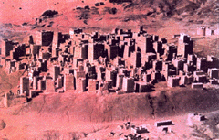
The people of Sabea (Sheba) were probably a mixture of East Africans and Southern Arabians. Saba had a very matrifocal society with a host of female deities. The most famous figure of Saba was none other than the Biblical Queen of Sheba (Saba), Makedda. Lokman, considered the 'wisest man of the ancient East' was one of these Africans. As late as the 7th Century AD these Blacks figure into Arabian culture and the coming of Islam. Mihdja, a Black man, is said to be the first Muslim killed in battle while another, Bilal, is regarded as a "third of the faith." Dhu'l-Nun al-Misri, born in Upper Egypt near Sudan, is regarded as the founder of Sufism. Today Sufism's greatest stronghold is in Southern Egypt and Sudan. Most controversial of all are the writings of a contemporary 9th Century Black scholar in residence at Baghdad by the name of Abu 'Uthman' Amr Ibn Bahr Al-Jahiz. Al-Jahiz, to confront a growing tide of anti-black sentiment in the Muslim world, published a highly controversial work at the time titled, Kitab Fakhr As-Sudan 'Ala Al-Bidan, "The Book of Glory of the Blacks over the Whites." Al-Jahiz in his work contended that even the Prophet Mohammad's father may have been of African lineage. Al-Jahiz however would have been far removed from the time of Muhammad's birth, leaving his assertions interesting but wholly inconclusive. Pictured above are the ruins of Marib, a city of Saba (Sheba) in Southern Yemen. (Photo courtesy of The African Ark, African Presence in Early Asia and Yemeni website)
|
Africoid Populations in India- Non Migrants, but Africoids
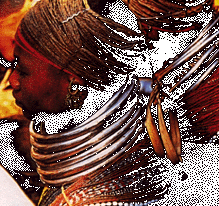
India has a rich history that spans back thousands of years. Western historians and anthropologists alike have termed some of its earliest inhabitants as Ethiopoids, Australoids, Hamitic, Eurafricans etc. A branch of these early inhabitants, who it seems have occupied the area longer than any other group, are called Dravidians. These peoples are believed to have been the founders of the two ancient Indus Valley cities of Harrapa and Mohenjo-Daro which reached their heights around 2200BC. Pictured above is a Bonda woman. The Bonda are believed to be some of the descendants of the Africoid types who originally inhabited India. No one knows exactly how and why these cultural complexes declined. Some have proposed the Aryan theory. This theory contends that highly patriarchal, aggressive and warlike nomadic white tribes known as Aryans, "the noble ones," swept down into the Indus Valley region some 3,500 years ago. The Africoid inhabitants of India were no strangers to combat, but the Aryans studied warfare and glorified battle. After centuries of conflict, they were victorious naming the region Aryavarta, "the Aryan Land." Modern Indian scholars have balked at this notion of the an Aryan army "sweeping down and driving the Dravidian populations before them." Rather they assert that the so-called Aryan types were northern populations who steadily migrated into India where they found the Indus Valley complexes already in decline. Invasion or migration theory, the fate of the more Africoid inhabitants of India remained much the same. A hierarchal system, Varna, (meaning color) was instituted by the ruling class of fairer-skinned northern nomads placing them at the top and darker skinned peoples at the bottom. Today this rigid socio-religous code is called the caste system. Cruel and harsh, this caste system controlled every aspect of daily life. It was written, "A Sudra (Black) who insults a twice-born man (white), shall have his tongue cut out. If he mentions the names and castes of the (twice-born) with contempt, an iron nail, ten fingers long, shall be thrust into his mouth. If he spits on a twice-born both his lips shall be cut off; if he urinates on him, the penis; if he breaks wind, the anus." This color-orientated social order became an integral part of the newly formed Hinduism.
|
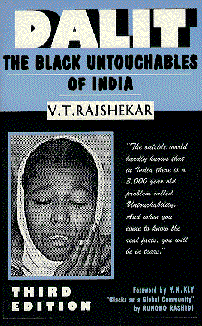
Even beneath these were the Outcastes. Despised as Untouchables and labeled as the physical manifestation of sin, they were forced to live outside communities, they ate from broken dishes and gained their clothes from corpses. They were made to practice humiliating acts such as attaching a cup to their chins to catch offensive spittle, and walking with a broom to sweep away signs of their pollutive passing. Today India is a virtual melting pot. The Africoid and Caucasian phenotypes have given way to a type more fitting of modern Indians. Even many Dravidians are hard to distinguish. But there still exist many Africoid types which live within India. The castes are mixed to a certain degree, thus color of skin is no longer a definitive description of a lower caste member. However one such group of Outcastes, the Dalits, have in recent decades strongly advocated a "Black African" connection to their roots. One of their most prominent spokesman is the Indian scholar, VT Rajeshekar. Pictured above is his work, Dalit: The Black Untouchables of India. For more on the political struggles of blacks in India see the following: The Dalitstan Journal (Photo and Information courtesy of Dalit: The Black Untouchables of India by VT Rajshekar)
|
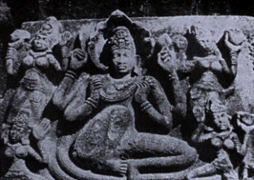
A good example of these Africoid types which inhabited early India can be learned from the artifacts of the region. More than a few depict figures not only black in color, but Africoid in phenotype. Pictured above is a statue of the Hindu god Vishnu. One of his incarnations, Krishna, is often painted either blue or black. Among some Dalits and other Indians who declare a Black heritage, he is considered a heroic legendary prince of Sudra origins who helped break an era of "Aryan" dominance. Another incarnation of Vishnu was the Buddha whose reformist movement became known as Buddhism. As with the Hindu deities, a significant amount of Africoid featured Buddhas exist in Southern India and especially Southeast Asia. (Photo and Information courtesy of Dalit: The Black Untouchables of India by VT Rajshekar)
|
Africoid Populations in China and Southeast Asia
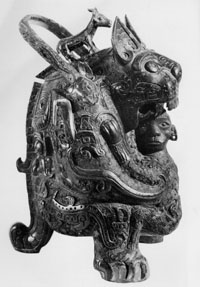
Early Chinese legends relate traditions of divine dynasties such as the Epoch of the Five Emperors. According to JA Rogers, the first Emperor, known as Fu-Hsi/Fu-hi (2953-2838BC) is described as a "wooly-haired Negro." Whether this was actually the case with this semi-legendary figure, we do not know. But the existence of Africoid types in the region since the most remote times is known, whatever their status and role may have been among the larger Asian populace. Quite a few Chinese of the period wrote of "Black Dwarfs" with whom they shared the region. According to Chinese archaeologist Kwang-chih Chang, early skulls found in Southern China bore evidence of "Oceanic Negroid" types. He goes on to state that as early as 221BC (the Chin Dynasty), "Negritos whom the Chinese call 'Black Dwarfs' are reported in the mountainous districts south of the Yangtze." Pictured above is a late Shang Dynasty vessel made of bronze with an Africoid type figure in a tiger's mouth. (Photo and Information courtesy of The African Presence in Early Asia ed. by Runoko Rashidi and Ivan Van Sertima and Chinese Art by Mary Tregear)
|
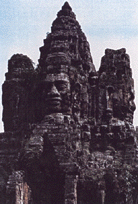
Southeast Asia also shows a significant Africoid presence. Much of the knowledge of this region come from Indian and Chinese scholars of the times. Chinese history speaks of the Funanese as being "ugly and black...their hair is curly." Chinese dynastic records as late as 192AD speak of Lin-yi (Champa), known as the "land of the Black men." The most enduring of the early kingdoms of Southeast Asia was Angkor which was founded by an Africoid peoples known as the Khmers. The Chinese described the Khmers as "small and black." Harvard University anthropologist Roland Burrage Dixon, discussing the Khmers in 1923, noted they were "marked by distinctly short stature, dark skin, curly or even frizzly hair, broad noses and thick negroid lips." Bernard Groslier links the early inhabitants of the region to the Australian natives and Melanasians whom he calls "black." These Melanasians are thought to have entered the region from southern China. The Khmer peoples he believed came from a mixture of these Melanasians with Mongloid types. The Khmer kingdom encompassed portions of the modern countries of Myanmar, Thailand, Kampuchea, Malaysia, Vietnam and Laos. One of the kingdom's rulers, Suryavarman II (1113-1150) built the funerary temple of Angor Wat pictured here. Along with the Angor Wat temple, these Africoid-Mongloid types constructed a complex and intricate water way system centuries before the famed canals of Venice. The modern day inhabitants of Thailand are in fact later so-called "Mongoloid" (outdated term) migrants who overran and mingled in with the Khmers.(Photo and Information courtesy of Echoes of the Old Dark Land by Charles Finch, African Presences in Early Asia ed. by Runoko Rashidi and Ivan Van Sertima and The Art of Indo-China by Bernard Groslier) |
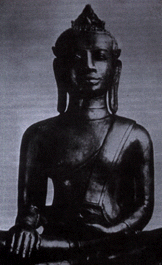
The image of the Buddha in Africoid style is very prominent in Southeast Asia, from Thailand to Vietnam. Pictured here is a Black phenotype Buddha dating back to 10th Century Thailand. (Photo courtesy of The Image of the Buddha)
|
Africoid Populations in the South Seas
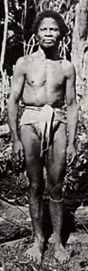
| The Agta, misnomered "Negritos," are the earliest inhabitants of the Philippines arriving there several thousand years ago. Successive waves of Malay and other Asian peoples intermixed with the Agta to produce the modern Philippino type. The remaining Agta were pushed into the mountain areas by the newly arrived populace. During World War II, many of these peoples provided assistance to guerrilla forces against the Japanese. Today, the Agta remain the most neglected and economically depressed of the Filippinos. Thousands still remain, huddled in shanty towns like Marcos and Macapagal Villages along Clark's northern border. Within the last four years the Philippine government, supported by funds from the U.S. Agency for International Development (USAID), has begun to make a start at relocating Agta families and providing them with improved educational and medical support. (Photo and Information courtesy of Physical Anthropology and Ancient and Modern Warfare)
|
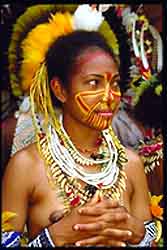
| The first settlers of Papua New Guinea probably reached its shores from Indochina about
50,000 years ago. Some may have continued the journey to become the "aborigines" of Australia, which was still linked by a land bridge to Cape York at that time. Papua New Guinea is a land of immense diversity. No two provinces are alike in the astounding complexity of this country's amazing people. Islolated from the rest of the world for thousands of years, New Guinea has developed much on its own. Known as the "Land of a Thousand Cultures," it can boast over 800 distinct languages and almost as many separate ethnic groups. The varying amounts of artwork and cultural attributes have fascinated outsiders for years. Jorge de Meneses was the first European to set foot on its shores, and named its people "Ilhas dos Papuas", or Land of the Fuzzy Hairs. Due to the Africoid features of its inhabitants, the island was named Papua New Guinea, in reference to the African region of Guinea (a mistake, but a common one of the era). A land of fierce warriors, it was to be over a century (1660AD) before Europeans dared conquer the land. Papua New Guinea gained full independence in 1975. Pictured here is a young woman, a dancer from the Central Province region. (Photo and Information courtesy of Peoples of the Earth and PNG Online)
|
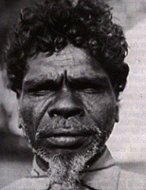
| The Koori of Australia, commonly referred to as Aborigines, are today called Australoids. They can be traced back to early populations in Southeast Asia and India. They are thought to have migrated through South central and Southeast Asia finally reaching Australia at least 50,000 years ago. Dubbed the world's "original explorers," it is unknown whether they reached Australia by foot or by naval vessels. They lived in relative isolation to the rest of the world until the late 1700s when the British began using Australia as site to deport its convicts. These newly arrived Europeans shattered the native way of life, committing genocidal against its inhabitants. In Tasmania, a small island south of Australia, all full-blooded natives were exterminated by encroaching Europeans. The last genocidal campaign against the native Tasmanians was known as "The Black War." Today the native population of Australia accounts for only 1% of the population and struggle against oppression and racism to secure their future. (Photo and Information courtesy of Physical Anthropology and Peoples of the Earth)
|
