
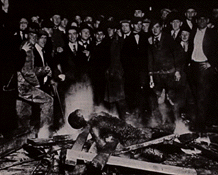
Burning of Black man whose parts were later sold as souvenirs
courtesy of A History of Lynching Violence had always been a factor and legitimate tactic in the maintenance of white supremacy. With disfranchisement came the ability to pass Jim Crow laws limiting black existence. And anyone who disobeyed these laws were a threat to the white power structure. Those who dared to do so learned quickly the wrath of the New South. This violence however was not random and without direction. Its first intended victims were those elements in the black community which constituted the greatest threat to white domination.
An instance of this can be seen in the great Memphis Race Riot of 1866. Between May 1 and May 3 of that year a racial conflict erupted in the streets of Memphis, Tennessee. Irish policemen, firemen and other white laborers rioted in the southern part of the city. For three days they attacked the black residents of the area but most especially the black Union troops stationed there. By May 4, when federal military officials had declared martial law in the city, two whites and at least forty-six blacks had been killed. Between seventy and eighty others had been wounded, at least five black women raped, and more than one-hundred black schools and ninety-one black houses had been burned.
The violence erupted initially between white policemen and black Union troops stationed in the city. This eruption of hostilities had been building for quite some time in the area. The black troops were part of a larger grouping of Union soldiers stationed in the city during Reconstruction. And while the white southerners disliked the Union soldiers, they especially despised the black troops. To be under the watch of those whom at one time were held in complete control was to them some bizarre nightmare. The following passage by Kevin R. Hardwick illustrates as much: |
When black men acted as provost guards in Memphis and other southern cities, they enforced a new order that, from the standpoint of many white Southerners, represented the world turned upside down. Thus, black soldiers were at once deeply threatening to those whites committed to the old order, and psychologically, as well as actively, liberating to blacks struggling to create the new. (Hardwick, p. 110) |
It was this force and pride the riots sought to eliminate. Hardwick goes on to make the following observation: |
The presence of black soldiers in Memphis, and their relations with both black and white residents of the city, are central to understanding the riot. The riot was in part directed at stripping these men, in the most direct and brutal way possible, of the authority that federal service had provided them. (Hardwick, pp. 110-111) |
To the whites of Memphis the black soldiers stood as an insolent wall to their superior civilization. |
The white policemen of Memphis especially took the presence of black soldiers, who outranked them, as an insult. Incidents between the two were quite frequent; Hardwick cites several of these cases. One involved a First Sergeant Peter Robinson of the 88th US Colored Infantry Regiment who was beaten by white policemen for not stepping from the sidewalk. Two noncommissioned fellow officers described the incident: |
A policeman came along with his hand in his bosom, and threw his whole weight against Sergt Backner�he just walked along and shoved him with his elbow as he passed hard enough to push Sergt. Backner out of his place up against the other wall. (Hardwick, p. 119) |
The white policemen of Memphis took out their frustration on black soldiers whenever they could. |
These events and emotions culminated into the Great Race Riot of 1866. It began on the same day on which black Union troops were to have been with drawn from Memphis. This is no coincidence for the white policemen realized that at that moment the black soldiers were vulnerable, without the protection of the federal government. When a large group of policemen attempted to arrest a black soldier, his fellow veterans refused to allow it. A fight broke out at the end of which a white officer lay dead and the policemen retreated to Memphis in disarray. After organizing a mob of several thousand men, they attacked the black settlements of the town. Their main targets were the soldiers. Hardwick writes the following: |
The violence of the riot was not random. It was targeted at those black individuals and institutions most symbolic of black empowerment---- the soldiers themselves, and the institutions that their presence sheltered. (Hardwick, p. 120) |
The white mob went after those blacks it considered the symbols of black power and the source of their frustration. Hardwick goes on to say: |
From the beginning the rioters focused on black veterans. Horatio N. Rankin, a black schoolmaster at Memphis, testified that 'the policemen commenced shooting at the negroes on South Street but seemed to fire principally at those dressed in uniform.' (Hardwick, p. 120) |
This clearly illustrates the need whites had to justify their dominance by destroying any assertion of black power or humanity. |
Other witnesses remembered seeing unarmed blacks who were not disturbed by the white mob. One man stated, "'The crowd was not firing at these colored people, but seemed to be looking after and pursuing the colored soldiers (Hardwick, p.121).'" A coroner who examined the bodies of thirteen black men killed in the riot stated that 'the bodies of all the negroes were dressed in soldiers clothes (Hardwick, p. 121).'" |
Some blacks told of escaping death by denying an affiliation with the black Union troops. One such black man, Taylor Hunt, commented that after being shot by a white man he was asked whether or not he was a soldier. When he said no, the mob left him alone and went their own way. |
But as the riot continued all blacks became targets for the white mob. Some were assaulted or killed simply for wearing blue, the color of the Union troops. A young black boy was forced into a burning house in front of his mother for wearing a pair of blue jeans. Four of the five black women who were raped during the riot by white men all had ties to the Union army. Two held pictures of black Union troops in their homes. Another had a brother in the 59th Colored Infantry while the last was the wife of a soldier. Hardwick summed up the entire episode with the following lines: |
Incidents like these created in actuality the white goal of black subordination. White Southerners could achieve this goal in Memphis only by destroying the most potent symbols of black power in the city----the soldiers themselves. (Hardwick, p. 123) |
The white mob in Memphis attempted through this riot to assert dominance over the blacks of the city and thus reclaim their crown of white supremacy. |
But blacks did not have to directly affect whites to threaten their prized positions. Evidence of this can be seen in the Tulsa, Oklahoma Riot of 1921 in which angry whites rioted in a black section of town. These whites destroyed a prosperous black business district known as "Little Africa" or the "Negro Wall Street." Nina Dunn estimated that 35 city blacks were "'looted systematically (p. 321).'" At least one account reported that the Tulsa police bombed the district. For blacks of this era white power meant black death; for the first to be ensured the latter had to occur. |
Back to KAMMAASI Black Politics Page

