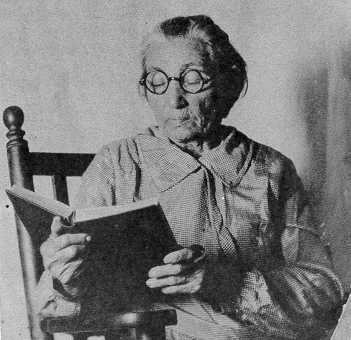
1854-1948
Documented writings of the late Julia Bigger, former teacher at Caddo Gap School, tell us the first settlement in the Caddo Gap region was at the Narrows, not where the town is presently located. After Montgomery County was created in 1842, this area was in Gap Township and the post office, was Centreville.
We are indebted to a federal census enumerator for the written record of a school in this area as early as 1850. This census shows forty-five year old Elijah L. Hughes, a native of Ireland, to be the lone school teacher in Gap Township. Thirty-two white school pupils -- twenty-one males and eleven females whose ages ranged from six to twenty--were reported.
The 1860 United States census gives the names of two white school teachers Gap Township -- Louisia Cole and E.M. Johnson. Scholars were not indicated on this report.
The next record we have of a school in this vicinity comes f rem the pen of Melinda Ann Jones Cubage, who, at the age of eighty-one, wrote an article for the Arkansas Gazette in the summer of 1936, relating her school days in Caddo Gap in the late 1860s. (We thank Bobbie Jones McLane of Hot Springs for furnishing us a copy of the Arkansas Family Historian, quarterly publication of the Arkansas State Genealogical Society, which featured this article.) Following is an extract from Mrs. Cubage's narrative entitled "Memories of Montgomery County":
"The next summer, after arriving at Caddo Gap, we attended a three-month school three miles from home and had to wade the Caddo River. Father said this would never do, so he hired Guilford Goodner to teach through the winter in an old log church near our home. Several others attended besides our family."
Mrs. Cubage's childhood home at Caddo Gap was off the Buttermilk Springs Road at the site where Frank Driggers lived in the early 1940s, just northeast of Bethel Cemetery. The location of the school which was three miles from her home is not known. It could have been at Centreville on the west side of the river at the Narrows or it could have possibly been at Manfred. In either case, the river would have been crossed and it would have been a "long" three miles distance.
Mrs. Cubage's story continues:
"The following summer Father induced Dr. W.R. Harrison of Rockport, an old friend of his, to come to Caddo Gap, and between them they started a school in the fall of '69. There were about seventy-five students in all.
"At the end of the nine months, Dr. Harrison had to go to Texas and that broke up the high school--but it had made an impression on the community, and we began to have more and better schools. A cousin of my mother, Miss Minnie Clingman, from Alabama, came and taught at the old log house. There was such a scarcity of teachers that Father decided to make me one, so I took the examination when I was seventeen and got a Third-Grade Certificate. I procured a school near Black Springs and taught for twenty dollars per month. At the end of three months I entered school at Center Point, Howard County."
According to the 1870 census, the name of the post of f ice in Gap Township had changed to Gap and the area had five white school teachers. They were W.M. Williams, H.T. Majors, James Cogburn, G.B. Willis and Benjamin Johnson. School pupils were not so-designated.
After attending school in Howard County, Mrs. Cubage (then Miss Jones) taught several terms at Daisy and Mount Ida, then says in the previously mentioned article "I resigned to take my home school in Caddo Gap. This was my last school. The next spring, May 1878, I married James Dodd Cubage.
From an article in the Montgomery Herald dated December 10, 1942, more is learned of the last school Mrs. Cubage taught. The newspaper did not name the author of the article, "First Schools in Caddo Gap,it which reads in part:
"The first free school in Caddo Gap community was taught by Miss Melinda Jones, later Mrs. Cubage, and was at Old
|
"The first teachers of free school in their order were Miss Melinda Jones in 1877, S.T. Tweedle in 1878, M.H. Olds in 1879, Harrison R. Collier in 1880 and A. Jones in 1883."
Mrs. Cubage had a younger sister, Fannie Jones Highsmith. From her memoirs, "Memories of a Pioneer Woman," more is gleaned about Old Bethel School on the Buttermilk Springs Road:
"School money was scarce, she wrote, itand what there was had to be divided with the Negro school. Then some of the people talked to Father about teaching the school himself, and this he did for eighteen months, taking his 'pill-bags' with him and letting some of the older boys substitute for him if he had to make a pressing call. (Her father was Dr. Alfred Jones, a practicing physician.)
"Old Bethel was a very large log house. It did not have any windows, did not need any as the cracks let in plenty of light and air. There was a large fireplace in one end. We had no pens from the store, but all of us brought goose and turkey feathers, and from these Father made pens with his 'pen knife' as he heard our lessons. We had no desks. Our seats were made of split logs with pegs for legs. We had a long shelf just under one of the longest cracks where we would sit to write our exercises or to practice penmanship. We used slates for most of our work, spittingon them and rubbing them off with our hands. We had no slate pencils, but we cut f ine ones from a bank of slate on the creek and whittled them into shape. No ink could be bought. We would gather 'ink balls' from oak trees. By sticking a nail into an ink ball and letting it stand for a f ew days we could squeeze out a little very black ink. Red ink was plentiful berry season. There was a cold spring about three hundred yards from the school house and below it the boys built a 'milk pen' where we could keep our bottles and buckets of milk f resh and cool for dinner. Our school day began at the same time the men got into the fields to work and closed at 'quitting time."'
Old Bethel School is first recorded as being School District 50 in Montgomery County's 1886 Personal Property Assessment and Tax Book. By census-taking time in 1900 the early settlement at the Narrows had vanished and the areals most populous site was at the location of present-day Caddo Gap. The post of f ice was called Caddo Gap . Two white school teachers, David R. Vaught and John H. McLean, were listed in Gap Township . Some one-hundred white students were reported as being in school anywhere from one to ten months with the majority attending either three or five months. One eleven-year old boy had the privilege of attending school for ten months; however, the location was not disclosed.
On November 4, 1908, John H. McLean, A.P. Vaught and L . C . Huey, directors of School District 50, purchased a parcel of land (NE 1/4 of NE 1/4, Section 13, Township 4, Range 25 West) from James R. and Mary Vaught on which a two-story f rame school building would be constructed f o r Caddo G a p, in Gap Township. Over two hundred white students were reported as being i,i sc . Amos Horn, a Caddo Gap native says, "While the new school was being built, classes were held in the Methodist Church. That's where I attended my first school. Loda Vaught McLean was my first teacher. Jesse Nelson was the f irst superintendent.
The 1910 census listed two white school teahers , Jesse L. Nelson and Carmon E. Alexanderhool; however, this was for the entire area of Gap Township and possibly included other schools as well as Caddo Sap District T.A. Humble was superintendent of the school f or one year, 1921-22 "Professor" Humble is remembered as a strict disciplinarian.
Some of the other teachers during those early years were Grace Davis Vaught, Celia Gladden, Amos Horn, G.W. Clark, Mrs. G.W. Clark, Ora Snell, Doratha Newth, Mary Hughes and Gladys Wallingsford.
Winfred McLean, a former Caddo Gap pupil, tells of one basketball game in 1926:
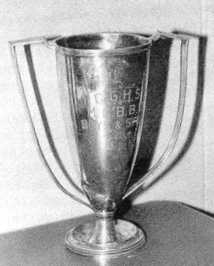 |
"About six inches of snow was on the ground when our team got to Mount Ida to play in a tournament. We had to scrape snow off the outside court before we could play, but Caddo Gap won. We brought back a beautiful 'Loving Cup' which was placed on display at the school. Some twenty years later it mysteriously disappeared. It was later found buried in the ground and was unearthed, polished and placed back on display at the school."
In 1929 a big change came to Caddo Gap School. A new building of native stone was constructed beside the old frame building, which was later torn down, and consolidation began. Dur-.ng the years 1 9 2 9 and 1930, Mountain View District 2, Oak Grove District 26, Mountain Home District 27, Manfred District 2 9 , Hopper District 30, and Fancy Hill District 31 became part of District 50. In 1933 Beulah District 46 was added to the system. Upon consolidation all schools except three -- Mountain View, Hopper and Beulah -- closed their doors forever as schools. These three were called "wing schools" where elementary grades were taught. Older pupils through the twelfth grade were bussed to the central school at Caddo Gap.
During this period of consolidation Hill (Colored) School District 10 became part of Caddo Gap School District 50. Under segregation laws effective in Arkansas at that time, colored children attended separate classes at Hill School with a colored teacher.
W.L. Wilhite became superintendent in the fall of 1930 and led the school through this transition. He left the school early in the 1934-35 term. Caddo Gap School went from an enrollment of ninety-four in 1928-29 to three-hundred ninety-seven in 1933-34. The property valuation rose from one thousand eight-hundred dollars to twenty-seven thousand five hundred dollars during the same period of time.
A system of busing was begun over hazardous roads, some having seen little motor traffic except billet and log trucks. Donna Tweedle Wisener recalls early busing: "One afternoon going back to Hopper the bus stalled-out and could not make the grade up the hill after crossing the low-water bridge over the Caddo at the Narrows. We all got out o f the bus to push. One of the younger boys, Haskell Williams, slipped and fell under the moving vehicle. We all thought he had been killed as the bus rolled over him, but he jumped up, very much alive. He had fallen into a deep rut and was not hurt at all." Traveling hand in hand with District 50's consolidation was the Great Depression of 1929, the culprit which would play havoc with the schoolls monetary budget for years to come. Amos Horn remembers the "hard times":
"I was teaching in the school one year when Wilhite was superintendent. He called the teachers into his office one day and stated that the school had run out of money and wanted to know what we thought about teaching the last three months to keep the pupils from losing credit for the five months we had already taught if the families of the students would feed us out of any surplus food they had. We all agreed. He wrote letters to the patrons and they agreed. They sent in food every Friday. I did not take any as I was living with my parents. The last week when Wilhite was distributing food he said, 'Amos, you have not taken any food so I want you to take some this time.' I received one gallon of homemade sorghum with about three inches of syrup in the jug that was so black and thick it would not pour out and one pint of black-eye peas with a weevil hole in every pea."
Roy Vergil Simpson, superintendent from the fall of 1935 through the 1936-37 term, tells more about those times:
"A peculiar form of financing developed. The pay the teachers drew was called a warrant. There might be no funds for the district to cash the warrants. If there were not, the warrants were 'registered.' The Caddo Gap district was two years behind in its payments. That meant you 'register your warrant and wait two years for your pay. Many of the teachers let the banks discount their warrants at a rate favorable to the bank."
Winfred McLean, then teaching at Mountain View says, "Sometimes we had to take as much as twenty percent discount when we let the banks take our warrants."
Years later, Julia Bigger referred to the 30s as "the days we taught for black eyed peas."
Simpson relates further:
"No textbooks were furnished then. We (the faculty) selected the books and I ordered them getting them at wholesale and selling them at retail to the students. The profit made from these sales was spent on books for the library."
This writer recalls the crowded conditions at the school in 1936-3?:
"I was in the sixth grade which was in the same room as the fifth. Seventynine pupils were enrolled in the two grades. We sat at double desks, many of them homemade. The first day of school some of us sat three to a desk. By the next day more desks had been moved in but they were so close together a person had to turn sideways to walk between them. Our teacher was Charles A. Simpson, a Methodist preacher. He read f rom the Bible and had prayer each morning before recitations began. He maintained discipline in spite of overcrowding. It was so crowded in the upper grades that the stage was used as a classroom."
Otto Ernest Rayburn served as superintendent from the beginning of the 1937-38 term through the spring of 1940 . By this time Caddo Gap School had a "fleet" of three buses with three drivers to run six routes. Each morning before daybreak the Hopper, Beulah and Mazarn drivers started picking up riders. Grade schoolers were left at Hopper, Beulah and Mountain View schools. The older ones were transported to the central school, arriving about seven-thirty. A f t e r unloading, the drivers made second runs to Oak Grove, Manfred and Buttermilk Springs, arriving back at school with loaded buses just as the eight-thirty bell was ringing, sometimes later. At three in the afternoon, Oak Grove, Manfred and Buttermilk Springs pupils were dismissed to board their buses for home. The remainder of the pupils stayed in classes until thrfze-thirty. The buses got back to the school about four o'clock to load-up again for the return trip home, with stops being made at the wing schools to pick up the little ones. Those were logg days for kids who lived at the Clark, Hot Spring and Garland County lines and at Fancy Hill since most of them helped with chores before leaving home and after getting back.
The Caddo River caused more school absenteeism than all other reasons combined. Two one-lane low-water bridges crossed the river, one at the Narrows, the other on the road towards Manfred. The slightest rain caused the river to rise river the bridges, so Oak Grove, Hopper and Manfred students had to be bussed home almost every time it rained. They could be marooned across the river for days. Pupils from those communities were expected to keep up their grades even when absent. Manfred pupils who did not live too far away defied the high water and walked to school via the swinging bridge.
There was not a drop of drinking water on the campus. Pupils walked a few hundred feet north and drank from Epps 1 Spring. lost of them lay on their bellies to drink. Those who could not "master" that technique learned early how to fold a sheet of tablet paper into a drinking cup. The spring was large, partially encased in cement with a free-flowing stream. The water was crystal clear and at least looked clean. Restrooms were two outhouses, one for boys and one for girls.
Any time a visiting preacher '?stopped by?' the school, the assembly bell was rung. All classes ceased and everyone marched to the auditorium for chapel. All local ministers were welcome, but Dr. John T. Barr from Norman came most often. If there was parental objection to children attending devotional services or praying in school, it was not made known.
Except for basketball goals, basketballs, a few softballs and bats, playground equipment was non-existent. The basketball court was in f rant of the main entrance to the building. The only place large and flat enough to play softball was on top of the hill west of the school behind the Baptist Church. During softball season, it was a long, hard climb itup" and a swift slide "down."
The school received a small allotment from the NYA (National Youth Administration), one of President F. D. Rooseveltts "New Deal" programs, established in 1935 to aid needy students. Some four or five students were given jobs and received about two dollars a month. They worked in the library, kept attendance records and assisted teachers when needed. (There were no teachers' aides nor substitutes then.) Some of the boys under the program helped keep the gounds clean.
No money was available for school itextras." The junior and senior classes presented yearly plays to help defray expenses. Reference books, basketball suits and a few desks were purchased with funds raised at the annual Halloween Carnival, pie suppers and cake walks. One particular cake walk will always bring a smile to any Caddo Gap student who can remember the late 1930s. A large, beautiful cake was always reserved for the winner of the "prettiest girl contest" held at the end of the cake walk. One night, midst laughter and "haw-haws" from the back of the auditorium, Rosie Forga's name was submitted as one of the prettiest girl nominees. No one had ever heard of Rosie; however, she was getting quite a few votes which were five cents each, as Audie Forga and Verbie Wright kept taking or sending nickels and dimes to the master of cermonies. Rosie was finally declared the winner after a considerable amount of cash had been raised for much-needed school supplies. When she was asked to step forward to receive her cake, up stepped Doyle Forga, a big, overgrown Pigeon Roost boy with red hair and an even redder face. Not only did Forga walk away with a cake that night, but with a new name as well. "Even now, people still call me 'Rosie, III Forga says. "It all started at that cake walk at Caddo Gap School."
Berry Vaught was the school's janitor for years. Berry was the first at school each morning and the last to leave in the afternoon. He washed windows, swept floors, kept the grounds clean and the fire going. He kept an eye on the "early birds" and surpervised the playground when needed. He bandaged skinned knees, wiped away tears and listened to everybody's problems. He was even known to hold down a classroom and teach on occasion. Berry was everybody's friend. By 1943 his pay was only thirty dollars a month.
The school building had a steam heating system with a boiler in the basement and pipes carrying steam into the rooms above. By the late 30s the system had become quite antiquated. The pipes and registers would shake, rattle and roll but they did not keep the building heated. In cold weather everyone had to wear coats indoors to keep warm. There were times in excessively cold weather when Rayburn would have Berry build a large bonfire on the school ground and classes would go outside in shifts to get warm.
Winfred Lee McLean became superintendent in the fall of 1940, retaining that position through the spring of 1944. During this time the school initiated its hot lunch program.
"The school rented the Eppst house where meals were cooked and served," McLean says. "One Friday night a month I kept a school bus at my home then left early Saturday morning for Little Rock where I picked up commodities and supplies. We asked each person to pay ten cents for a meal if he could. Those who could not pay ate anyway. Ola Vann was the first supervisor."
The hot lunches now served at Caddo Gap School were a "far cry" from the lunches Fay Bohannon tells about taking to school in 1934:
"My lunch usually consisted of two homemade biscuits with a piece of pork in one and a fried egg in the other," Bohannon states. "For dessert I had a chocolate roll made from left-over biscuit dough at breakfast or at times a 'half moon' apple or peach pie. I took my lunch wrapped in newspaper since we could not afford brown bags."
While McLean was superintendent the boiler in the basement broke down and was completely beyond repair. "I've done all I can do," Berry told him. "We must have another boiler."
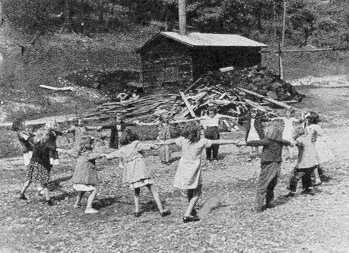 |
McLean wondered what to do about heating the building. As always, the school was in a "money crunch." Even if funds had been available, a new boiler could not have been found during World War II. But he started looking around. Finally, he found an abandoned boiler at an old mill site. It was placed on skids and hauled to the school. Being too large to go in the basement, it was set up outside and a l'boiler room" f ramed up around it. A pipe for carrying steam was run in mid-air from the boiler to the school building. "We wrapped the pipe as well as we could to keep it from freezing," McLean says. "Berry shoveled coal all winter long to keep up enough steam to heat the
During World War II the school got its first f lag pole, " McLean continues. "We pledged allegiance around the flag every morning, then the pupils marched military fashion to classes."
The Montqomery County Herald dated December 10, 1942, reported that nearly seven hundred dollars worth of war bonds and stamps had been sold just a few days previous at a "Remember Pearl Harbor" program at Caddo Gap School.
These five boys, all former Caddo Gap pupils, lost their lives in World War II: C.A. Adcock, Robert Bohannon, Willis "Billy" McClarie, Andy Smith and J.P. Smith. Shady Grove School District 33 and Pisgah School District 58 consolidated with District 50 December 15, 1942. Both were wing schools during the 1943-44 term where grades one through six were taught. The following year both schools closed and the grade schoolers started going to Beulah.
While adult education is a popular thing today, it was almost unheard of forty-two years ago ... but not so at Caddo Gap. An exception to the rule was Ozelle Thomas, who had quit school to get married, then at the age of thirty-three and with five children, re-entered in the tenth grade in order to graduate with her daughter.
Beginning in the fall of 1944, John Granville Cubage became superintendent and served in that capacity through the 1952-53 term. Caddo Gap School was finally able to start a gradual building and improvement program. A drinking fountain was installed on the school grounds and flush toilets became a reality.
 |
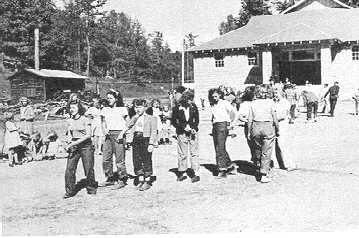 |
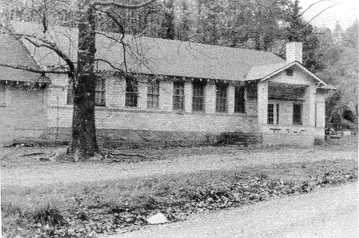
| Ida S. Cobb Cottage of Domestic Science | Campus Scene at Caddo Gap School |
The Ida S. Cobb Cottage of Domestic Science was built on a parcel of land adjoining the school which Mrs. Cobb donated to District 50 in 1 9 4 4 . In later years it served as the lunchroom.
The Mountain View wing school closed at t@e end of the 1945-46 term. On September 23, 1946, the school purchased six and two-thirds acres of land (E 1/2 NE 1/4, Section 27, Township 4 South, Range 23 West ) from J.A. and M.E. Short and plans began to be formulated for a new wing school in the Beulah area.
Hopper School closed at the end of the 1950-51 season.
Beulah School closed at the end of the 195l-52 term, with its pupils, grades one through six, transferring to Caddo Gap's newly-constructed wing school Grandview, located about a mile farther east on Highway 70.
Ruby Chloe Forga West and W.C. Efird were the first teachers at Grandview School when it opened with 1952-53 term. Grandview was often referred to as the "new" Beulah School.
Caddo Gap School was the last school in Montgomery County to get a gym. It was completed in 1954 during the tenure of Earl Tweedle, superintendent f rom the fall of 1953 through the spring of 1958. Regarding the gym, Tweedle says, "I am sure it had a positive effect upon the basketball teams. Caddo Gap enjoyed many years of winning teams. They were runner-up in the State Tournament at Russellville in February, 1958." That was when the Wildcats won their thirty-sixth straight victory of the season under the leadership of Coach Tommy Barrett. Caddo Gap defeated the Waldo Bulldogs 72 to 67. Carlton Coffman broke his arm in the middle of the fourth quarter but continued to play the rest of the game which went into overtime.
The new gym was heated with propane so the old steam heating system in the stone building was liput aside" and propane heaters installed.
In 1954-55, integration came to Caddo Gap School when Hill (colored) School closed and two black children entered the previously all-white school.
Haskell Dillard served as superintendent for two terms, 1958 and 1960.
Preston Moore became superintendent in the fall of 1960 and remained through the term of 1963-64. Grandview, District 50's last wing school, closed in the spring of 1964. Frankye Jo Driggers was the school's last teacher. All pupils now attended the central school.
Francis Scott Key, Caddo Gap School's last superintendent, took over that position in the fall of 1964. In the late 60s a new high water bridge was built across the Caddo River at the Narrows. No longer would there be absenteeism from Oak Grove and Hopper students because of high water. It is said that while the bridge was being built "old timers" around Caddo Gap told the engineers they were not building it high enough. The engineers scoffed and said, "Water will never get over this bridge." The engineers were wrong .... the "old timers" knew their river! Water has gotten over the new bridge several times, but not so many times that it greatly affected school attendance.
Now, only the Manfred students were sent home when it rained. A new bridge would eventually span the river towards Manfred (1984), but it would come too late to help Caddo Gap School. Its last group of seniors graduated in the spring of 1971. By the following fall it had consolidated with Norman School Digtrirt 28 and was part of the new Caddo Hills School District 28.
Caddo Gap School District 50 is now just a memory in the hearts of many. The only reminders at the old school site are the gym, now used as a VFW Post, a dilapidated cottage of domestic science and few sections of the cherished Senior Walk.
Hollis Simpson was superintendent from 1972-78 during the actual construction of the Caddo Hills buildings. The first two years after consolidation, Caddo Hills students were housed on three campuses the elementary and high school at Norman and the Caddo Gap campus. By the fall of 1973 the new high school building was ready for grades seven through twelve. The following year the Caddo Gap buildings were sold to the VFW and the Caddo Gap elementary students moved to the new Caddo Hills Elementary across the drive from the high school. (They had been bused to lunch on the new campus the preceding year.) Charles Faulkner was superintendent in 1978, J. Frank Scott from 1979-82, and Jay Holland was acting-superintendent in 1982-83. Wilburn Davis led the school from 1983-86. John Bass is the new superintendent at Caddo Hills at a salary of $37,000.
After additions were made to the Caddo Hills elementary building in 1975 and 1983, the Norman Grade School was vacated and all students were housed on one campus. The agricultural-home economics building was completed in 1973, and the physical education building in 1976. The football program was begun in 1981. The new field house was finished in time for the 7A North District Basketball Tournament in March 1985. Band, public school music, computer courses, Spanish, and art have been added to the curriculum since 1981.
Every visitor to the Caddo Hills campus comments on the beauty of the campus and the surrounding meadows and mountains that Caddo Hills students and faculty sometimes take for granted. Former students of this district, however, make sure that their roots are not forgotten, as they show up each fourth Saturday in June to the Caddo Hills campus to recount their early schooling and to reacquaint themselves with former classmates. This annual alumni reunion welcomes all former students of any school that now is included in the Caddo Hills District.