Bem's self-perception theory states that people do not often recall old attitudes and
recognize a conflict with their behavior; instead, they often simply infer their attitudes directly
from their behavior. A survey study of 56 female university students was conducted to examine
this theory in respect to safety behaviors as they relate to an overall fear of being assaulted on
campus. The surveys were broken into two groups of 28 which consisted of "high salience" and
"low salience" statements respectively. The groups were then compared by mean responses to
an overall fear of being assaulted. The results revealed that students' perceptions of the amount
of safety behavior they exhibit is related to how fearful they believe themselves to be. It was
concluded that female students' self-perceptions of fearfulness conformed to Bem's theory.
We all possess some degree of fear upon leaving the comfortable surroundings of our homes. It is when we venture out into or come in contact with the greater population of our society that we become fearful for our personal safety. While out and about we are all, at sometime, conscious that we may be in danger of receiving some bodily harm. Even while in our homes, an unexpected knock on the door or an unfamiliar face roaming outside can trigger a feeling of apprehension. Everyday we hear stories of persons abducted, persons assaulted, and persons murdered. Many of us take precautions against becoming a victim of such a horrible act and many of us are conscious of the fact that we are fearful of becoming such a victim.
How then, do we account for our fears? It is possible that we are aware of likelihood of becoming a victim and thus take the steps to protect ourselves. It is also possible that we take protective measures without any real awareness of the amount of fear we feel. It is this possibility which I find most interesting. The ability of persons to act, without a conscious awareness of the rationale behind those actions, is the phenomena under study.
Daryl Bem (1972) proposed an explanation of the effect of behavior on a person's attitudes along the lines of, but simpler than, cognitive-dissonance theory. According to dissonance theory, if a person acts as though she/he believes in X, that person interprets the action as meaning she/he believes in X. If, then, this person recalls an earlier belief contrary to X (not X), she/he is forced to recognize the inconsistency between the implication of the action, X, and the belief, not X. To remove this inconsistency the person then must change her/his attitude to X.
According to Bem's self-perception theory, the first two steps may be true without ever going further and dealing with inconsistency. That is, that a person may simply infer from her or his actions what her or his beliefs must be. Bem argues that in cases when there is no earlier belief or a person is unable to recall one, then the person is simply inclined to adopt the belief implied by the behavior. Bem argued that "what the dissonance theories may have been demonstrating is that people infer their own attitudes from observing their own behavior, in just the same way an outside observer would infer their attitudes" (Psychology 1992 p. 514).
Following from this, we may apply the self-perception theory to the realm of personal
safety. If we accept Bem's model, then we can hypothesize that persons who undertake more
precautions pertaining to their personal safety will believe that they are more fearful than those
who take fewer. By making people consciously aware of the protective measures which they
take, we also hope to manipulate their conscious awareness of the amount of fear they feel. To
clarify, the hypothesis, properly stated is this: Those who are led to believe that they exhibit
many self-protective behaviors will be led to infer that they possess a higher fear of crime than
those who are led to believe that they don't exhibit as many such behaviors.
Sample
Respondents consisted of 56 female University students. Students were drawn from seven (7) sections of EPCO 211. Of these students, 54 were undergraduates while 2 were graduate students. 23 students lived on campus in dormitories, 24 in off campus apartments, 7 in off campus sororities, and 2 in other housing. While 9 of the students had at one time been the victim of an assault, 26 had known someone who was victimized. Of the randomized surveys, 29 students received a "low salience" survey and 27 students a "high salience" survey. Of the total 56 respondents, 6 were eliminated from analysis for reasons such as comparing answers during the survey (2), failure to read the directions and questions (3), and knowledge of the survey's purpose (1). These dismissals brought the final total to 50 respondents; 25 in each group.
Measures
I constructed two survey questionnaires which consisted of 10 close-ended questions in the first section in which students responded either 'yes' or 'no' (see appendix). These questions, the independent variables, were adapted from research conducted by Tomas Blumenfeld and designed to place respondents in two distinct categories. In the "high salience" condition statements were worded as behaviors which are conducted 'sometimes' and designed to elicit 'yes' responses thus increasing the students' belief in safety concern. The "low salience" condition statements conversely were worded as behaviors which are 'always' exhibited and designed to elicit 'no' responses thus decreasing the students' belief in safety concern.
In the second section, students' were asked to rate on a 9 point scale how fearful the were
of being assaulted on campus, the dependent variable. An additional 8 questions, ranging from
beliefs of how common burglaries and assaults were on campus to demographic information,
were included to give the appearance of a more in depth and multi-topic study.
Procedure
Students participating in the study were told that I was an NIU student who was conducting a survey of safety precautions taken by female students at NIU. Between the dates of Nov. 11th and Nov. 21st 1996, I personally distributed surveys in four sections of EPCO 211 while in the remaining three surveys were distributed by the professors of the respective sections. In all sections a pre-constructed set of directions (see appendix) was read to the students. As stated, the surveys which had been randomized using a random numbers table, were distributed to the students. Respondents were given as much time as was needed, which ranged from 10-20 minutes in all cases, and the surveys were collected.
Manipulation Check
The mean number of 'yes' responses to the safety behavior questions was 4.88 for the 'low-salience' group and 7.84 for the 'high-salience' group. The difference between the groups' means was statistically significant (t = -6.36, df = 40.65, p<.000 one-tailed), indicating that the manipulation of the salience was effective (see Table 1).
| Table 1 | Variable="Yes" | # of Cases | Mean | S.D. | S.E. of Mean |
|---|---|---|---|---|---|
| Group 1 (Low) | 25 | 4.88 | 1.965 | .393 | |
| Group 2 (High) | 25 | 7.84 | 1.248 | .250 | |
| Levene's Test for Equality of Variances: F= 3.271 P= .077 | |||||
| Variances | T-Value | df | 2-Tail Sig | SE of Diff. | 95% CI for Diff |
| Equal | -6.36 | 48 | .000 | .465 | (-3.896, -2.024) |
| Unequal | -6.36 | 40.65 | .000 | .465 | (-3.900, -2.020) |
Dependent Measures
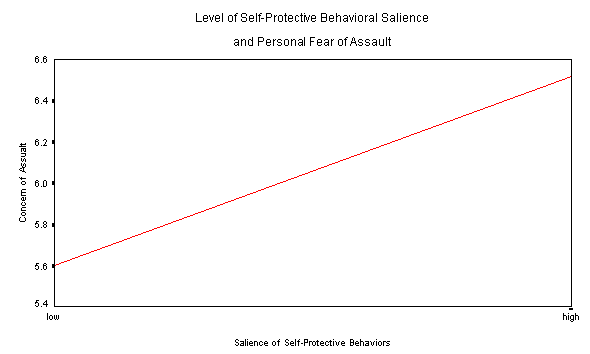
When asked the question, 'how concerned are you of being assaulted on campus', persons in the 'low-salience' condition had a mean response score of 5.6 in contrast to persons in the 'high-salience' condition who had a mean response score of 6.52 (see Graph 1). The difference between the group means was nearly significant (t = -1.49, df = 48, p<.071 one-tailed), (see Table 2).
| Table 2 | |||||
|---|---|---|---|---|---|
| Variable="CONASS" | # of Cases | Mean | S.D. | S.E. of Mean | |
| Group 1 (Low) | 25 | 5.60 | 2.500 | .500 | |
| Group 2 (High) | 25 | 6.52 | 1.806 | .361 | |
| Levene's Test for Equality of Means: F= 2.679 P= .108 | |||||
| Variances | T-Value | df | 2-Tail SigSE of Diff. | 95% CI for Diff | |
| Equal | -1.49 | 48 | .142 | .617 | (-2.160, .320) |
| Unequal | -1.49 | 43.68 | .143 | .617 | (-2.163, .323) |
Following from the above analysis of the data it is concluded that the hypothesis has been supported. As stated, those persons in the 'high-salience' group indicated a higher degree of concern of being assaulted than did those in the 'low-salience' group.
As an interesting additional analysis, the questions of "have you ever been assaulted" and
"do you know anyone who has ever been assaulted" were compared with respondents' concern
of being assaulted. The analysis showed no significant difference between the groups in either
question (see Table 3). It was expected that persons who had been the victim of an assault in the
past would be more concerned about being assaulted, regardless of salience. Surprisingly, this
was not the case.
| Table 3 | ||||
|---|---|---|---|---|
| Question:Have you ever been assaulted? | ||||
| Variable="CONASS" | # of Cases | Mean | S.D. | S.E. of Mean |
| Yes | 24 | 6.16 | 1.971 | .402 |
| No | 26 | 5.96 | 2.441 | .479 |
| T-Value = .33 P= .373 (one-tailed) | ||||
| Question: Do you know anyone who has ever been assaulted? | ||||
| Variable="CONASS" | # of Cases | Mean | S.D. | S.E. of Mean |
| Yes | 8 | 6.25 | 2.252 | .796 |
| No | 42 | 6.02 | 2.225 | .343 |
| T-Value= .26 P= .397 (one-tailed) | ||||
The results of the study were consistent both with the hypothesis and Bem's theory itself. The manipulation of the respondents' salience proved effective as it did affect the level of concern they expressed. Furthermore, the fact that the mean number of 'yes' responses to the safety behaviors statements in the 'high-salience' group was significantly higher than that in the 'low-salience' group, proves the manipulation was effective. The 'high-salience' group reporting a greater concern of being assaulted than that of the 'low-salience' group supports my original hypothesis. In the study, the subjects' self-perceptions of their own concern was significantly related to the amount of safety behavior which they were made aware of exhibiting.
Further research on this subject needs to be done in order to gain a greater understanding
of this phenomena. While this study has proven to be somewhat improved from past trials,
further refinements would be beneficial. Better control of all conditions relevant to the subjects
(i.e. time of survey, location, etc) needs to be attained. Also, refinements to the safety behavior
statements need to be made in order to achieve more significant differences in salience. Lastly,
a greater number of subjects may positively affect the overall findings.
Laird, J. and Thompson, N. (1992) Self-Perception Theory. Psychology
Boston, MA: Houghton Mifflin Co. 514-515
West, S. and Wicklund, R. (1980). Self-Perception Theory. A Primer of Social Psychological Theories, 8, 100-115.
Salancik, G. and Conway, M. (1975) Attitude Inferences from Salient and Relavent
Cognitive Content About Behavior. Journal of Personality and Social Psychology, V.
32, No. 5, 829-840.