The Totalogy of Influence on the Developing Mind
A Multi-structured Analysis of Aggression
Introduction
The topic of aggression is broad and has been
widely studied. A large amount of
research has been dedicated to this topic specifically. The reason for this is simple. Aggression and aggressive behavior are
fascinating to us as researchers. The
question of why does a person act out against the norms of society is
tantalizing and offers many avenues of discussion. Secondly, the study of such behavior has practical implications
in our everyday lives. Currently, there
is much pressure upon the powers that be to understand the nature and control
the existence of crime, especially violent interpersonal crime. Many Americans and persons the world over
live in fear of becoming the victim of an aggressive and most likely violent
act. The current trend in reducing this
fear has begun to move away from the reactive method of dealing with aggressive
and violent persons after the commission of an act but instead the partly
proactive attempt to understand and correct the process by which a person becomes
aggressive. The attempt then is to
intervene this process of “aggressive socialization” and/or resocialize an
aggressive individual before s/he becomes a problem for society.
In line with this reasoning, in becomes
important to understand the nature of aggression as it manifests itself in it’s
earliest forms. These forms of
aggression normally show themselves in the behaviors of children. Therefore, the study of children gives us
insight into the process by which aggression becomes socialized. It also gives us a better understanding of
the traits, intrinsic to the individual, which facilitate this
socialization. How better, then, to
study the emergence of aggressive behavior, than through the observation and in
depth analysis of child development. An
analysis of this type and magnitude may tell us not only the process by which
aggression develops, but also the similar traits and characteristics of
aggressive individuals in general.
Furthermore, we may learn that the children which are aggressive today,
are likely the adults which act aggressively in the future.
The range of speculation about aggressive
behavior is extremely intense and diverse, again indicating our level of
curiosity for and concern about the topic.
Fortunately, this wide range means we are not forced to accept any
single dominant theory about the “true” nature of aggression. This has been accomplished largely through a
recognition that there is no single discipline or scientific approach which has
a monopoly of “truth’ about aggression.
As enlightened scholars we recognize that contributions come from many
fields, including biology, psychology, sociology, anthropology and political
science. The nature of the problem
demands an interdisciplinary approach, both in conceptualization and in
research. There are, however,
limitations to treating aggression as a single narrow concept, especially
across disciplines. These limitations
become apparent when one tries to define the term aggression.
While it is nice for us to think of and
define aggression in terms of a behavioral process, it becomes difficult to
separate from other forms of behavior.
Aggression may be applied to a specific response such as killing or a
physical attack. However, it may also
be used to refer to a myriad of emotional and attitudinal states such as anger
or hatred. It may refer to a motivation
or intention regardless of consequences or it may conversely refer to an action
regardless of intent. If aggressive
behavior is defined in terms of anger and emotional involvement we need to keep
in mind that there may be individuals who get extremely angry without ever
attacking or injuring anyone. One the
other hand, there may be individuals who are capable of extreme acts of
violence without any type of emotional involvement. If we conceptualize aggression simply by actions, we have once
again missed the mark. If we use
killing as an example, an action which would be considered aggressive by most
of us through common sense, we need be very careful in how we describe it. A high proportion of all killing which takes
place among animals involves food-getting behavior, and has little to nothing
to do with aggression. Likewise, the
farmer who kills his chickens is not angry with them and has no desire to see
them suffer (we hope) but is merely hungry.
We may be well served by understanding
aggression in terms of not only the behavior but the intentions of the
“aggressor” and the way in which the behavior is perceived by others. An illustration would be an exchange between
a husband and wife wherein the woman relentlessly badgers the man who in return
ignores her and leaves the room. The
man may perceive his wife’s actions, which may or may not be intended as aggressive,
as aggressive. Vice versa, the woman
may view her husband’s behavior as aggressive, whether or not he intended it to
be so. Therefore, we have a situation
wherein there may be high levels of aggression in the interaction yet no real
act of aggression may be perceived by us the observer. In the above example, our conceptualization
may be radically changed if it turns out that the farmer actually does intend
harm to his chickens or receives pleasure from their slaughter.
The above discussion and examples illustrate
that it is extremely difficult, if not impossible, to isolate the necessary and
sufficient conditions to produce a single satisfactory definition. This is not to say that definitions don’t
exist. Buss (1971) for example, states
that aggression is the attempt of one individual to deliver noxious stimuli to
another. While this is nice definition,
it in no way captures the whole of aggression in a satisfactory way. Again, however, it may be impossible at this
point to achieve a definition which does.
The best we can hope for, then, is to conceptualize aggression in a
broad enough manner soas to include as many instances of “aggression’ as
possible, while being narrow enough so that it is able to be measured. When aggression or aggressive behavior is
used in this paper it will refer to any action or intent which has the
possibility of causing harm or distress to another, whether the other be aware
or not, and/or those actions which are perceived by another or the larger society
as harmful or distressful. Again, this
definition is in no way offered as all inclusive or perfect by any means, it’s
only purpose is to provide a common point of reference throughout the remained
of this discussion.
Aggression Research
As stated, aggression is a broad and heavily
studied area. There have been hundreds
of studies and almost as many theories of the process by which aggression is
manifested. At the most basic level, if
a basic level indeed exists, there is the ever present nature vs. nurture
debate. There are many writers and
researchers who believe that the underlying mechanisms of aggression of innate,
while others believe that they are acquired.
Freud’s early (1920, 1925) theories on aggression cast aggressive
behavior as a “primordial reaction” to thwarted pleasure or pain avoidance
(Dielman & Barton, 1983). According
to Freud, aggression was the natural reaction by individuals when some goal or
object of their desire was blocked to them.
This was a response which was “hard wired” into the species and not
normally under their direct control.
Lorenz (1963) theorized that aggressive behavior became part of the
human condition through the process of natural selection. From his line of reasoning, aggression
promoted the survival of a species by guaranteeing an adequate distribution of
resources. Aggressive behavior
functioned in a “what’s mine is mine” capacity so that the strongest and most
aggressive of the species was able to protect it’s young and secure that which
was needed to sustain it’s own life and the lives of it’s own (Dielman &
Barton, 1983).
Moreover, some researchers believe that the
root of aggressive behavior can be traced to purely physical and/or chemical
characteristics of the brain and central nervous system. Some studies (Eslinger et al, 1985;
Price et al, 1990) have shown that aggressive, antisocial, and
disinhibited behavior may be linked to physical trauma or disease in certain
areas of the frontal lobes. A study
done by Giancola et al (1994) found that subjects who performed poorly
on tasks associated with frontal lobe activation acted significantly more
aggressive in a laboratory test than did subjects who performed well. Bear (1991) through neuroanatomical research
found an association between damage to basal-orbital region of the frontal
lobes and aggressive behavior.
Furthermore, numerous studies have found significant correlations
between high testosterone and certain neurotransmitter levels and aggressive
behavior in males. Research has also
demonstrated an association between aggression and other regions of the brain,
specifically the hypothalamus and limbic system, which are believed to serve a
mediating role. Delgado (1967) found
that stimulation of the hypothalamus of a dominant monkey in a colony prompted
him to attack subordinate males but not friendly females. In contrast, hypothalamic stimulation
elicited submissiveness in a monkey when she occupied a low hierarchical
position, but increased aggressiveness toward subordinates as her social rank
increased.
On the side of external influences upon
aggressive behavior, much evidence has also been found. Studies have ranged from the effects of
parental discipline in the home, to peer interaction, to violence on television. One widely studied area within this group is
that of the mediating influence of social context upon aggression. Many researchers, including DeRosier et
al, have found that the context in which aggressive behavior occurs is as,
if not more, important than the disposition of the individual. It has also been shown that aggressive
behavior, especially in children, arises within the context of at least one
other individual and most often within the context of a group of peers (Hartup,
1983; Ladd, 1983). Furthermore, problem
behaviors in general have been found to be associated with rejection by one’s
peers (Pope et al, 1991).
Observation learning of aggression has also
gained much support. Findings of
numerous studies show that children can acquire entire repertoires of novel
aggressive behavior from observing aggressive models and can retain such
response patterns over extended periods of time (Bandura, 1973; Hicks,
1968). Popular theories state that in
modern society, aggressive styles of behavior can be adopted from 3 principal
sources. One origin is the aggression
modeled and reinforced by family members.
Studies have shown that parents who favor aggressive solutions to common
problems have children who tend to use similar aggressive tactics in dealing
with others (Bandura & Walters, 1959).
Another source of aggressive behavior has been shown to be provided by
the mass media. Findings show that
exposure to televised violence can have at least four different effects on
viewers: 1) it teaches aggressive styles of conduct; 2) it alters restraints
over aggressive behaviors; 3) it desensitizes and habituates people to
violence; and 4) it shapes peoples images of reality upon which they base many
of their actions (Bandura, 1973; Leyens et al, 1975; Park et al,
1977).
Parental discipline style has shown to be
associated with aggressive acts in children.
It has been found that parents of aggressive children are generally
unskilled, but they are particularly unskilled in their use of punishment for
deviant behavior (Patterson, 1982).
Furthermore, parents exhibiting an authoritarian style of discipline and
control also seem to have children who exhibit more aggressive behaviors. In general, much research has shown that
aggressive and/or delinquent children are more likely to some from a family in
which: one or both parents have sought mental health treatment, one or both
parents have had some problem with drugs or alcohol, one or both parents report
high stress levels both inside and outside or the home, and families where
there is poor interaction (Skolnick, 1978; Campbell et al, 1991).
Social factors somewhat outside the of the
family have also been identified as having some association with
aggression. Major factors not widely
addressed in research are that of social position and social economic status
(SES). Associations between low social
status, poverty and aggression have been found by many social researchers. Bernard (1990) stated that “three social
factors (urban environment, low social position, and racial and ethnic
discrimination) increase the likelihood of...aggression”. People in lower social classes live in more
stressful conditions , have little money or power to employ in coping with
stress and have fewer institutional resources available to them (Kohn,
1976). Coupled with existence in an
urban environment, which is inherently more dangerous and therefore stressful
and the density of people, the probability of interpersonal conflict and acts
of aggression is greatly increased.
According to this, the aforementioned social factors, along with a
myriad of other social factors, lead to higher and more frequent states of
arousal which in turn leads to an increased likelihood of aggression (Bernard,
1990).
Given the above discussion of innate and
learned influences of aggression it would seem we are at an impasse. With such a wide variety of theories in
existence it seems difficult to make any real sense out of the field. While we may think that the diametrically
opposed nature of innate vs. learned does not lend itself to combination, this
is the task which we are undertaking.
The thought that all of these competing theories can be reconciled is
not so far fetched as it may initially seem.
In fact, this current trend toward reconciliation has been referred to
as the Biosocial Models of development.
Three types of Biosocial models are the: Additive model, Intermediate
Variable model, and Interaction model.
All of these models claim a multi-factoral influence upon development,
however, the difference lies in the way in which each of these factors are seen
to affect development and aggression.
Additive models are based on the proposition that biological variables
on behavior are independent of the effects of social variables on
behavior. When combined in a model, the
total variance explained is the sum of what is explained in separate biological
and social models. In contrast, intermediate
models are based on the proposition that the effects of biological variables on
behavior are indirect, operating through the direct effects of intermediate
variables. Lastly, interaction models
are based on the assumption that the effects of social factors on behavior
predispositions will be different for individuals with different biological
characteristics (Udry, 1994).
It is this last model, the interaction model,
which will be proposed in this research.
It is my belief that models of interaction are those most likely to
explain behavior development. Additive
models seem unlikely to be accurate in this area due to the fact that little
evidence supports the belief that variables as complex as biological
characteristics and social influences seem add upon one another. Certainly there is much evidence that
suggests that biological factors influence behavior and social perceptions of
behavior while social factors, in turn, have influence upon biological factors
and responses. Intermediate models come
closer, in my opinion, to fully capturing the nature of development, however,
still have the limitation of failing to recognize the possibility that
intermediate variables may be influenced by the very behavior they are shown to
mediate. My position will become
clearer by discussing the model proposed for this study.
From a literature review including all of the
theories stated above, the fact that became most obvious was that any proposed
model would need take into account the effects of at least 2 generations. The reasons for this are simple; the
discussion of genetic factors of behavior requires the understanding of genetic
transmission. If we are to study the
genetic influences upon a child, we must look into how the child received
her/his genetic makeup and how it differs from the transmission to other
children. Therefore, my proposed model
must include the parents of the individual.
Another reason for entering parents into the model is the well
documented belief that children’s development is influenced significantly
through modeling and interaction at home.
Therefore, it is important to understand the major figures which are
providing the child with models and with whom the child is interacting on a
regular basis.
At this point, a second fact becomes
clear. When we speak about parental
influence upon a child, we seem to imply that parent influence is static. That is to say, how a parent influences a
child from time A to time B does not change.
I believe that this tacit assumption need not be made. It believe it is safe to assume that in the
same way that social factors will be influencing the behavior of the child,
social influences will be affecting the behavior of the parents as well. Additionally, when looking at differences in
parents of aggressive children, it may benefit us to go further back in an
attempt to understand the development of the parent as well. Therefore, following from research conducted
by Doumas et al a model describing interaction across three generations
is constructed. This model is depicted
in Fig 1.
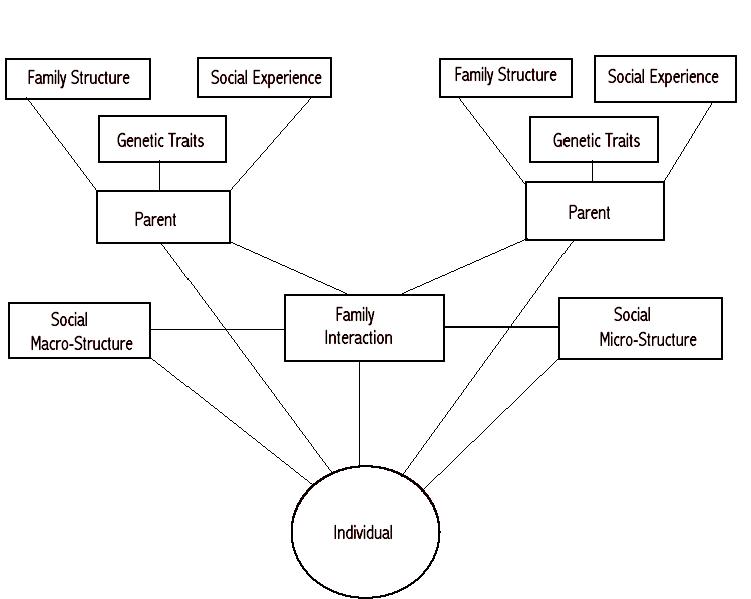
Figure 1
Method
Subjects
200 families with at least one child aged 8 -
18 will be recruited through public
announcement. A goal in
recruitment would be to have nearly an equal number of male and
female children in the study although disproportions would not
represent a severe detriment. Some
requirements for participation would be that families would need be U.S.
citizens (as major cultural variables are hoped to be excluded), who can speak
English (ease of administration). Also,
for families in which the children are not the biological offspring of the
participating parents, the biological parents must be able to be contacted and
participate as well.
Measures
The measures for this study will be numerous
as an in depth study of the development of aggression is the goal. A majority of information will be obtained
strictly from administered questionnaires, with additional information being
gathered through medical and school records, and medical tests. In order to obtain information about
parental development (or Generation III (G3) information as it will hence be referred
to) questionnaires will be administered to parents which cover events occurring
in their family of origin (as done by Doumas et al, 1994). These questionnaires will consist of an
inventory containing questions about child abuse and marital aggression in the
family of origin including: how often they were physically/verbally abused as a
child and how often there was physical/verbal abuse between their parents.
In order to obtain information about the
marital relationship in the current family (Generation II), several measures
will be utilized. Again, as used by
Doumas et al (1994), the Domestic Conflict Index will be administered to
measure conflict style in the family.
The DCI contains a combination of five subscales: Verbal aggression,
Physical aggression, Cruel, Damage possessions, and Humiliate/Ridicule/Isolate
(Doumas et al, 1984). Following
Doumas, the DCI would be administered once as a measure of one’s own behavior
and once as a measure of one’s partner.
Score from the two would be combined and averaged to yield a score for
each spouse. To measure discipline
style, the Child Abuse Potential Inventory (CAP, Milner, 1986) would be
administered. The CAP abuse scale
discriminates between a number of different maltreating and comparison groups
and elevated CAP abuse scores are significantly related to later physical and
child abuse (Doumas et al, 1984).
In addition, parents would complete the CED-S (Radloff, 1977) which is a
screening measure for depressive symptoms (Campbell et al, 1991). The Dyadic Adjustment Scale (DAS, Spanier,
1976) is a reliable and widely used measure of marital satisfaction. In this study the DAS would serve as an
additional tool for measuring family interaction within the home. Lastly, the Life Experiences Survey (LES,
Sarason, Johnson & Siegel, 1978), a measure of stressful life events
(Campell et al, 1991) would be used as a support measure of social
influence upon family interaction.
The measure of aggression of the children
will be assessed through the use of the Child Hostility Inventory (Parent
version) (CHIP; Kazdin et al, 1987) and the Child Behavior Checklist
(CBC; Achenbach and Edelbrock, 1983).
The CHIP, a 38-item inventory, provides an overall aggression score
which is defined by three subscales: assault, indirect hostility, and verbal
aggression. The CBC is a 118-item
inventory used to measure parents reports of child behavior problems. The CBC yields two broad-band groupings of
scores, as well as 9 behavior problem subscales (Doumas et al, 1984).
As mentioned earlier, various medical tests
will be conducted in an effort to determine biological variables. A blood test will be administered to all
participants, screening for hormone levels as well as possible drug and alcohol
use. A CAT scat and PET scan would also
be administered to all participants to study the possibility of brain function
as a biological determinant of aggressive behavior, paying particular attention
to frontal lobe and hippocampus activity.
Scales would need to be constructed to facilitate analysis with scores
obtained in the above questionnaires.
One possibility would be to construct 7-point Likert scales for level of
brain functioning as evidenced through these medical tests, where 1 would be
extremely poor functioning and 7 nearly perfect functioning. In support of these measures, the SOP and
CAT tests (Giancola & Zeichner, 1994) would be administered to subjects to
measure frontal lobe functioning. Lastly,
the WAIS-R would be used in a similar manner as by Giancola & Zeichner, to
measure intelligence and to control for the possibility that behavior is not
more a function of intelligence than frontal lobe functioning.
Lastly, a group of questionnaires would be
administered to obtain a variety of background information. Such information would include: Place of
birth, place of residence during childhood, size of family, age, gender,
schools attended, major life events, etc.
Results
This section to be included April 1, 2170.
Discussion
The results of the present study are expected
to lend support to the proposed model.
That is, that numerous biological and social factors should be
identified. Once identified, these
factors should lend themselves to association not only between themselves and
aggressive behavior but also between factors and other variables. The first order of business would most
likely be to conduct a correlational analysis of all observed measures. From this correlational analysis a picture
would begin to present itself as to the major factors contributing to the
occurrence of aggression. Having chosen
the most significantly correlated factors, a regression analysis would need to
be conducted in order to achieve a portrait of the possible process(es) by
which aggression seems to develop.
ANCOVA analysis would be conducted to account for the fact we believe
that there is a high amount of variable interaction occurring.
Again, we would hope to find that the
regression equations obtained lend support to the hypothesized model. We would expect to see high correlation
coefficients and beta scores between G3 and G2 measures of aggression. We would hope that measures of aggression
such as verbal and physical abuse of G3, witnessed by G2 would correlate
significantly with aggression of G2. We
would also expect that measures of social factors and social experience of G2
would correlate with aggression of G2.
Genetic and physical abnormality factors should also correlate
significantly with aggression in both G2 and G1, so that physical abnormality
in parents correlated with aggression in parents and physical abnormality in
children correlated with aggression in children.
Therefore, the overall scores and
associations we would hope to see may come to resemble a grouping such as the
following:
Family Structure Factors
G3 __
Verbal/physical
abuse scores (spouse) |
High correlation
Family size |------------------------>Parental (G2) aggression scores
Verbal/physical
abuse scores (child) __|
Social Experience
Factors
__
Life Experiences
Scale (G2) | High correlation
Major life events
measures (G2)
|------------------------>Parental (G2)aggression scores
Place of birth,
place lived during |
childhood, schools
attended, etc (G2)__|
Genetic Factors
__
CAT/PET scan
measures (G3)
| High correlation
Blood screen
measures (hormone levels) (G3)
|--------------------> Genetic factor measures (G2)
SOP, CAT task
scores __|
Family
Interaction
__
DCI scores | High correlation
CAP scores
|----------------------------------------> Parental (G2) aggression
DAS scores |
CES-D scores_|
Influence Upon
Child
__
Parental (G2)
aggression measures |
High correlation
Family interaction
measures |-------------------------------> Child
(G1) aggression
Social factor scores
(TV watched, |
schools attended,
place of residence, etc)__|
In conclusion, the proposed model consists of
a number of factors including both innate and external or social. It is hypothesized that there should be a
high correlation between both genetic and social measures across
generations. These findings would
support the belief that aggression is influenced both by a predisposition and
external stimuli which are in constant interaction. This observation of this interaction effect lays waste to the
contention that the development of aggression can be adequately understood
through study in a single discipline.
In order to achieve a true understanding of how aggression becomes
socialized in the individual we must recognize the multitude of factors which a
bearing down upon the child at any point and time. No one field holds a monopoly upon the “truth” about aggression
and we must bear this in mind in our research.
Future studies should attempt to reconcile the multitude of theories
which have been represented here.
View the bibliography