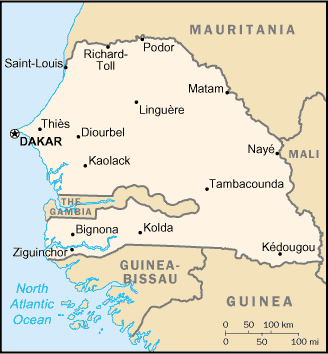
A map of Senegal. Thies is close to Dakar. During stage, Senegal seemed rather undeveloped, but in Guinea, it seemed leaps and bounds ahead. Afterall, they had ice cream.
While our official Peace Corps experience started in Philadelphia with ice-breakers and vaccinations, the true adventure started in Senegal. In true African fashion, the Air Afrique plane had not yet arrived when we turned up at the airport and we were obliged to spend another night in New York. But after that one last round of American food and telephone calls to our family, we finally boarded the plane, whose overhead bins had to be taped shut with duct tape, and arrived at Dakar around midnight. We were greeted by the very enthusiastic trainers and shuttled back to the training center in 'alhamdoulilayes', as we called the Senegalese buses. All I remember from that trip is that there were fires along the road. Once at the center, we were fed, assigned to rooms, and I entered into the world of mosquito nets and squishy foam mattresses for the first time.
About an hour after falling asleep, I woke up to the sound of my alarm clock going off in my still locked duffel bag. Not wanting to wake up my room-mates, I groped around in the dark for my keys and tried to open the bag. Not surprisingly, I wasn't successful and one of the Senegalese trainers got up and turned on the light, while I tried to explain in French what I was doing. I finally found the alarm clock, pulled it out and turned off the alarm, but it kept on beeping. I stared, perplexed, convinced that my clock had been possessed by the devil, until I remembered that I had two clocks, and the other one was beeping. Clock found, I solved the problem and went back to bed. And then the next morning, training commenced.
We trained in Thies, Senegal for three months. On our third day, we were sent off with our host families - the part of training that I had been dreading. My family lived close to the center, so rather than wait for a taxi, my host-mother decided we should just walk back. Nene, my sister, took my smaller suitcase, while my mother and I each grabbed a handle of my duffel bag. After a few minutes, she decided it would just be easier to carry the bag on her head. The first thing we did once we got to the house was to sit on the mats and then my family named me. They'd had seven trainees before me, so they were starting to run short on names. And thus, I became Aminata Niang, and later, Aminata Magassouba, when I moved to Guinea. Niang is a Serer last name and my family was very proud that they were Serer. In particular, this meant that we ate more millet than rice. The Serer are also shape-shifters and my brother, Lamine, assured me that he was part snake, which is why he had no fear of them. Living with a host-family was definitely an intense experience. I alternated between loving and hating them. I felt like I could never live up to Juma, the previous trainee, who was out-going and talkative and played soccer with the neighbourhood children. But still, they looked out for me and ultimately, provided me with a good introduction to West African culture. I miss the nights that we spent out on the streets with the neighbours when the electricity went out. The moon shone down on the mosque and everything seemed peaceful and beautiful.
This is the family that I stayed with while I was there.
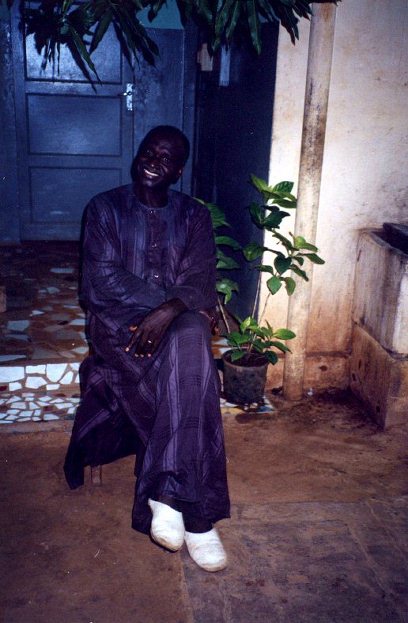
My host-father, Abdou Niang. Sometimes he did the call to prayer at the mosque across the street from our house. While very beautiful, it was also very loud at five in the morning. Additionally, every morning, he pounded on the door of the room next to mine to wake up my brothers to go and pray.
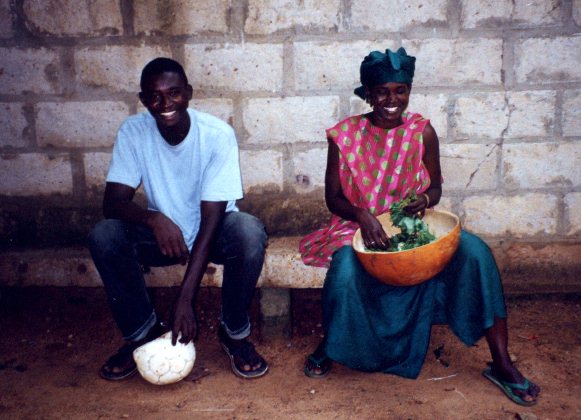
My host-brother, Lamine, and host-mother, Fatou. Fatou is cleaning bissap leaves to go with our dinner. Yummy. She is a really good cook and generally, a funny woman. I have a vivid memory of an evening we spent sitting out on the maps, as was the norm. Fatou was telling me about Senegalese food. She started listing the different kinds of Yassas there were: Yassa poulet (Yassa chicken), Yassa poisson (fish), and then, instead of saying Yassa mouton (sheep), she said Yassa baa. She thought this was so funny that she kept on repeating it, baaing like a sheep. She was a snack lady and made delicious sugared peanuts, fataya (delicious deep-fried fish dumplings) and popcorn, which, she told me, was a special Senegalese treat.
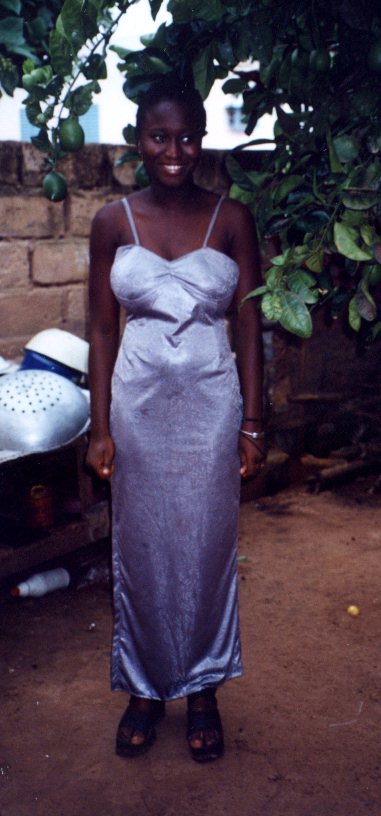
One of my host-sisters, Mama. She changed for the picture, which is a shame, because I thought her other dress was prettier.
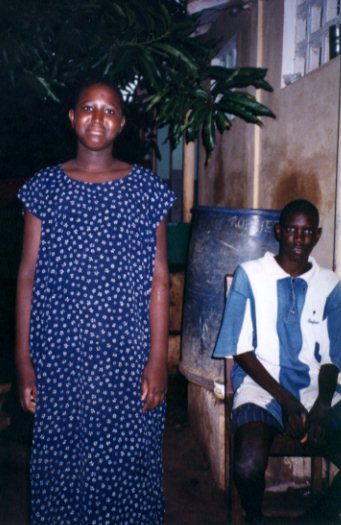
Another host-sister, Aissatou, and the cousin whose name I never learned how to spell. Everyone always teased Aissatou, primarily because she made a good victim and whined. I spent a lot of time with Aissatou - playing cards with her or helping her wash the dishes. She also liked to play with my hair.
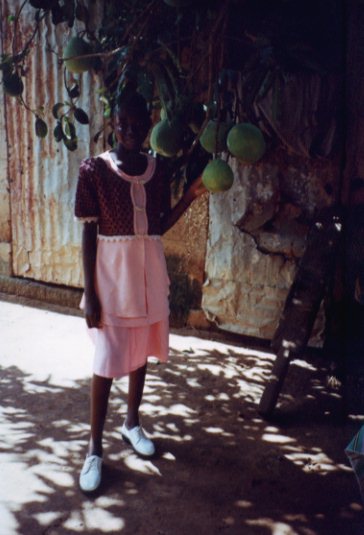
Nene underneath the pamplemousse tree. The grapefruit from this tree was delightfully sweet and my family was quite proud of it. My only complaint was that I regularly hit my head on the grapefruit while walking in and out of the compound. Nene was dressed up to go and visit her aunt.
I never got a picture of my other host-brother, Pape, who also went by Samba. This is the family that named me Aminata, which remained my name for the next two years. Fortunately, I really like the name. I was very worried they would name me Binta.