he meal is
potluck, or as we like to say, "pot-providence." Everyone brings
something to share with everyone else. When the weather is nice, all the
food is placed on a long folding table out in the carport. A smaller
card table at one end of the long table contains drinks, cups, forks,
napkins, etc. A chest full of ice sits on the floor beside the card
table. Kids run wildly around having so much fun that they must be
collared by parents and forced to eat something. After a prayer of
thanksgiving is offered, people line up, talking and laughing, to serve
their plates. In the middle of all the food sits a single loaf of bread
next to a large plastic jug containing the fruit of the vine. Each
believer partakes of the bread and juice while going through the serving
line. The smaller kids are encouraged to occupy one of the few places at
a table to eat. (They sure can be messy!) Chairs for adults (there are
not enough for everyone) are clustered in circles, mainly occupied by
the womenfolk, who eat while discussing home schooling, child training,
sewing, an upcoming church social, the new church we hope to start, etc.
Most of the men stand to eat, balancing their plates on top of their
cups, grouped into small clusters and solving the world�s problems or
pondering some hot topic of theology. The atmosphere is not unlike that
of a wedding banquet. It is a great time of fellowship, encouragement,
edification, friendship, caring, catching-up, getting to know, praying
with, exhorting, and maturing. The reason for the event? In case you did
not recognize it, this is the Lord�s Supper, New Testament style!
Foreign though it may seem to the contemporary church,
the first century church enjoyed the Lord�s Supper as a banquet that
foreshadowed the marriage supper of the Lamb. It was not until after the
close of the New Testament era that the early church fathers altered the
Lord�s Supper from its pristine form into a memorial service. We
advocate a return to the way of Christ and His apostles.
The Form & Focus of the Lord's
Supper: A Feast & The Future
The very first Lord�s Supper is also called the Last
Supper, because it was the last meal Jesus shared with his disciples
before His crucifixion. The occasion for the meal was the Passover. At
this Passover Feast, Jesus and His disciples reclined at a table heaped
with food (Ex 12, De 16). Jewish tradition tells us that this meal
typically lasted for hours. During the course of the meal, "while they
were eating" (Mt 26:26), Jesus took a loaf bread and compared it to his
body. He had already taken up a cup and had them all drink from it.
Later, "after the supper" (Lk 22:20), Jesus took the cup again and
compared it to his blood, which was soon to be poured out. Thus, the
bread and wine of the Lord�s Supper were introduced in the context of a
full meal (the Passover). Would the Twelve have somehow deduced that the
newly instituted Lord�s Supper was not to be a true meal? Or would they
naturally have assumed it to be a feast, just like the Passover?
"The Passover celebrated two events, the deliverance
from Egypt and the anticipated coming Messianic deliverance" (Reinecker,
Linguistic Key to the Greek NT, p. 207). Soon after that Last
Supper, Jesus became the ultimate sacrificial Passover Lamb, suffering
on the cross to deliver His people from their sins. Jesus keenly desired
to eat that Passover with His disciples, saying that He would "not eat
it again until it finds fulfillment in the kingdom of God" (Lk 22:16).
Note that Jesus looked forward to a time when He could "eat" the
Passover "again" in the kingdom of God. The "fulfillment" (Lk 22:16) of
this evidently was later written about by John in Re 19:7-9. There, an
angel declared, "Blessed are those who are invited to the wedding supper
of the Lamb!" The Last Supper and the early church�s Lord�s Suppers all
looked forward to a fulfillment in the wedding supper of the Lamb. (And
what better way to typify a banquet than with a banquet?)
His future wedding banquet was much on our Lord�s mind
that night. He mentioned it first at the beginning of the Passover feast
(Lk 22:16). He mentioned it again when passing the cup, saying, "I will
not drink again of the fruit of the vine until the kingdom of God comes"
(Lk 22:18). Then, after the supper, He referred to it yet again, saying,
"I confer on you a kingdom . . . so that you may eat and drink at my
table in my kingdom . . ." (Lk 22:29-30).
Whereas twenty-first century Gentiles associate heaven
with clouds and harps, first century Jews thought of heaven as a time of
feasting at Messiah�s table. This idea of eating and drinking at the
Messiah�s table was common imagery in Jewish thought of the first
century. For instance, a Jewish leader once said to Jesus, "Blessed is
the man who will eat at the feast in the kingdom of God" (Lk 14:15). In
Mt 8:11 Jesus Himself said that "many will come from the east and the
west, and will take their places at the feast with Abraham, Isaac and
Jacob in the kingdom of heaven."
The eating that is associated with the coming of
Christ�s kingdom is even seen in the model prayer of Mt 6:9-11. In
reference to the kingdom, Jesus taught us to pray, "your kingdom come,
your will be done." The very next sentence is "Give us today our daily
bread." Interestingly, the Greek underlying Mt 6:11 is difficult to
translate. Literally, it reads something akin to, "the bread of us
belonging to the coming day give us today." Linking 6:11 with 6:10,
Jesus may well have been teaching us to ask that the bread of the
Messianic (kingdom come) banquet be given to us today. I.e., let the
kingdom come and the feast begin today!
The most extensive treatment of the Lord�s Supper is
found in 1 Corinthians 10 - 11. The deep divisions of the Corinthian
believers resulted in their Lord�s Supper meetings doing more harm than
good (11:17-18). They were partaking of the Supper in a "unworthy
manner" (11:27). Evidently the rich, not wanting to eat with the lower
social classes, came to the meeting so early and remained there so long
that some became drunk. Making matters worse, by the time that the
working class believers arrived, delayed by employment constraints, all
the food was gone and they went home hungry (11:21-22). Some of the
Corinthians failed to recognize that the Supper as a sacred, covenant
meal (11:23-32). The abuses were so bad that it had ceased being the
Lord�s Supper and had instead become their "own" supper (11:21, NASV).
Thus Paul asked, "Don�t you have homes to eat and drink in?" If merely
eating ones own supper were the objective, private dining at home would
do. Their sinful selfishness absolutely betrayed the very essence of
what the Lord�s Supper is all about.
From the nature of their abuse of the supper, it is
evident that the Corinthian church regularly partook of the Lord�s
Supper as a true meal. In contrast, no one today would ever come to a
typical Lord�s Supper service expecting to have physical hunger
satisfied, nor could they possibly get drunk from drinking a thimble
sized cup of wine (or much less, grape juice). However, the inspired
solution to the Corinthian abuse of the Supper was not that the church
cease eating it as a full meal. Instead, Paul wrote, "when you come
together to eat, wait for each other." Only those so famished or
undisciplined or selfish that they could not wait for the others are
instructed to "eat at home" (1Co 11:34). Paul wrote to the Corinthian
church some twenty years after Jesus first turned His Last Supper into
our Lord�s Supper. Just as the Last Supper was a true meal, so too the
Corinthians understood the Lord�s Supper to be a true meal.
Further, the word behind "supper" (1Co 11:20) is
deipnon, which means "dinner, the main meal toward evening,
banquet." It never refers to anything less than a true meal, such as an
appetizer, snack or hors d�oeuvres. How likely is it that the
authors of the NT would use deipnon to refer to the Lord�s
"Supper" if it were not supposed to be a true meal? The Lord�s Supper
originally had numerous forward looking aspects to it. As a full meal,
it prefigured the feast of the coming kingdom, the marriage supper of
the Lamb.
The opinion of scholars is clearly weighted toward the
conclusion that the Lord�s Supper was originally eaten as a full meal.
Donald Guthrie, in The Lion Handbook of the Bible, states that
"in the early days the Lord�s Supper took place in the course of a
communal meal. All brought what food they could and it was shared
together." Dr John Drane, in The New Lion Encyclopedia, commented
that "Jesus instituted this common meal at Passover time, at the last
supper shared with His disciples before His death . . . the Lord�s
Supper looks back to the death of Jesus, and it looks forward to the
time when He will come back again. Throughout the New Testament period
the Lord�s Supper was an actual meal shared in the homes of Christians.
It was only much later that the Lord�s Supper was moved to a special
building and Christian prayers and praises that had developed from the
synagogue services and other sources were added to create a grand
ceremony." J. G. Simpson, in an entry about the Eucharist in The
Dictionary of the Bible, observed that "the name Lord�s Supper,
though legitimately derived from 1 Corinthians 11:20, is not there
applied to the sacrament itself, but to the Love Feast or Agape, a meal
commemorating the Last Supper, and not yet separated from the Eucharist
when St. Paul wrote." Canon Leon Morris, in his Commentary on 1
Corinthians for the Tyndale New Testament Commentaries
insists that 1Co 11 "reveals that at Corinth the Holy Communion was not
simply a token meal as with us, but an actual meal. Moreover it seems
clear that it was a meal to which each of the participants brought
food." I Howard Marshall, in Christian Beliefs noted that the
Lord�s Supper "was observed by His disciples, at first as part of a
communal meal, Sunday by Sunday."
The Functions of the Lord's
Supper: A. Reminding Jesus
Partaking of the bread and cup as an integral part of
the meal originally served several important functions. One of these was
to remind Jesus of His promise to return. "Reminding" God of His
covenant promises is a thoroughly Scriptural concept. In the covenant
God made with Noah, He promised never to destroy the earth by flood
again, signified by the rainbow. That sign is certainly designed to
remind us of God�s promise, but God also declared, "whenever the rainbow
appears in the clouds, I will see it and remember the everlasting
covenant between God and all living creatures of every kind on the
earth" (Ge 9:16 ). Later on in redemptive history, as a part of His
covenant with Abraham, God promised to bring the Israelites out of their
coming Egyptian bondage. Accordingly, at the appointed time, "God heard
their groaning and he remembered his covenant with Abraham, with Isaac
and with jacob. So God looked on the Israelites and was concerned about
them" (Ex 2:24-25). And during the Babylonian captivity, Ezekiel,
records that God promised Jerusalem that He would "remember the covenant
I made with you" (Ez 16:60).
The Lord�s Supper is the sign of the new covenant. As
Jesus took the cup He said, "this is my blood of the covenant, which is
poured out for many for the forgiveness of sins" (Mt 26:28). As with any
sign, it is to serve as a reminder. Thus Jesus said that we are to
partake of the bread "in remembrance of me" (Lk 22:19). The Greek for
"remembrance" is anamnesis and means "reminder." Literally
translated, Jesus said, "do this unto my reminder." The issue before us
is whether that reminder is to be primarily for Jesus� benefit or for
ours. The prepositional phrase "of me" (or "my") is translated from the
single Greek word, emos, which grammatically denotes possession
(i.e., the reminder belongs to Jesus). Thus, the church was to partake
of the bread of the Lord�s Supper specifically to remind Jesus of His
promise to return and eat the Supper again, in person (Lk 22:16, 18).
Understood in this light, it was originally designed to be like a prayer
asking Jesus to return ("Thy kingdom come", Mt 6:11). Just as the
rainbow reminds God of His covenant with Noah, just like the groaning
reminded God of His covenant with Abraham, so too partaking of the bread
of the Lord�s Supper was designed to remind Jesus of His promise to
return. Colin Brown quotes J. Jeremias as understanding Jesus to use
anamnesis in the sense of a reminder for God, "The Lord�s Supper
would thus be an enacted prayer" (NIDNTT, III, p. 244).
Paul, in 1Co 11:26 confirms this idea by stating that
the early church, in eating the Lord�s Supper, did actually "proclaim
the Lord�s death until He comes." To whom did they proclaim His death,
and why? Arguably, they proclaimed it to the Lord Himself, as a reminder
for Him to return. It is significant that the Greek behind "until" is
achri hou. When used with the subjuctive, it grammatically can
denote a goal, or an objective (Reinecker, Linguistic Key To The
Greek NT, p. 34). According to the English usage, I may use an
umbrella "until" it stops raining, merely denoting a time frame. (Using
the umbrella has nothing to do with making it stop raining.) However,
this is not how the Greek behind "until� is used in 1Co 11:26. Paul
instructed the church to partake of the bread and cup as a means of
proclaiming the Lord�s death (as a reminder) "until" (so that, with the
goal of) persuading Him to come! Thus, in proclaiming His death through
the loaf and cup, the Supper looked forward to and anticipated His
return.
This idea of seeking to persuade the Lord to return is
not unlike the plea of the martyred saints of Re 6 who called out, "How
long, Sovereign Lord, holy and true, until you judge the inhabitants of
the earth and avenge our blood?" (Re 6:10). And what did Peter have in
mind when he wrote that his readers should look forward to the day of
God and "speed its coming?" (2Pe 3:12). If it was futile to seek to
persuade Jesus to return, then why did Jesus instruct his disciples to
pray, "Thy kingdom come, Thy will be done?" (Mt 6:10).
The Functions of the Lord's
Supper: B. Creating Unity
All this emphasis on the Supper as a true meal is not
to say that we should jettison the loaf and cup, representative of the
body and blood of our Lord. To the contrary, they remain a vital part of
the Supper (1Co 11:23-26). But just as the form of the Lord�s Supper is
important (a full fellowship meal that prefigured the wedding banquet of
the Lamb), so too the form of the bread and cup are important. Paul made
mention of "the" cup of thanksgiving and of the "one loaf" (1Co
10:16-17). The significance of using but one cup and one loaf in the
Supper is "because there is one loaf, we who are many, are one body, for
we all partake of the one loaf" (1Co 10:16-17). The one loaf not only
pictures our unity in Christ, but according to 1Co 10:17 even creates
unity. Notice careful the wording of the inspired text. "Because" there
is one loaf, therefore we are one body, "for" we all partake of the one
loaf (1Co 10:17). Partaking of a pile of broken cracker crumbs and
multiple cups of the fruit of the wine is a picture of disunity,
division, and individuality. At the very least, it completely misses the
imagery of unity. At worse, it would prohibit the Lord from using the
one loaf to create unity in a body of believers.
The Functions of the Lord's
Supper: C. Fellowship
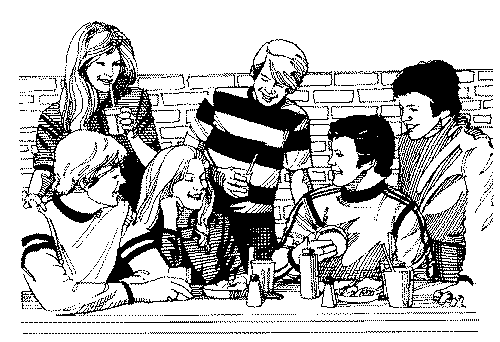 In speaking to the church at Laodicea,
our resurrected Lord offered to come in and "eat" (deipneo) with
anyone who hears His voice and opens the door, a picture of fellowship
and communion (Re 3:30). The idea that fellowship and acceptance is
epitomized by eating together was derived not only from the Hebrew
culture of Jesus� day, but also from the earliest Hebrew Scriptures. Ex
18:12 reveals that Jethro, Moses, Aaron, and all the elders of Israel
came to "eat bread" in the "presence of God." More divine dining
occurred at the cutting of the Sinai covenant, when Moses, Aaron, Nadab,
Abihu and the seventy elders of Israel when up on Mt Sinai where they
"saw God, and they ate and drank" (Ex 24:9-11). It is significant that
"God did not raise his hand against these leaders" (Ex 24:11a). They
were accepted by Him, as evidenced in the holy meal they ate in His
presence.
In speaking to the church at Laodicea,
our resurrected Lord offered to come in and "eat" (deipneo) with
anyone who hears His voice and opens the door, a picture of fellowship
and communion (Re 3:30). The idea that fellowship and acceptance is
epitomized by eating together was derived not only from the Hebrew
culture of Jesus� day, but also from the earliest Hebrew Scriptures. Ex
18:12 reveals that Jethro, Moses, Aaron, and all the elders of Israel
came to "eat bread" in the "presence of God." More divine dining
occurred at the cutting of the Sinai covenant, when Moses, Aaron, Nadab,
Abihu and the seventy elders of Israel when up on Mt Sinai where they
"saw God, and they ate and drank" (Ex 24:9-11). It is significant that
"God did not raise his hand against these leaders" (Ex 24:11a). They
were accepted by Him, as evidenced in the holy meal they ate in His
presence.
This fellowship in feasting theme is continued on in
the book of Acts, where we learn that the early church devoted
themselves to "fellowship in the breaking of bread" (2:42, literal
translation). In your English version, notice that in Ac 2:42 there is
an "and" between "teaching" and "fellowship," and between "bread" and
"prayer," but not between "fellowship" and "bread." In the Greek, the
words "fellowship" and "breaking of bread" are linked together as
simultaneous activities. They had fellowship with one another as they
broke bread together. Luke further informs us that this eating was done
with "glad and sincere hearts" (2:26). Sounds inviting, doesn�t it? Many
commentaries associate the phrase, "breaking of bread" throughout the
books of Acts with the Lord�s Supper. This is because Luke, who wrote
Acts, recorded in his gospel that Jesus took bread and "broke it" at the
last supper (22:19). If this conclusion is accurate, then early church
enjoyed the Lord�s Supper as a time of fellowship and gladness, just
like one would enjoy at a wedding party.
The Frequency of the Lord's Supper: Weekly
We have thus seen the original form (a full fellowship
meal with one cup and one loaf) and focus (forward looking) of the
Lord�s Supper. One final and important aspect needs to be considered:
its frequency. How often did the New Testament church partake of the
Supper? The Roman Catholics have it right on this point. Early believers
ate the Lord�s Supper weekly, and it was the main purpose for their
coming together each Lord�s Day.
The first evidence for this is grammatical. The
technical term, "Lord�s Day" is from a unique phrase in the Greek,
kuriakon hemeran, which literally reads, "the day belonging to the
Lord." The words "belonging to the Lord" are from kuriakos, which
occurs in the NT only in Re 1:10 and in 1Co 11:20, where Paul uses it to
refer to the "Lord�s Supper" or the "Supper belonging to the Lord"
(kuriakon deipnon). The connection between these two uses must
not be missed! If the purpose of the weekly church meeting is to observe
the Lord�s Supper, it only makes sense that this supper belonging
to the Lord would be eaten on the day belonging to the Lord (the
first day of the week). John�s revelation (Re 1:10) evidently thus
occurred on the first day of the week, the day in which Jesus rose from
the dead and the day on which the early church met to eat the Supper
belonging to the Lord. The resurrection and the day and the supper all
go together as a package deal!
Second, the only reason ever given in the New Testament
as to the regular purpose for a church meeting is to eat the Lord�s
Supper. In Ac 20:7, Luke informs us that, "On the first day of the week
we came together to break bread." The word "to" in Ac 20:7 is known as a
telic infinitive. It denotes a purpose or objective. Their meeting was a
meating! Another place in the NT that the purpose for a church gathering
is stated is found in 1Co 11:17-22. The "meetings" (11:17) were doing
more harm than good because when they came "together as a church"
(11:18a) they had divisions so deep that "when you come together, it is
not the Lord�s Supper you eat" (11:18b). From this is it obvious that
the primary reason for their church meetings was to eat the Lord�s
Supper. Sadly, their abuses of the Supper were so gross that it had
ceased being the Lord�s Supper, but officially they were gathering each
week to celebrate the Supper. The third and last location of a reference
to the reason for an assembly is found in 1Co 11:33, "when you come
together to eat, wait for each other." As before, it shows that the
reason they came together was to "eat." Lest this appear to be making a
mountain out of a mole hill, it must be realized that no other reason is
ever given in the Scriptures as to the purpose of a regular, weekly
church meeting.
The fellowship and encouragement that each member
enjoys in such a gathering is tremendous. It is the Christian equivalent
of the neighborhood bar. It is the true happy meal or happy hour. It is
a time that God uses to create unity in a body of believers. This aspect
of the church�s meeting should not be rushed or replaced. Certainly it
is appropriate to also have a 1Co 14 phase of the gathering (an
interactive time of teaching, worship, singing, testimony, prayers,
etc.), but not at the expense of the weekly Lord�s Supper.
Practical
Considerations
Practicing the Lord�s Supper as a full meal today is
can be a means of great blessing to the church. Here are some practical
considerations concerning the "how to"s of implementing it.
Attitude: Be sure the church understands that the
Lord�s Supper is the main purpose for the weekly gathering. It is
neither optional nor secondary to some type of "worship service". Even
if a church only has the Lord�s Supper one week, it has fulfilled its
primary reason for having a meeting that week.
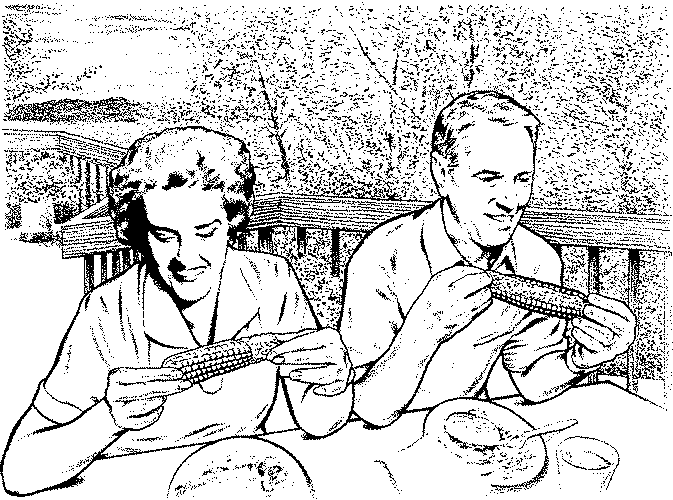 Food: If at all possible, make the
meal potluck and purpose to eat whatever it brought. This makes the
administration of the food much easier. Trust God�s sovereignty! In ten
years of doing this, our church only had one Sunday where everyone
brought desserts, and even then we solved the "problem" by simply
ordering out for pizza! Over-planning the meal can take a lot of the fun
out and make it burdensome. The one thing that is pre-planned is who
supplies the one loaf and the fruit of the vine. The family that is
hosting the meeting always supplies the bread and cup for our
church.
Food: If at all possible, make the
meal potluck and purpose to eat whatever it brought. This makes the
administration of the food much easier. Trust God�s sovereignty! In ten
years of doing this, our church only had one Sunday where everyone
brought desserts, and even then we solved the "problem" by simply
ordering out for pizza! Over-planning the meal can take a lot of the fun
out and make it burdensome. The one thing that is pre-planned is who
supplies the one loaf and the fruit of the vine. The family that is
hosting the meeting always supplies the bread and cup for our
church.
Giving: Since celebrating the meal is a New
Testament pattern and something important to the life of a properly
functioning church, money spent by individual families on food to bring
is a legitimate giving expense. Rather than merely dropping an offering
in a plate each week, go to the grocery store and buy the best food you
can afford. Bring it to the Supper as a sacrificial offering!
Clean Up: To facilitate clean up, you may want to
consider using paper plates and napkins. At our church we do use plastic
forks and cups, which need to be washed, but that is because folks
sometimes carelessly throw away their utensils along with the rest of
their trash. Better to throw away a plastic fork than a metal one! To
help avoid spills, the host family supplies wicker plate holders each
week, which can be reused and don�t usually need to be washed.
Logistics: In warm weather it may be appropriate to
eat outside, in the shade of a carport or backyard. Spilled food and
drink is inevitable, and clean up is much easier outside. A large
folding table can be placed where necessary and stored away after the
meeting. In cold weather, when eating indoors is necessary, consider
covering any nicely upholstered furniture with a layer of plastic and
then cloth. Since children make the most mess, reserve any available
seating at a table for them and insist they use it!
The Cup and Loaf: Some have found that taking the
cup and loaf prior to the meal separates it from the meal too much as a
separate act. It is as if the Lord�s Supper is the cup and loaf, and
everything else is just lunch. To overcome this false dichotomy, try
placing the cup and loaf on the table with the rest of the food of the
Lord�s Supper. The cup and loaf can be pointed out in advance of the
meeting and mentioned in the prayer prior to the meal, but then placed
on the buffet table with everything else. This way, folks can partake of
it as they pass through the serving line. This is a freedom
issue.
Should the loaf be unleavened and the fruit of the
vine alcoholic? The Jews ate unleavened bread in the Passover meal to
symbolize the quickness with which God brought them out of Egypt.
Certainly Jesus used unleavened bread in the original Last Supper.
However, nothing is said in the NT about Gentile churches using
unleavened bread in the Lord�s Supper. Though sometimes in the NT yeast
is associated with evil (1Co 5:6-8), it is also used to represent God�s
kingdom (Mt 13:33)! As we see it, it is a matter of freedom. As related
to wine, it is clear from 1Co 11 that wine was used in the Lord�s Supper
(some became drunk). However, no clear theological reason is ever given
in Scripture for so doing (but consider Ge 27:28, Isa 25:6-9, Ro 14:21).
As with the unleavened bread, it is a freedom issue.
Unbelievers: Should unbelievers be allowed to
partake of the Lord�s Supper? The Lord�s Supper, as a sacred, covenant
meal, has significance only to believers. To nonbelievers, it is merely
food for the belly! It is clear from 1Co 14:23-25 that unbelievers will
occasionally attend church meetings. Unbelievers get hungry just like
believers do, so invite them to eat too. Love them to Jesus! The danger
in taking the Lord�s Supper in an unworthy manner applies only to
believers (1Co 11:27-32).
Regarding the one cup and loaf, if an unbelieving
child desires to drink the grape juice just because he likes grape
juice, that is fine. However, if the parents purposely give it to an
unbelieving child as a religious act, then that would be a violation of
what the Lord�s Supper is all about. It would be closely akin to the
error of infant baptism.
Ordained Clergy: Some traditional churches feel
that only an ordained clergyman can officiate at the Lord�s table. This
is evidently a holdover from Roman Catholicism. The New Testament makes
no so such requirements.
Conclusion
Now that the New Testament form of the Supper has been
duly established, the next question facing believers today concerns our
Lord�s intent for post-first century churches. Does Jesus desire for His
people to celebrate the Lord�s Supper in the same way it was eaten in
the New Testament? Or could it be a matter of indifference to Him? Do we
have the freedom to deviate from the Supper�s original form as a true
banquet? Why would anyone want to depart from the way Christ and His
apostles practiced the Lord�s Supper? The apostles plainly were pleased
when churches held to their traditions (1Co 11:2) and even commanded
that they do so (2Th 2:15). We have no authorization to deviate from
it.
To summarize all that has been posited, the Lord�s
Supper is the primary purpose for which the church is to gather each
Lord�s Day. Eaten as a full meal, the Supper typifies the wedding supper
of the Lamb and is thus forward-looking. It is to be partaken of as a
feast, in a joyful, wedding atmosphere rather than in a somber, funeral
atmosphere. A major benefit of the Supper as a banquet is the fellowship
and encouragement each member experiences. Within the context of this
full meal, there is to be one cup and one loaf from which all partake.
These are symbolic of Jesus� body and blood and serve to remind Jesus of
His promise to return. The one loaf is to be used not only to symbolize
the unity of a body of believers but also because God will use it to
create unity within a body of believers.
Revised 03/06/03