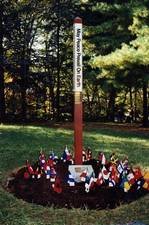
What are Peace Poles?
Peace Poles are hand crafted monuments erected the world
over as an international symbol of peace. Their purpose is to spread the
message:
"MAY PEACE PREVAIL ON
EARTH", and act as a constant reminder for us to visualize and pray for
world peace. Peace Poles act as a focal point for a community to come together
and talk about peace.
Peace Pole Origins:
Some regard peace poles as wooden obelisks.
Traditionally they are posts with four or six sides inscribed with the
words, "May Peace Prevail On Earth" in various
languages. Over 200,000 have been placed in 160 countries. It is a movement
that was started in 1955 in Japan (where there was a tradition of posts
adorned with vertical type) by Masahisa Goi and is carried on today by The
World Peace Prayer Society.
Other historical context:
Among the historical precedents for erecting
poles to make statements are the "Liberty Poles" of the Post-Revolutionary War
Period in the United States. In looking for a way to retire the new federal
government's war debt, Alexander Hamilton suggested a tax on whiskey.
On the frontier, settlers and livestock upstream made
water contamination a problem. Whiskey was disease-free and safe to drink. It
was not their only beverage, but was so important that it was used as
currency. Even ministers were paid in rye whiskey. Frontiersmen were poor and
did not see as much as twenty dollars in hard currency in a year. Taking some
of that with a tax on whiskey seemed to them like taxing breathing.
In response they erected "Liberty Poles" as statements
about wanting liberty from this incursion. George Washington marched over 7000
troops to face them and it is said that along the road there was a liberty
pole every four or five miles.
Incidentally, some think that this was the act that
established the sovereignty of federal government after the revolution.
Their Poles:
The odds are that their poles were round and made out of
green, not seasoned and sawed, timber. Working green wood was standard at the
time, and turning it to make it round was also. If it wasn't turned on a lathe
(for a couple of thousand years simple foot powered lathes had been made on
location in forests for turning green wood) then it probably was cleaned up
with a plane to make a respectable pole - something it would be interesting to
try for a peace pole if anyone ever requests it.
Japan:
If traveling in Japan, its not uncommon to see a stone post or
a wood post with text set on it vertically. Masahisa Goi brought the tradition
to the rest of the world with peace poles.
Peace Poles have been planted on sites that include the
tomb of 'Confucius' in China, the Pyramids of Giza, and the magnetic North
Pole in Canada.
