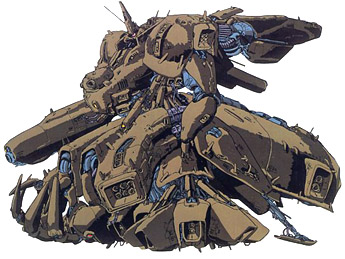
Judas

Expanding Field Gun x 1: This large, hand-held cannon fires a singular beam that can be altered to take on a cone like shape (with shorter range). While this does less damage, it is effective against large numbers of advancing foes. It is mounted on a specialized rack that allows it to be fired from a fixed position, or detached into the unit's hands.
Pyromach Missile x 4: These launchers are mounted around the mobile suit's body, and let loose a new warhead developed by the United Alliance. Upon contact with a target, these missiles will release a second, extremely precise explosion meant to pierce the surface area that it strikes. Then they release a third charge almost instantly after the second has gone through, sending a flourishing explosion into the newly opened wound. Each unit can fire a volley of six missiles at a time, and carries a total payload of thirty.
Gattling Vulcan Mount x 2: Mounted in the shoulders of this mammoth, these weapons are improved variations Uewings 100 mm machine guns. These chain guns have a faster cycling rate, however, enabling them to drill through most light targets in their path.
Judas is intended to be the United Alliance Armed Forces' ultimate alternative to the Grand Cross' mobile suits. Constructed at both the UAAF's Gibraltar manufacturing center and lunar research facilities, this mass of weaponry and heavily plated armor is built to last. Once dismissed as an uneconomical (and somewhat desperate) concept, it has been given new life thanks to the apparent failure of the Zodiac G project. Without a means to subvert the Grand Cross forces from within, the Alliance's military minds have decided to tackle it head-on, working with proven technology that they already have a keen understanding of. Now, despite their beleaguered state, the Earth's military has slowly started to roll out its first few units.
Arguably, Judas is neither a mobile walker nor a mobile suit, but an incredible hybrid of the two. Its arsenal is made almost exclusively of high-yield assault weapons, each able to deliver large amounts of damage over long distances. However, it still has some of the physical maneuverability of its smaller cousins. It cannot really walk, but it can rotate its upper body and move its arms with surprising agility. Its six arms, four conventional and two heavy claws, help it fend off foes at close range. A lack of fully articulated legs is offset by a complex network of verniers that give it hover and jumping capabilities.
Judas' mobility can be augmented with the addition of a large riding armor, which docks with the mobile weapon and locks it into place. Besides enhancing its ground speed, this option package also gives the machine low-level flying abilities, helping its girth defy gravity. Of course, size wouldn't be a problem if it weren't for the tremendous nuclear fusion core that powers this behemoth. Though not very large on its own, the additional safety equipment and internal shielding forced designers to increase the original prototype's size. If any future variations or modifications are made, this is likely the first element that they will try to improve on. Until then, all Judas units that roll off the assembly line have the burden of being larger than life.
Strategists have concluded that all Judas units, until they are in wider manufacture (which looks further and further away each day), are to be treated with the same distinction as regimental command machines or small battleships. Though it can be used by a single pilot, its cockpit has enough stations for a crew of four. A typical Alliance squadron is highly unlikely to have one amongst its ranks, as they are usually kept safe and sound until the fight comes to them. Some critics within the UAAF have cried foul at this, but there is little that they can do.