Ahzi
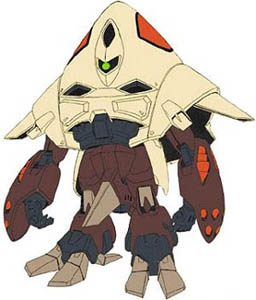

Hyper Vulcan x 3: Each of the forearms and the dorso fin of the Ahzi mount high caliber hyper vulcans that have a high cycling rate. These weapons fire heavy shells that explode over a surface, combining penetrating power with shear force. The forearm weapons can only be used in mobile suit mode, however, while the dorso gun is limited to use in transit mode.
Omni Rocket x 10: A new form of missile developed for use in multiple environments. It is as effective a torpedo as it is an airborne warhead, though its sophisticated propulsion system forces it to trade firepower for range, maneuverability, and versatility. Quite possibly the greatest benefit of the omni is its onboard sensor scrambler, which creates ghost signatures to baffle a anti-missile systems. These warheads can be launched in either mode from the mobile suit's large forearms.
Thus was pronounced the unflattering response of the Grand Cross' review board during their evaluation of the Tresdemo Foundation's Ahzi. Granted, aside from an ugly look, there really isn't much wrong with this mobile suit. In fact, simulation tests have shown that it is not only quite a capable addition to the colony army's ranks, but a welcome one where duty officers are concerned. Yet, it still seems to have met with only scorn and criticism from pilots. They've ignored the fact that it presents its fair share of technological breakthroughs; more than most of the Foundation's other recent designs. Instead, they focus on the faults, harboring a prejudice that had long been nurtured by the infamously problematic pre-prodution tests on the mobile suit.
 Despite these reactions, however, the Foundation pressed on in developing the
Ahzi. A trial run of the mobile suit included the deployment of a "limited
edition" model, which was meant to shakedown its concepts. At least ten of these
units were assigned to the Earth-based strike teams of General Phillip Kingsley.
Another half dozen were under the command of Grand Cross officer Daniel Age,
working out of Operae Pretium Est in the earlier days of the war. In both cases,
both the strengths and flaws of the original design were discovered, from
ammunition limitations to cockpit layout and even leakage. Ultimately, besides
the armaments, the entire body was radically redesigned to accommodate a better energy
battery and a more rapid transformation system, not to mention the traditional
Grand Cross mono-eye sensor.
Despite these reactions, however, the Foundation pressed on in developing the
Ahzi. A trial run of the mobile suit included the deployment of a "limited
edition" model, which was meant to shakedown its concepts. At least ten of these
units were assigned to the Earth-based strike teams of General Phillip Kingsley.
Another half dozen were under the command of Grand Cross officer Daniel Age,
working out of Operae Pretium Est in the earlier days of the war. In both cases,
both the strengths and flaws of the original design were discovered, from
ammunition limitations to cockpit layout and even leakage. Ultimately, besides
the armaments, the entire body was radically redesigned to accommodate a better energy
battery and a more rapid transformation system, not to mention the traditional
Grand Cross mono-eye sensor.
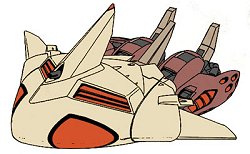
The Ahzi has been designed for the duel purpose of serving as both an aquatic strike unit and a space fighter; a complex requirement meant to keep the mobile suit from being marginalized or pigeon-holed for only very special duties. For the first task, it has been given a strengthened internal structure that allows it fend off the rigors of deep sea pressure. For helping the second, its armor has an ablative layer that allows it survive the intense heat of atmospheric re-entry. Modular propulsion pods allow technicians to equip it for either environment, swapping out a set of propeller turbines for conventional verniers and vice versa. This feature marked the creation of a new mission-custom design that was noted for future Grand Cross projects.
As both a ranged and melee combatant, the Ahzi is just above average; neither as strong as some specialized mass production models, nor as mediocre as the old Aeshma Prime. Its variable construction allows it to transform into a high speed transit mode, well suited as either a mini-sub or space fighter. Furthermore, the Ahzi uses a modified form of the current mobile suit electrical battery which allows for a special "low output" setting that staggers its power use. Though this confines the unit to its transit mode, at about half its normal speed, it stretches its energy lifespan to over twelve hours. All of these perks, however, are still overshadowed by the lingering curse that floats around the unfortunate Ahzi.