Aeshma Lycean
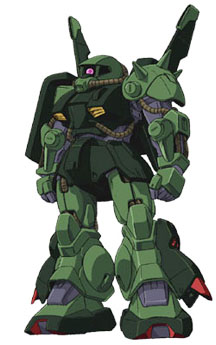

Shield Set x 1: Built into the mobile suit's right shoulder, one shield can actually be detached and held in one of its hands for added versatility. The second shield is smaller, and less durable, but is already clamped to one of the mobile suit's arms. Made of thick titanium alloy, either can withstand at least two or three direct hits before losing integrity.
Heat Hawk x 1: A short titanium axe that has been covered in ablative coating, this weapon carries a powerful thermal charge when activated. Added to the sharpness already present in the blade, it makes the hawk rather potent for such a small weapon.
Unable to be placed in immediate combat assignments, these mobile suits were allocated to Operae's engineering division, to serve as test beds for new design concepts. Stripping apart much of the original frame, one development team discovered that this unit's energy distribution network and myomer arrangement were perfect for an experimental propulsion system. The Active Balance Control (ABC) vernier used an independent onboard computer to constantly monitor, adjust, and regulate thrust output and myomer tension, keeping both at an ideal level. In effect, this gave the Lycean amazing balance despite its bulk, ensuring that, like a cat, it always lands on its feet.
Still, as impressive as it sounds, the ABC vernier was scrapped for further use on future mobile weapon projects. The cost of installation, along with the constant maintenance its secondary computer required, made it impractical for mass production. Grand Cross tacticians showed more interest, however, in Lycean's primary armament: a Beam Bayonet that replaces the heavy machinegun intended for the original Mark II. The power and versatility of this device helped ensure the unit's success in many combat operations and environments.
At first, only the five prototype Aeshma II's had been converted into the Lycean variant. Operating out of Operae Pretium Est, and later from different Chariot class vessels, these mobile suits proved quite a surprise for the unwary United Alliance, whose tacticians were amazed by the rapid progress of the Grand Cross' mobile suit program. Its variable assault capabilities made it a favorite for both sieges and close-range dueling. The Grand Cross' military high command has acknowledged this track record by approving the Lycean for full mass production.
These factory-made units are slightly different from the original prototypes. They have been equipped with a standard vernier assembly, as well as a stronger battery that allows them to maintain their top speed despite the weight of additional weaponry. A light shield has also been added to the mix, to offer improved defensive capabilities. Sporting a green paint scheme instead of the test-type's dark blue, the new Lycean looks much more like a successor to the Aeshma Prime. With the Vayu filling the Wing's atmospheric flight niche, it initially seemed destined to become the Grand Cross' new general purpose unit. However, the recent upgrades to the Prime and Wing, along with release of several new mobile suits, has dulled a little of the Lycean's lustre.
Cell Artwork by MS Gundam 3DCG