- Lycean II -
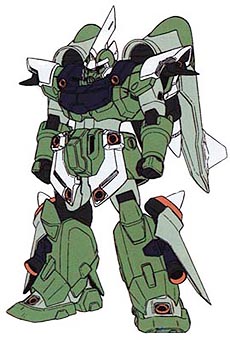
So what's all of this have to do with the GC's Lycean II? Well, this mobile suit represents an unprecedented development for the colony nation: it is the first machine produced that is still inferior to Earth's best. It is also, in part, an attempt to ammend a black mark made by one of the GC's most expensive technological failures, the Active Balance Control (ABC) vernier. First used on the original Lycean prototypes of the First Space War, it was an arrangement of thrusters that relied on a delicately-timed computer response system to constantly keep a mobile suit steady and agile during high-speed flight. It also made the suit remarkably hard to knock over, since all forces exerted against it were balanced back with an engine burst. However, with expense outweighing innovation, ABC system development was cancelled and the records shoved aside. It was only decades later, when cheaper computer systems made the engine layout viable, that it returned to the drawing board.
It is not chance that the first mobile suit use the new ABC vernier was also named the Lycean. Built from the frame of an Aeshma IV, this unit was actually called the "Superior Mobility Aeshma" by its designers, who quickly rechristened it after test pilots began jokingly calling it the "S & M Aeshma." The crude nickname was oddly appropriate, though, with the Lycean gaining a reputation for being particularly rough on pilots. The main cause for this is not the ABC system, but a new thruster design that uses lasers to ignite engine propellant, allowing the suit to fly at extremely high speeds (more than twice that of the Aeshma IV).
Despite these advanced features, however, the core of the Lycean is still a ten year old mobile suit that's past its prime. Though its modifications allow it to surpass most of what the Alliance's regular forces field, it still only comes close to the performance levels of the advanced high-speed and transformable units of the Newtype Corps. Its armor is old, and its weaponry is dated. The ABC nozzles on its body are vulnerable, and easily clogged or damaged by enemy fire or even just dust or debris. Combining these factors with the lingering expense of the new main engines, and the Lycean II faces most of the problems of its ancestor. This has lead to its premature reassignment to second-line duties, where it often serves as a garrison, escort, or training unit well outside the combat zone.
