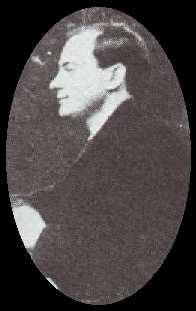
'Pearse was more than a
patriot; he was a virtuous
man.
He possessed all the qualities which go to the making
of
a Saint... it would not be astonishing if Pearse
were
canonized some day...'
That passage is taken from Louis Le Roux's biography
of Pearse, first published in English in 1932, and to date the only full-length
biography. It illustrates the virtual impossibility of writing, even
today, an objective study of a man whose death elevated him into the most
sacred realms of national mythology. Behind the Pearse of legend
- the orator, the Gael, the child Pearse, allegedly swearing on his knees
to free Ireland or die fighting the English, the man Pearse, writing a
promised poem to his mother in the condemned cell - it is not merely difficult
but almost blasphemous to discern a human being of flesh and blood.
It is the historian's obligation to make the attempt, but in the circumstances,
and at fifty years' remove, it can only be an interim one.
Patrick Henry Pearse was born on November 1879
at 27 Great Brunswick Street, now Pearse Street, Dublin, where his father,
James Pearse, carried on business as a monumental sculptor. James
Pearse was born, according to his obituaries, in London in December 1839
and seems to have been thoroughly English and probably Protestant stock,
although he was a Roman Catholic at least as early as the birth of his
first child in 1864. He came to Dublin, reputedly from Birmingham,
as a very young man, being one of a group of ecclesiastical crafts-men
brought to Ireland as the influence of the Gothic revival swept over post-Emancipation
church-building. He worked for various monumental firms before finally
setting up in indepen-dent business in i 8 78. By the time of his
death he had attained a considerable eminence as a sculptor; his most acclaimed
work was the heroic group of figures crowning the façade of the
National Bank in College Green, but examples of his style are to be found
in many of the churches built in Ireland in the second half of the century,
and the Freeman's Journal described him as 'the pioneer of modern Gothic
art, as applied to Church work, in this country.'
He married twice: firstly, Emily Fox, who bore
him two children before dying in 1876 at the age of thirty, and secondly,
in October 1877, when he was thirty-seven, Margaret Brady, a twenty-year-old
Irish girl whose family came from Meath. She bore him four children,
two of them sons, Patrick, born in 1879, and William James, born in 1881.
In politics James Pearse was a convinced Home
Ruler, but of a mentality unmistakably that of an English radical.
His one literary work was a pamphlet entitled England's duty to Ireland
as it appears to an Englishman, published in 1886 in reply to an anti-Home
Rule and anti-clerical tract of a Catholic Fellow of Trinity College, Dublin,
Thomas Maguire. Pearse's pamphlet shows remarkably wide reading for
a man who must have had relatively little formal education, triumphantly
quoting Caius Gracchus, Tiberius Sempronius, Polybius, Addison and Thomas
D'Arcy Magee, to sustain the thesis that 'you ought not to force a mode
of government upon an unwilling people. And you cannot for ever do
so, whether you ought to or not . . .' 'I am Englishman enough to say,'
he declared, 'that were I an Irishman my duty and my patriotism would force
me into the ranks of Mr. Parnell.'
James Pearse maintained his English connections
throughout his life; members of the Pearse family stood sponsor at Patrick's
baptism, and it was on a visit to his brother's home in Birming-ham that
he suddenly collapsed and died in 1900. His body was brought back
to Dublin and buried in Glasnevin. His business was carried on for
some years by his younger son, among whose work is a Mater Dolorosa which
still stands in Westland Row church. James Pearse, English radical,
mature and opinionated, must have been an interesting father for a boy
in his teens. James Pearse may well have suffered neglect in a nationalist
tradition to which the source of filial inspiration must almost always
be seen as maternal. At the very least he provided the mixed background
not unusual to Irish patriots: Parnell's mother was an American, Thomas
Mac-Donagh's mother English, Tom Clarke's father a Presbyterian and a soldier
in the British Army, Éamon de Valera's father Spanish.
Patrick was educated at the Christian Brothers'
School, Westland Row, and through the old Royal University. He took
his BA in 1901 and was soon after called to the bar. In I905 he made
one of his few appearances as a barrister, pleading, with Tim Healy, before
the King's Bench division, the case of a Donegal farmer who had been fined
one shilling at Dunfanaghy for putting his name on his cart in 'illegible',
that is to say, Irish, letters. Pearse's defense was described by
one of the judges as very ingenious, interesting, and from a literary point
of view, instructive,' but he lost his case. He never apparently
practiced again, and in later years described the lawyer's craft as 'the
most ignoble of all professions'. His career was instead to lie in
education.
In September igo8 he founded St Enda's College
as an experimental bilingual secondary school for boys in Cullens-wood
House, Rathmines. In 1910 he decided that the house was too small
and too close to the city to give full scope to his ideas. Cullenswood
House was converted into St Ita's, a sister--school for girls, while the
main school was moved to The Hermitage at Rathfarnham, the lease of which
Pearse managed to secure with the financial backing of some friends.
St Enda's now became wholly a boarding-school, and assumed the form described
so affectionately in Pearse's own Story of a Success and in Desmond Ryan's
writings.
Pearse's educational ideas were in advance of
their time. The school language and games were Irish, and all other
subjects except languages and the scientific subjects were taught bilingually.
Nature study was encouraged, and Irish plays were regularly performed.
The disciplinary emphasis was upon trust and self-reliance. Opinions
naturally vary as to how wholly successful these methods proved, but such
an issue falls outside the scope of this study. Two points are relevant.
Firstly, the role of educationalist always remained central to Pearse's
character and was to be the theme of many of his writings, of which the
best-known in this context is the collection of essays between 1912 and
1914, later published in pamphlet form in The Murder Machine. This
work combines liberal teaching methods with unyielding nationalism.
'What the teacher should bring to his pupils is not a set of ready-made
opinions, or a stock of cut-and-dry information, but an inspiration and
an example; and his main qualification should be, not such an overmastering
will as shall impose itself at all hazards upon all weaker wills that come
under its influence but rather so infectious an enthu-siasm as shall kindle
new enthusiasm.' To an anxious parent who asked what he should do with
a son who was good at nothing but playing the tin whistle, Pearse replied:
'Buy a tin whistle for him.'
With these thoroughly modern ideas went, however,
a view of the place of nationalism in education with which some might quarrel.
'If the true work of the teacher be ... to help the child to realize himself
at his best and worthiest, the factor of nation-ality is of prime importance.'
The child was to be taught that the Irish separatist tradition began in
1169 and embraced the supporters of Edward Bruce, Art MacMurrough, Shane
O'Neill, and just about everyone else who had ever taken up arms in Ireland.
This is scarcely the view of modern historical scholar-ship, but it was
logically the view of a man who saw no incompatibility between the roles
of educationalist and propa-gandist to his pupils of Gaelic and, at least
from 1910 onwards, physical force nationalism. As MacDara, the hero
of Pearse's most famous play The Singer, published in 1915, declares: 'The
true teacher must suffer and do. He must break bread to the people,
he must go into Gethsemane and toil up the steep of Golgotha. . . . Sometimes
I think that to be a woman and to serve and suffer as women do is the highest
thing. Perhaps that is why I felt it proud and wondrous to be a teacher,
for a teacher does that.'
However successful St Enda's may have been educationally
it did not pay its way. Pearse had no head for money matters, he
was sometimes unable to pay his teachers' salaries, and was recurrently
saved from the school's creditors by loyal friends. Yet even this
was to play a circumstantial part in the inevitable process by which Pearse's
educational work gained the active support of the I.R.B.
Pearse, like so many of the young men of his
time, came to nationalism through the Gaelic League. His love of
Irish was apparently first stimulated around the age of eleven or twelve
by a female relative of his mother's who was well versed in Gaelic history
and legend. The youthful Pearse studied Irish through the grammar
and texts of the Society for the Preserva-tion of the Irish Language, and
later at the classes held by Canon O'Leary in Dame Street. As an
adult he widened his knowledge by regular visits to the Connacht Gaeltacht,
where he acquired a cottage at Rosmuc. Pearse's Irish was largely
self-taught, and although many of his works were to be written in that
medium, expert opinion can always detect that he was not a native speaker.
But his writings were suffused by a tremendous love of the language and
of the Gaeltacht folk to whom it was the medium of story-telling and reminiscence.
This quality of folk sympathy is seen most clearly in the simpler and less
rhetorical of Pearse's writings such as the stories Iosagán and
Brigid of the Songs.
Pearse's advocacy of the Gaelic revival was remarkably
precocious. At the age of seventeen he founded the New Ireland Literary
Society with the object of popularizing Irish poetry and folklore to 'the
barbarian'. His three presidential addresses, subsequently published
in 1898, in his nineteenth year, show him an ardent Gaelic Nationalist
of a mystical rather than a revolutionary kind. 'The Gael is not
like other men,' he declared in 1897, just before his eighteenth birthday,
'the spade, and the loom, and the sword are not for him. But a destiny
more glorious than that of Rome, more glorious than that of Britain, awaits
him: to become the saviour of idealism in modern intellectual and social
life . . .'
Naturally Pearse was quickly attracted to the
Gaelic League which, it must be recalled, was from its foundation in 1893
up to the Dundalk convention Of 1915 an essentially non-political body.
'My service to Douglas Hyde,' Pearse wrote in 1913, 'began when I was only
sixteen.' In 1903 he became editor of An Claidheamh Soluis, the organ of
the League, a post which he retained until 1909. Four years later
Pearse was to describe the Gaelic League as 'a spent force', the first
stage of a revolution which was now to be brought about. But by that
time Pearse was a member of the Volunteers and on the fringes of the I.R.B.;
in 1909 his resignation from An Claidheamh Soluis seems to have been chiefly
the result of the growing demands made upon his time by St Enda's.
Pearse in 1909 was therefore known principally
as a dominant figure in the Gaelic revival movement, a writer and speaker
of great force and fluency. Physically he had developed a com-manding
presence. He was about average height, of stocky build, with a clear
and impressive profile, although according to contemporaries his facial
appearance was marred by a distinct cast in the left eye. By dint
of application he had become a fine orator, overcoming in the process a
slight
natural stammer. His oratory was of the set piece rather than the
impromptu kind, his speeches carefully memorized and rehearsed before a
mirror in St Enda's. He was not as yet a consistent physical-force
revolutionary; as late as April 1912 he spoke from a Home Rule platform
in Sackville Street, though making the reservation that Home Rule was a
stepping-stone to complete independence. As late as igi2 Pearse was
also, according to Desmond Ryan, still critical of the Irish Republican
Brotherhood as an associa-tion of 'talkers and old Fenians, past all capacity
for action'. These might seem incongruous sentiments for the future
Commander-in-Chief of a revolution largely organized by the Brotherhood.
But three factors determined Pearse's rapid pro-gression to the centre
of the republican stage. Firstly, he was a militant Gael, prepared
to follow to the bitter end the prompt-ings of his nationalist conscience.
Secondly, he was a man who could move and inspire other men. And
thirdly, the I.R.B. was in the same period undergoing a rejuvenation which
could cause it to appreciate the potential utility of a man with these
qualities.
In the period before the outbreak of the First
World War the I.R.B. came increasingly under the control of a generation
of young, vigorous men. The key figure in this process seems to have
been Tom Clarke. To no single figure, Clarke, Pearse, or MacDermott
can the inspiration of 1916 be ascribed. But un-doubtedly the fact
that Clarke, the symbolic fellow-martyr of an older generation, was prepared
to throw the weight of his name behind the young men and their policy of
action was a major influence in its ' success. These younger men,
determined upon a fight, were ready to make use of congenial material.
Clarke had already been enormously impressed by a speech which Pearse had
made at an Emmet commemoration concert in 1911, and in June 1913 the I.R.B.
chose Pearse to deliver the Bodenstown oration at the grave of Wolfe Tone.
Pearse, in the first of a set of orations which have passed into Irish
history, fully identified himself with the tradition of Tone. 'We
have come to the holiest place in Ireland,' he began, 'holier to us even
than the place where Patrick sleeps in Down. Patrick brought us life,
but this man died for us.' In the same month Pearse began to contribute
a series of articles 'From a Hermitage' to Irish Freedom, the I.R.B. newspaper,
which also show a steady progression towards physical force. 'There
are only two ways of righting wrongs; reform and revolution', he wrote
in October 19I3- 'Reform is possible when those who inflict the wrong can
be got to see things from the point of view of those who suffer the wrong.'
Pearse was not yet, apparently, a member of the
I.R.B. He was still disliked in some I.R.B. circles for his spasmodic con-stitutionalism.
Many of his senior and university students resi-dent at St Enda's, including
Desmond Ryan, were sworn members of the I.R.B. at least eighteen months
before their headmaster. Late in 1913 Pearse approached Bulmer Hobson
with the project of a fund-raising American lecture tour to rescue St Enda's
from a financial crisis. Hobson wrote to John Devoy with the approval
of Clarke and MacDermott recom-mending Pearse as 'all right and in line
with us here' and St Enda's as 'the only college preparing boys for the
Universities that is really and intensely national in tone'.
The precise occasion when Pearse was actually
sworn into the I.R.B. has been and probably always will be the subject
of controversy, but the most probable date is shortly after the foundation
of the Volunteers in November 1913 and before Pearse went to America.
Of the founding group of the Volun-teers, which first met on 11 November
1913, Pearse is listed by Bulmer Hobson amongst those members who were
not in the I.R.B. But the Volunteers were from the outset effectively infiltrated
by a cadre of I.R.B. men. Elections to officer rank were used to
place them in key positions, and particularly after the split with Redmond
in September 1914 the revolutionary nucleus of the Volunteers was supplied
by the secret organiza-tion. The overt purpose of the Volunteers
was firstly defensive against conscription and partition, but at least
from September 1914 the covert purpose of the I.R.B. was to mount a rising
before the war ended.
Pearse rapidly rose to a position of prominence
in both organizations. He was one of the principal speakers at the
Rotunda Rink meeting which launched the Volunteers on 25 November I 9 I
3, and from then on became the principal orator of the movement, his work
culminating in his electrifying oration at the O'Donovan Rossa funeral
in August 1915- On 6 Decem-ber I914, at the first meeting of the General
Council of the Volunteers after the split with Redmond, he was appointed
Director of Organization, and as such issued orders on behalf of MacNeill,
the Chief of Staff. Equally, in May 1915, he was appointed, with
Joseph Plunkett and Eamonn Ceannt, a mem-ber of a three-man military committee
set up by the Supreme Council of the I.R.B. to draft a plan for a military
insurrection. This committee later became the Military Council and
was widened in I9I5 to include Clarke and MacDermott, ex officio, as Secretary
and Treasurer of the Supreme Council and its key figures, and in 1916 Connolly
and MacDonagh. In September 1915 Pearse figures as a co-opted member
of the Supreme Council of the I.R.B. In January 1916 the Supreme Council
decided upon revolution at 'the earliest date possible', leaving the timing
and details to the Military Council. What followed is history, and
will be discussed in its place by other contributors to this series.
Two fundamental questions do, however, arise
concerning Pearse's position. Firstly, why was Pearse, after only
two and a half years in the I.R.B., and with no military experience, elected
by the Military Council to the position of Commander--in-Chief? Secondly,
why was Pearse prepared to place himself at the head of a rising which
had little initial chance of success and which, after the failure of the
arms ship to arrive, he knew could only conclude in his own death?
The first question is only partially answered
by Pearse's oratorical powers. More fundamental was the position
which he held as a member of the Supreme Council of the I.R.B. and of its
Military Council, and at the same time Director of Organiza-tion of the
Volunteers. Plunkett and Ceannt were also com-mandants in the Volunteers,
but no other I.R.B. man held such prominent dual rank as Pearse.
Clarke, for example, a dedicated revolutionary continually under detective
observation, had held back from the prominent role in the Volunteers which
Pearse naturally assumed, and Clarke's role and that of MacDermott in the
planning of the rising was necessarily little known outside the I.R.B.
Pearse therefore was indispensable in the link
between the I.R.B. and the Volunteers. When he issued orders for
military maneuvers, culminating in the decisive order of Easter 1916, he
did so in a dual capacity. To the rank and file non-I.R.B. Volunteer
he was the spokesman of the Volunteer leadership. To the I.R.B. man
in the know he was the spokesman of the Brotherhood. The I.R.B. was
the agent and mainspring of the rising, but with probably not much more
than two thousand members, of whom perhaps about a quarter were militarily
active, it needed the umbrella of the Volunteers. Hence the protracted
deception of MacNeill; hence also the key role of Pearse, whom several
of the I.R.B. leaders still regarded as a political amateur.
The seven signatories of the Proclamation of
the Republic, the seven members of the Provisional Government, were the
seven members of the Military Council of the I.R.B. But the ordinary Volunteer,
living in 1916 when communications were so much slower than today, confused
by orders and counter-manding orders, about to embark upon a desperate
gamble against the mightiest empire in the world, knew little of the actual
planning of the rising which had been perhaps the best -kept secret in
Irish revolutionary history. To such a Volunteer, Pearse of the I.R.B.
seven was the most familiar figure, the name which had appeared on so many
Volunteer orders since December 1914- So the duality of the secret and
open organiza-tions, and the reluctance of MacNeill, the technical head
of the Volunteers, to strike, propelled Pearse inexorably to the titular
leadership.
Why, in turn, was Pearse prepared to assume a
role which virtually guaranteed his execution? The answer to this
question most probably lies in his writings between igi2 and igi6.
In this period Pearse developed the idealism of his I897 essay to the point
where he concluded that his own generation had lost the right to freedom
by its decadence and servility, and could only be rejuvenated by a blood-sacrifice.
This idea was broadly shared by Connolly, Plunkett, MacDonagh and MacDermott.
But Pearse, in both his controversial and his dramatic writings, developed
it most fully and single-mindedly. He once wrote to himself, in his
short-lived journal An Barr Buadh, 'Pearse, you are too dark in yourself...
Is it your English blood that is the cause of that, I wonder?' He went
on later: 'However, you have the gift of speech. You can make your
audience laugh or cry as you please. I suppose there are two Pearses,
the sombre and taciturn Pearse and the gay and sunny Pearse.' As the Abbey
actress, Máire nic Shiubhlaigh, a sympathetic observer, re-called,
inside St Enda's he was 'a quiet young man, full of nothing but the business
of the school. But outside, some might have said Pearse was vain
- a bit of a poseur'.
He was indeed a gentle and considerate if rather
humourless man in his school and in his private life, and he was deeply
con-scious of the responsibilities of military leadership: 'It is a terrible
responsibility to be cast upon a man, that of bidding the cannon speak
and the grapeshot pour,' he wrote in January 1914. But a month earlier
he had written: 'May it not be said with entire truth that the reason why
Ireland is not free is that Ireland has not deserved to be free?' The right
to freedom, he became convinced, could only be won in arms: 'We must accus-tom
ourselves to the thought of arms, to the sight of arms, to the use of arms.
We may make mistakes in the beginning and shoot the wrong people; but bloodshed
is a cleansing and a sanctifying thing, and the nation which regards it
as a final horror has lost its manhood.' Of the European war he wrote in
December 1915: 'The last sixteen months have been the most glorious in
the history of Europe. Heroism has come back to the earth.... The
old heart of the earth needed to be warmed with the red wine of the battlefields.
Such august homage was never before offered to God as this, the homage
of millions of lives given gladly for love of country.'
With this concept of the cleansing effect of
bloodshed there developed in Pearse's mind a vision of the overthrow of
injustice by the sacrificial death of virtue. If Pearse's nationalism
stemmed principally from Tone, Emmet, and Mitchel, this sacrificial concept
had a strongly religious, even Messianic quality. The hero of his
play The King, first produced in l912, is a young child whose innocent
readiness to give his life for his people frees them where the efforts
of the adult king have failed. 'I do homage to thee, 0 dead King,
0 victorious child!' says the king at the end, 'I kiss thee, 0 white body,
since it is thy purity that hath redeemed my people.' And The Singer, his
last play, which is often seen as expressive of his own sense of mission,
ends in the same way with the hero going out to certain death crying, 'One
man can free a people as one Man redeemed the world.' The same expectancy
of death is seen in several of Pearse's poems such as The Mother, with
its famous lines:
I do not grudge them; Lord, I do not grudge
My two strong sons that I have seen go out
To break themselves and die, they and a few,
In bloody protest for a glorious thing.
And still more clearly in Renunciation:
I have turned my face
To this road before me,
To the deed that I see
And the death I shall die.
And so, on 3 May 1916, Pearse died, as he had
foretold. As soldiers, he and his colleagues were failures.
The military plan was foredoomed once the arms failed to arrive, and arguably
was ill conceived from the beginning. There were already those who
questioned the logic of sitting within a tightening ring in Dublin waiting
to be overwhelmed. Such men were to come back from English prison
camps to apply the lessons of igi6 in a more ruthless and ultimately more
successful kind of war.
But whether they could have done that without
1916 is another question. Maxwell's firing squad made Pearse, even
more than his colleagues, the inspiration of a national myth. His
was in many ways a strange, divided nature. His elevation of death
to the status of a first principle is uncongenial to an age less familiar
with the grand gesture. In his own time he was an unrepresentative
figure, regarded as an unpractical visionary by many not merely in the
Parliamentary Party but in the I.R.B. In the secret groundwork which preceded
the rising others, specifi-cally Clarke and MacDermott, appear to have
played a greater part. But it is difficult not to feel that by the
standards of his own teachings, posterity vindicated Pearse. He had
become con-vinced that the risings of the past had been bedeviled by a
last- minute reluctance to strike. In common with the rest of the
I.R.B. Military Council he was determined not to repeat that fatal hesitancy.
To him to strike was in a sense to win. 'We seem to have lost.' he
said at his court martial: 'we have not lost.' And on Wednesday of Easter
week in the GPO he is reported as remarking: 'When we are wiped out, people
will blame us for everything, condemn us.... After a few years they will
see the meaning of what we tried to do.' And indeed, as the released prisoners
came back to Dublin in the following year they were accorded a heroes'
welcome. If Pearse's course was sacrificial and irrational, it had
the unanswerable self-justification of success. As he wrote in his
poem The Fool, some six months before he was executed:
The lawyers have sat in council,
the men with the keen, long faces,
And said, ‘This man is a fool’,
and others have said, ‘He blasphemeth’;
And the wise have pitied the fool
that hath striven to give a life
In the world of time and
space among the bulk of actual things
To a dream that was dreamed
in the heart, and that only the heart could hold.
O wise men, riddle me this: what
if the dream come true?
What if the dream come true? And
if millions unborn shall dwell
In the house that I shaped in my
heart, the noble house of thought?
Lord, I have staked my soul, I
have asked the lives of my kin
On the truth of thy dreadful word,
do not remember my failures,
But remember my faith.
-Pádraig H. Pearse 1915 |