� �
� �
� �
�
 ����
����
����
����
by
T�nia Guerra
This project is an investigation into the nature of man�s participation in the building of the spaces around him. It seeks to understand how the architect, as maker, can engage the user and how the user, in exchange, can participate in the creation and re-creation of the work.
The inspiration came from the work of the French novelist Alain Robbe-Grillet. Although in a medium different from that of architecture, the author manages to engage his readers in an exploration, which he defines as an experience of life, and in which the act of reading is transformed in an experience very similar to that of experiencing architectural spaces.
Robbe-Grillet�s narratives are made of relentless use of descriptive form, acknowledging perceptive experience as the only way to explore the reality around us. Although aiming at objectivity, naming no emotions and refusing any complicity, he offers the reader spaces that are far from objective.
Through the narrator�s descriptions of the objects surrounding him, we are able to feel and experience the spaces these objects come to form. The objects are never placed in homogeneous space and time, instead they are always described in relation to one another, and as the narrator sees them. In a sense, they are more authentic and interesting than the reality around us and the reason seems to lie in the way they are constructed. They challenge us to question our pre-conceived definitions of the world, in which our experience is substituted by scientific assumptions and where meaning cannot be found.
Science tells us that space is a homogeneous, pre-given three-dimensional entity, whose existence is independent of us. Robbe-Grillet, in privileging perceptive experience, demonstrates that space can only come into existence after being experienced by the body. It is the body that defines space as the result of an interaction. The world exists and is there before any contact with the perceiving subject , but space can only come into existence after his body interacts with the surrounding objects. In a similar way meaning is understood. As Merleau-Ponty tells us, meaning cannot be found entirely in the world, nor in our mind, but in the contact of both. The world informs us and we, in turn, give meaning to it.
In Robbe-Grillet�s theories, the meaning of life is directly related to the exercise of building the spaces around oneself. This meaning giving act is always associated with participation and imagination. One can only find meaning in the world if one is engaged, if one participates in building the reality around oneself.
The way
his texts are presented help sustain this idea, for instead of presenting
a story with beginning and end, Robbe-Grillet offers fragments of a story,
which can only make sense after the reader�s interpretation. He aims at
provoking the reader to perceive the reality around him, demonstrating
that the world we live in has to be experienced and felt, and the usual
gaps encountered on the way filled out with our imagination.
The
(novel)author today proclaims his absolute need of the reader�s cooperation,
an active, conscious, creative assistance. What he asks of him is no longer
to receive ready-made a world completed, full, closed upon itself, but
on the contrary to participate in a creation, to invent in his turn the
work - and the world - and thus learn to invent his own life.
Robbe-Grillet is often criticized for not exercising his responsibility as an author, a fact that contradicts the immense care he has in constructing, and sometimes de-constructing his novels. Besides, for a careful reader, the key to the understanding of his work is nowhere other than in the work itself. The experience of the narrator and the way he makes sense of the reality surrounding him are the thread for going through his labyrinthine texts.
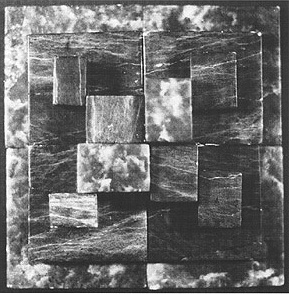
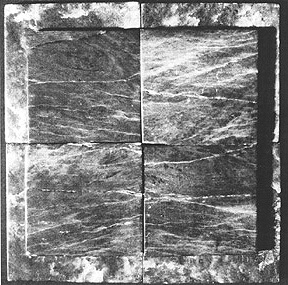
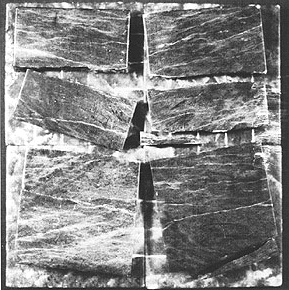
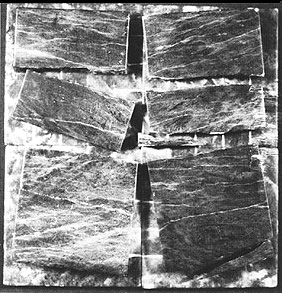
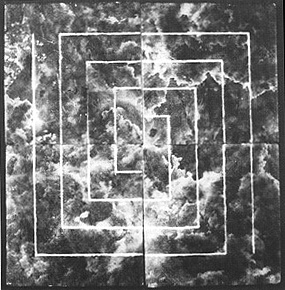
Like the labyrinths of Robbe-Grillet, this puzzle is to be felt and experienced. It is made on soap stone, a delicate material that at first looks hard and cold, but when experienced shows extreme softness and warmth. The choice reflects an intention of holding the observer�s attention, which is then compelled by the carefully cut and polished pieces to touch and feel them, starting the experience that will transform him from mere observer, into active user. At each manipulation a different relationship emerges, and new possibilities are created. On the other hand, if the observer does not touch the work and play with it, its innermost significance will elude him.
References:
Alain Robbe-Grillet, For a New Novel, translated by Richard Howard (Evanston: Northwestern University Press,1965).
Alain Robbe-Grillet, In the Labyrinth, translated by Richard Howard (New York: Grove Press, 1978).
Maurice Merleau-Ponty, Phenomenology of Perception, translated by Colin Smith (London: Routledge, 1995).
*This Essay has been previously published as part of the catalogue of the graduate program of history and theory at McGill University's School of Architecture. The catalogue, which includes a total of twelve student essays, as well as the original essay "Hermeneutics as Architectural Discourse" by the course director, Dr. Alberto Perez-Gomez, is available at a nominal cost upon request.

[Theory Corner][Research Area][Dark Room][What's New][Search/Links][Portfolio/Resum�][Talk Back]
Unless
Indicated All Material On This Site
Copyright�1997
Marcio Oliveira
All Rights Reserved