Nickolas Copernicus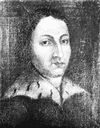 |
Two systems, Two men, The Beginning of a Revolution. |
Nickolas Copernicus |
Two systems, Two men, The Beginning of a Revolution. |
Copernicus realized that the Ptolemaic system was becoming far too complex to be correct, and he looked for a simpler explanation. As Ockham's Razor states, "With all things being equal, the simplest explanation is the correct explanation." He searched through texts from the Greeks, and found many different men explaining their theories that the sun was at the center of the universe, not the Earth. He modified the Ptolemaic geocentric theory and placed the sun at the center of the universe. The result, although not much simpler, was much more aesthetic.
Copernicus worked for four years preparing his manuscript, De hypothesibus motuum coelestium a se constitutis commentariolus ("A Commentary on the Theories of the Motions of Heavenly Objects from Their Arrangements"), which he privately distributed amongst his friends. His main ideas of the work were that the irregular motions of the planets are caused by the earth's motion around its axis and around the sun. He also stated that the Earth was not the center of our planetary system, but only the center of the moon's orbit. He also discussed the order of the planets. In the Ptolemaic system the order of bodies around the Earth was, Earth, Moon, Mercury, Venus, Sun, Mars, Jupiter, and Saturn. Copernicus changed the order to be Mercury, Venus, Earth with the moon rotating around it, Mars, Jupiter, and Saturn.
One of the more radical changes in the Copernican system is the theory about the fixity of the stars. As stated above, the Ptolemaic system was of the belief that the stars were on a fixed sphere outside of the orbit of Saturn. Copernicus believed that the stars were too far away to be measured, and this belief led astronomers to believe in the existence of the universe, a much larger system than that of the sun and Earth.
Another change was in the system of gravity. Aristotle believed that objects fell toward the Earth because they fell toward the "natural place," or the center of the universe. But when Copernicus moved the center of the universe to the center of the sun, Aristotle's theory needed to be changed. The problem was finally resolved when Newton posed his theory of gravity.
The Copernican system was opposed heavily from the Catholic Church. Because Copernicus moved the Earth from its former position at the center of the universe, making it "just another planet," the Church opposed his theory. Making the Earth "just another planet" was undermining the belief that the Earth and man are God's supreme creations and the focus of the universe. This undermining of the Church helped in the scientific revolution of the Renaissance. Science, for once, was right and the Church was becoming more and more wrong.
Source:
"Copernicus, Nickolas" Britannica Online.
http://www.eb.com:180/cgi-bin/g?DocF=micro/206/79.html
[Accessed 09 April 1998].