
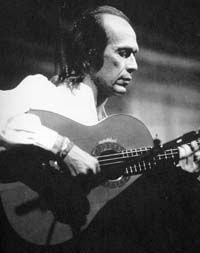
Excerpt from Acoustic Guitar interview with Paco de Lucia
by Guilermo Juan Christie
...What music do you listen to when you're at home?
I listen to a little bit of everything. I listen to musicians that I like. Classical musicians, jazz musicians. I listen to flamenco, salsa, Brazilian music.... Anything, but mostly flamenco.
What drew you again to the experience of collaborating with John McLaughlin and Al Di Meola?
Well, I learned a lot with these people, because flamencos up until my time-now of course it's different because there are young guys who understand this stuff-but I never went to school to learn music or harmony, and I had to learn somewhere. I didn't have the discipline to go to school, but I needed to learn. So I figured that jazz players knew a lot about harmony, and I got together with them. But never with the idea of contaminating flamenco as the purists say, nor with the idea of becoming a jazz musician.
Your intentions were pretty well misunderstood in those early days, no? And the musical results were sneered at by a lot of flamencos.
I think it was clear that my sole intention was to learn, so as to be able to bring to the flamenco tradition valid ideas that sounded good within flamenco. And I was always very careful and very respectful of flamenco, because I felt very devoted and took it very seriously. But when you're trying to bring about some evolution in a music that hasn't changed in years and years, because to change it was considered sacrilege, and because the purists would say that flamenco always had to be played the same way or it wasn't pure, you had to be very careful. And I think I've always been exceedingly careful with flamenco, and exceedingly careful in my own music.
So, the idea in playing with McLaughlin and Di Meola and guys like that was to learn from them, and then very carefully apply to flamenco some new things that worked but that were't goind to spoil the essence, or the message, or the expression of flamenko.
You used to say you were really scared about playing with these guys.
Naturally
Do you feel more sure of yourself now?
Yeah, I feel a little more confident now. Before, I'd go up on stage and compete with these guys without knowing anything about improvisation. I really didn't know how to improvise or even how improvisation worked. Like I didn't know that you had entire scales that went with certain chords. So I would hear a chord and go grabbing for notes, and by the time I found the sound I was after, the next chord would be on top of me. So it was really distressing, until I learned that there were norms, there were structures, there were formulas for improvising. After that I was a little calmer.
But still, an improvisation is supposed to be exciting, right? So you never know what's going to happen. You jump headfirst, and sometimes you fly. Other times you crash and get so banged up you never recover from it.
You're traveling more to the US with the sextet as well. How come?
Yeah, lately I've been going to the U.S. It's not a country I was going to regularly in the past. It's a country I've always been a little scared of. It was too big, too much stuff happened there. And everyone from everywhere goes to the U.S. to triumph, so there's this feeling of competitiveness. I'm a very laid-back person, so I felt kind of lazy about going there. I like the U.S. a lot in another sense - to go there to visit friends and vacation and stuff like that. But it's all sort of come up lately, so I guess I have to do it.
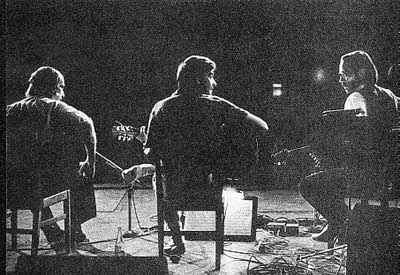
Paco de Lucia , John McLaughlin, Al Di Meola
