Space Shuttle Orbiter
The combined forces of Earth's gravity and the
speed the Space Shuttle orbiter achieves during
launch help the orbiter maintain its orbit of Earth. No
engines are running during this phase of the mission.
The height of the orbit depends on the purpose
of the mission but ranges between 120 and 350
miles above Earth. The orbiter circles Earth at a
speed of about 17,500 miles per hour (or 5 miles per
second) and, at that speed, takes about 90 minutes
to orbit Earth once. The orbiter circles Earth following
the same path, while Earth rotates beneath it.
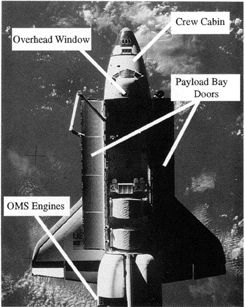
The nose of the orbiter houses the crew cabin,
which is a pressurized area where astronauts live
and work during missions. This compartment supports
guidance, navigation, and control equipment;
environmental controls and the life support system;
and displays and controls. It also contains crew
accommodations for sleeping, waste management
facilities, and a galley.
The part of the orbiter that corresponds to the
passenger section of an airplane is called the
payload bay. This bay is not pressurized and during
a mission is used for transporting satellites
and scientific experiments to and from Earth as
well as transporting International Space Station
components to space.
The payload bay doors play an important role in
each mission. When these doors are open, the heat
generated by the orbiter's electronics can be radiated
into space as a primary means of cooling the
orbiter. The doors are 60 feet long and composed of
a composite epoxy material. The payload bay doors
are the largest aerospace structure constructed
from a composite material and weigh approximately
3,264 pounds (on Earth).
The orbital maneuvering system (OMS) engines
at the rear of the orbiter are used to change orbit,
to leave orbit, and to return to Earth. These
engines cannot be used once the orbiter enters
Earth's atmosphere.
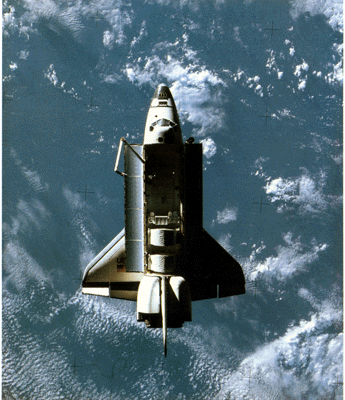
A variety of cloud types form the backdrop for this
scene of the Space Shuttle orbiter. The image
was captured during STS-7 in June 1983 by a
70-mm camera aboard a free-flying satellite.
For more information on NASA's Shuttle program,
visit the NASA Office of Space Flight Home Page at
http://www.osf.hq.nasa.gov/
To find out about NASA On-line Resources for
Educators, visit the NASA Education Home Page at
http://www.hq.nasa.gov/education
Back
Designed: Stargate