Space Shuttle Endeavour Lifts Off Into Space
 The Space Shuttle Endeavour lifts off on mission STS-54
from the NASA Kennedy Space Center in Florida.
Endeavour is one of NASA's four reusable launch vehicles
used to carry payloads and crewmembers into space to
conduct experiments in a microgravity environment. The
Space Shuttle system consists of four parts: the orbiter,
external tank, and two solid rocket boosters.
In the launch configuration, the orbiter and two solid rocket
boosters (SRB) attach to the external tank (ET) in a vertical
or nose-up position on the launch pad. Four bolts attach
each of the SRB's to the platform.
The silo-like brown external tank contains the propellants
for the three main engines on the orbiter. At launch, the
Space Shuttle's main engines ignite first at T minus 6
seconds. When computers verify the engines are operating
at the proper thrust level, they send a signal to ignite the
SRB. At T minus 0 seconds, the hoiddown explosive bolts
blow and the Space Shuttle lifts off the launch pad.
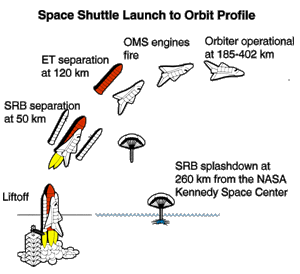
Little more than 2 minutes into the flight, the SRB'S, their
fuel expended, jettison. The boosters briefly continue to
ascend, while small motors fire to push them away from the
Space Shuttle. The boosters turn and begin to descend.
Parachutes deploy to decelerate them for a safe
splashdown in the Atlantic Ocean. Two ships recover the
boosters and return them to a processing facility for
refurbishment and eventual reuse.
Meanwhile, the orbiter and external tank continue to
ascend, using the thrust of the three main engines.
Approximately eight minutes after launch, the three Space
Shuttle engines shut down and the external tank jettisons
from the orbiter. The external tank continues on a ballistic
trajectory and enters the atmosphere where it disintegrates.
After main engine cut-off, the orbiter and the external tank
move along a trajectory that, if not corrected, would result in
the vehicle entering the atmosphere about halfway around
the world from the launch site. However, a brief firing of the
orbiter's two Orbital Maneuvering System (OMS) thrusters
changes the trajectory and orbit is achieved. The OMS
engines are also used on orbit for any velocity changes and
reentry.
Facts and Figures
Orbiter
Wing Span 23.79 meters
Length 37.24 meters
Height 17.27 meters
Payload Bay 18.3 meters x 4.6 meters
Payload Weight (launch max.) 24,948 kilograms
(approx.)
Main Engine (each)
Thrust at 1 00% throttle setting:
Sea Level 1,670 kilonewtons
Vacuum 2,1 00 kilonewtons
External TanK ET
Length 47 meters
Diameter 8.4 meters
Gross Weight (full) 750,980 kilograms
Solid Rocket Booster (SRB, each)
Length 45.46 meters
Diameter 3.7 meters
Thrust at Lift-off 14,685 kilonewtons
Gross Weight (approx.) 589,670 kilograms
Operations
Gross Lift-off Weight (approx.) 2,041,200 kilograms
Total thrust at launch 33,327 kilonewtons
SRB separation altitude 50 kilometers
SRB splashdown distance from KSC 260 kilometers
ET separation altitude (approx.) 120 kilometers
Orbital velocity (approx.) 27,869 kilometers/hour
Back
Designed: Stargate