
STS-60 returns to Earth. Discovery is one of
NASA's four reusable launch vehicles used
to carry payloads and crewmembers into
space.
When a mission's planned in-orbit operations
have been accomplished, the emphasis on
board the orbiter turns to the task of
preparing the vehicle for its return to Earth.
The crew typically spends the day before
entry stowing equipment, cleaning up the
living areas, and making final system tests
which insure a safe entry and landing.
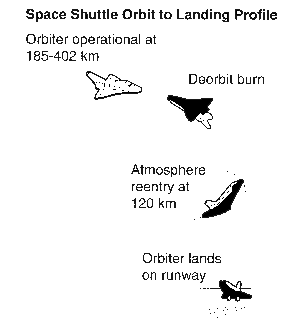
On the day of entry, the crew usually wakes
up 6 hours before the deorbit burn and
performs the final system tests needed for
entry. The spacecraft maneuvers into a
tail-first attitude before performing the deorbit
burn. The orbital maneuvering system
(OMS) engines fire to slow the spacecraft,
which lowers it into the atmosphere. The
orbiter then turns back into a nose-first
attitude. Small jet thrusters control the
orbiter's maneuvering until its aerodynamic
control surfaces encounter enough
atmosphere to function like a conventional
glider. This usually occurs 30 minutes before
touchdown at an altitude of about 120 km.
The atmosphere causes drag which slows
the spacecraft down from orbital velocity to a
safe landing speed.
The orbiter's exterior heats up to as much as
1,620 OC shortly after entering the
atmosphere due to friction caused by drag.
Extensive thermal protection shields the
spacecraft from the high heat levels. Gray
colored composite material protects the
areas (the nose and leading edge of the
wings) from the most intense heat. Black
tiles cover the belly and portions along the
side of the orbiter which heat up to as much
as 816 "C. White tiles and thermal blankets
protect the rest of the spacecraft, where
temperatures are lower.
The on-board computers fly the orbiter until it
goes subsonic (slower than the speed of
sound or Mach 1) approximately 4 minutes
prior to landing. At this time, the commander
takes manual flight control of the spacecraft
and flies a large spiral approach centered
about 13 km from the runway threshold. At
the completion of the spiral approach, the
orbiter lines up with the runway centerline at
an altitude of about 3 km and 1 1 km
downrange from the runway threshold.
Once lined up with the runway, the orbiter
flies a steep 18" to 200 flight path until an
altitude of about 600 meters when it begins
shallowing out to a 1.5" flight path. The pilot
lowers the landing gear at an altitude of
1 00 m and the commander lands the orbiter
about 750 m past the runway threshold.
Shortly after landing, the pilot deploys the
drag chute and the commander lowers the
nose and applies wheel brakes. After about
one hour of post-landing activities, which
include shutting down systems, the crew
exits the orbiter marking the completion of
another successful Space Shuttle mission.
Facts and Figures (Typical Mission)
Maximum Mach number Mach 26
Orbital velocity 27,500 km/hr
Atmosphere re-entry velocity 28,500 km/hr
Average descent rate 70 m/sec
Maximum descent rate 150 m/sec
Maximum G force 1.6 g's
Certified G force limit 2.1-2.5 g's
Maximum airspeed 575 km/hr
Certified airspeed limit 617 km/hr
Landing velocity 370 km/hr
Landing weight 82,000-102,000 kg
Runway length 4.6 km
Rollout distance 3 km