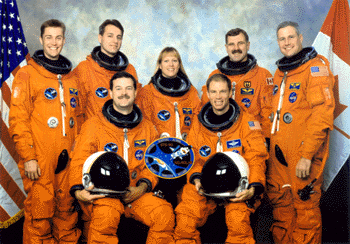
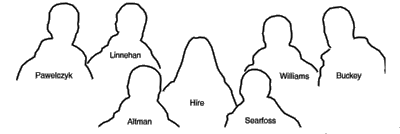
- Commander Richard A. Searfoss (Lt. Colonel, USAF, Colonel Selectee)
- Pilot Scott D. Altman (Commander, USN)
- Payload Commander Mission Specialist Richard M. Linnehan, D.V.M.
- Mission Specialist Kathryn P. (Kay) Hire
- Mission Specialist CSA Astronaut Dafydd (Dave) Rhys Williams,M.D.
- Payload Specialist Jay Clark Buckey, Jr., M.D.
- Payload Specialist James A. (Jim) Pawelczyk, Ph.D.
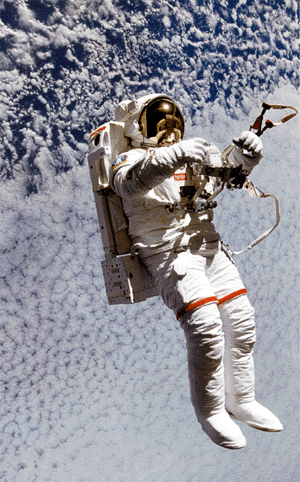
Simplified Aid for Extravehicular activity Rescue
(SAFER) a few meters from the cabin of the Space
Shuttle Discovery. He is one of two mission specialists
who participated in a spacewalk, or extravehicular
activity (EVA), during the STS-64 Space Shuttle mission
in September, 1994. The spacewalk represents the first
use of SAFER. A team at the NASA Johnson Space
Center planned and developed SAFER as a self-rescue
device for future use on the International Space Station
in the event that a tethered astronaut breaks away
during an EVA and a Shuttle is not available to assist in
the rescue.
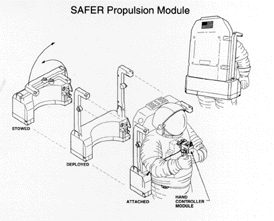
SAFER, is a small, self-contained, propulsive backpack
device that can provide free-flying mobility for a spacewalker.
Attached to the spacesuit's display and control
module is a hand controller, similar to a joystick, which
operates various combinations of thrusters that can
propel the astronaut back to the safety of the Space
Station. Each of the 24 fixed-position thrusters expel
nitrogen gas with a force of 3.6 newtons. The astronaut
can move the unit up and down, back and forth, side to
side, yaw, pitch, and roll by manipulating the hand
controller. SAFER includes an attitude control which
automatically maintains a rotational position selected by
the astronaut.
SAFER has a 1.4 kg supply of nitrogen, which provides
a 3.05 meter-per-second change in velocity before the
supply is exhausted. The Shuttle's nitrogen system can
recharge SAFER in orbit, and the battery pack which
powers SAFER is replaceable during an EVA.
SAFER stows in the airlock for launch and landing with
the upper towers folded. The unit measures 35.6 cm
high, 66 cm wide, and 25 cm deep, and has a mass of
37.6 kg. The height of the unit increases to 88.9 cm
when the arms are fully extended. Before an EVA, the
astronaut unfolds SAFER's arms and attaches the unit
so that it cradles the spacesuit's portable Life Support
System backpack.
Three SAFER units will be stored on board the Space
Station. These models will differ from the test model in
several areas: the operational model will be smaller and
include a stowage area for the hand control unit; the fuel
will be contained in highly pressurized tanks that can not
be recharged in orbit. If used, a new unit will be brought
up by the Shuttle. The used units will be brought back to
Earth and recharged for future use.
For the Classroom
1 .Demonstrate the principle of the SAFER unit's
propulsion system by inflating and releasing a
balloon.
2.Define yaw, pitch, and roll. Research and find other
examples of things that yaw, pitch, and roll,
3.Research Space Shuttle missions where astronauts
experimented with gas-propelled maneuvering units.
Compare and contrast your findings with SAFER.
4.Read science fiction stories where characters wear
propulsion packs as a means of transportation.
5.Create a chart of other professions that use rescue
devices. Have students build models of the rescue
devices, demonstrate how they are used, and
explain scientific principles that make each work.