 |
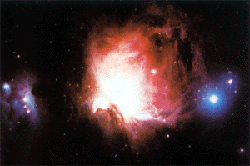
M42, THE NEBULA OF ORION, surrendered luminescent by one of the three stars that constitutes the sword of Orion, is easily observable with twins.
Photo: Royal Observatory, Edinburgh. |
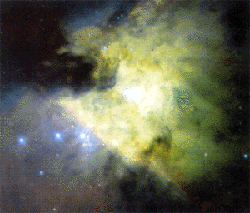 |
THE CENTRAL ZONE OF THE BIG NEBULA OF ORION with four stars of the Trapeze, stars of recent formation responsible for the excitation of his gases.
Photo: Lick Observatory, Universty of California, Santa Cruz. |
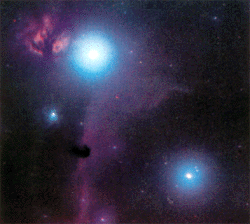 |
THE NEBULA DIFFUSE GALACTIC IC 434 circles Z�ta of Orion, most meridional of the three stars of the "Orion Belt", called as "Maguses", that dominate the wintry sky.
Photo: Royal Observatory, Edinburgh. |
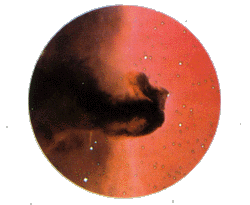 |
THE HEAD OF HORSE is a dark nebula that interposes himself between IC 434 and us.
His form recalls the one of the chess game piece.
Photo: David Malin, Angelo-Australian Telescope Board. |
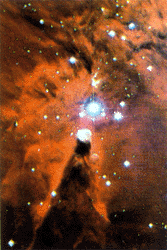 |
THE NEBULA OF THE CONE, in the constellation of the Unicorn, is another dark nebula example detaching himself on a brilliant region of hydrogen ionized.
Photo: David Malin, Angelo-Australian Telescope Board. |
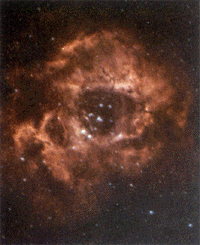 |
THE BOW, in the wintry constellation of the Unicorn, is a region stippled of globules of Bok: it is protostar in formation.
Photo: Hale Observatories, Pasadena. |
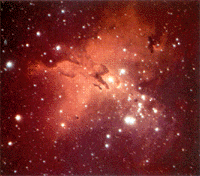 |
The HEAP OPENED M16 AND THE NEBULA OF THE EAGLE, a crucible where forms himself of new stars, situated between constellations of the Snake, of The ecu of Sobieski and the Sagittarius.
Photo: Hale Observatories, Pasadena. |
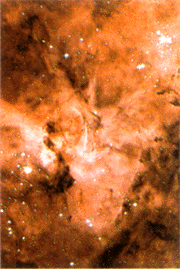 |
THE NEBULA NGC 3372 circles Eta of Streamlines it, to a time of the most brilliant star of heavens of the South and today invisible to the naked eye.
Photo: David Malin, Angelo-Australian Telescope Board. |
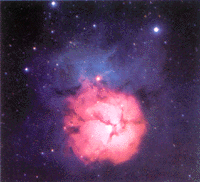 |
THE TRIFIDE (M20) is in the Sagittarius : it is a nebula divided in three parts that already gave birth to six young very hot stars.
Photo: David Malin, Angelo-Australian Telescope Board. |
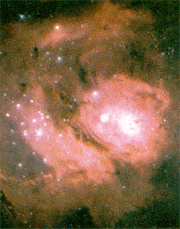 |
THE NEBULA OF THE LAGOON (M8) in the constellation of the Sagittarius, is furrowed by a Canal of dark cold matter.
Photo: Kitt Peak National Observatory, Tucson. |