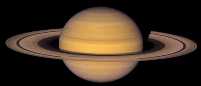
Saturnian Facts
| Mass(kg) |
5.69x10^26 |
| Diameter(km) |
120,660 |
| Mean Density(kg/m^3) |
690 |
| Escape Velocity(m/sec) |
35,600 |
| Average distance from Sun (AU) |
9.539 |
| Rotational Period (Length of day in Earth hours) |
10.2 |
| Revolution period (Length of year in Earth years) |
29.46 |
| Obliquity (Tilt of axis in degrees) |
26.7� |
| Orbit Inclination |
2.49� |
| Orbit Eccentricity (deviation from circular) |
0.056 |
| Mean Temperature (In Kelvin) |
88�K |
| Visual Geometric Albedo(Reflectivity) |
0.46 |
| Atmospheric Components |
97% Hydrogen, 3% Helium, .05% Methane |
| Rings |
Rings are 270,000 km in diameter, but only a few hundred
meters thick. Particles are centimeters to decameters in size and
are ice (some may be covered with ice); there are traces of silicate
and carbon minerals. There are four main ring groups and three more
faint, narrow ring groups separated by gaps called divisions. |
Saturn's Largest Moons
| Name |
Diameter(miles) |
Average distance from planet (miles) |
| Mimas |
242 |
115,022 |
| Enceladus |
310 |
147,572 |
| Tethys |
650 |
182,689 |
| Dione |
694 |
233,988 |
| Rhea |
947 |
332,964 |
| Titan |
3193 |
757,547 |
| Hyperion |
180 |
918,220 |
| Iapetus |
893 |
2,208,000 |
| Phoebe |
136 |
8,030,240 |
Webmaster: [email protected]
This page hosted by  �
Get your own Free Home Page
�
Get your own Free Home Page