Spiders Terminology


Scientific Name

Explication

Explicatory Drawing
Click the icon

Abdomen

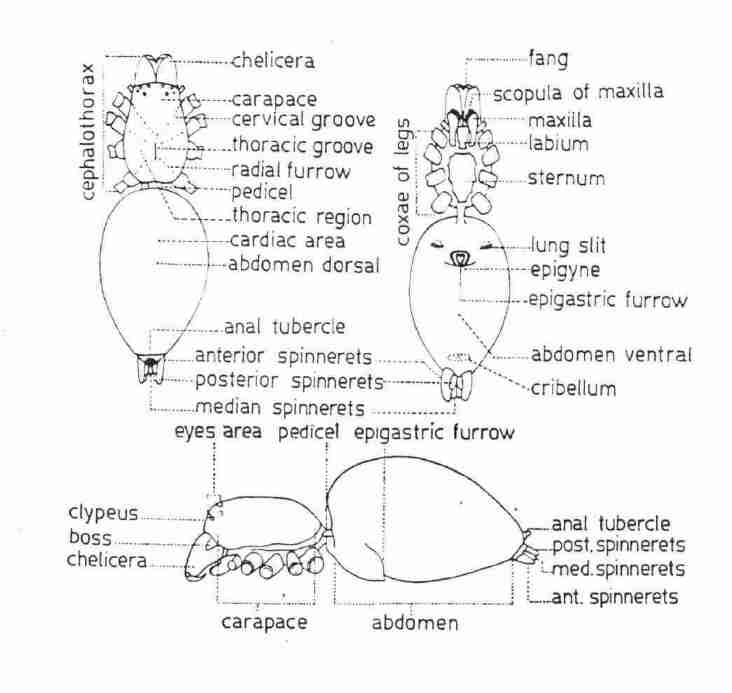
The posterior (rear) of the two major divisions of a spider
Terminlog2

Accessory claws

Serrated, thickened hairs near the true claws in some spiders
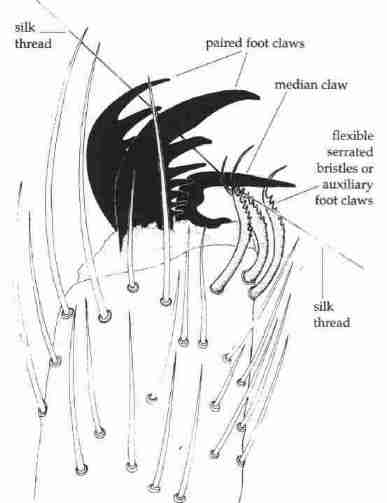
AuxClaws

Alveolus

A ventral depression in the male palp which receives the basal and middle divisions of the genital bulb. Although usually described as a cup-like depression, the alveolus is actually a ringed depression to the inner margin of which is joined the basal haematodocha
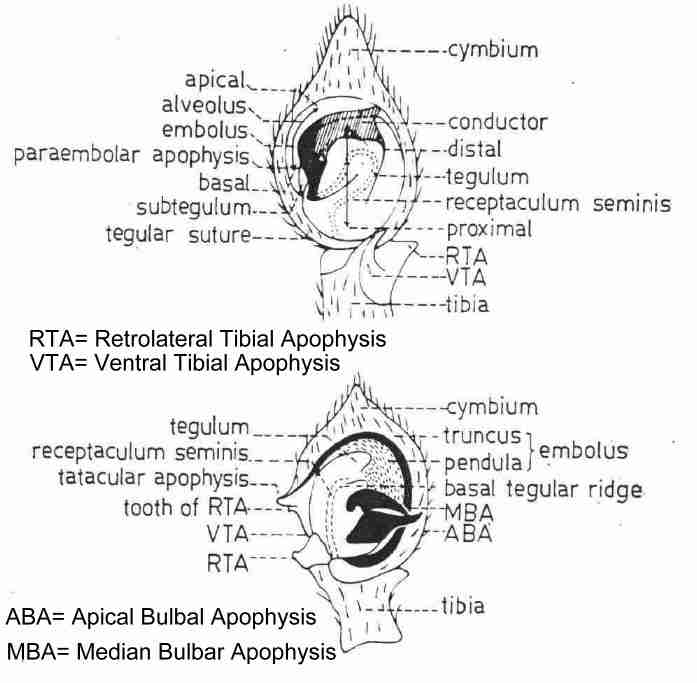
BulbusTerm1

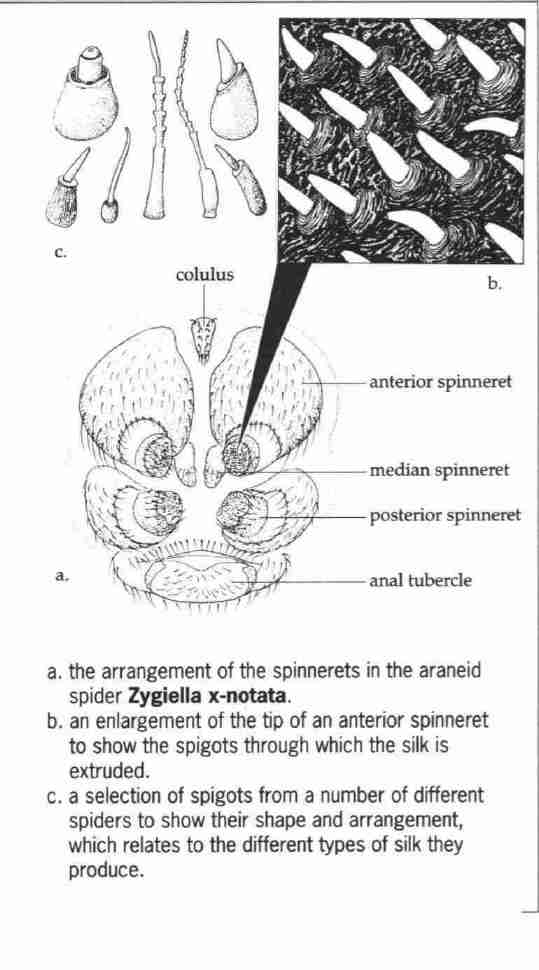
Anal tubercle

A small projection, dorsal to the spinners, carrying the anal opening

Terminlog2

Annulations

Rings of pigmentation around leg segments

Anterior

Nearer the front or head
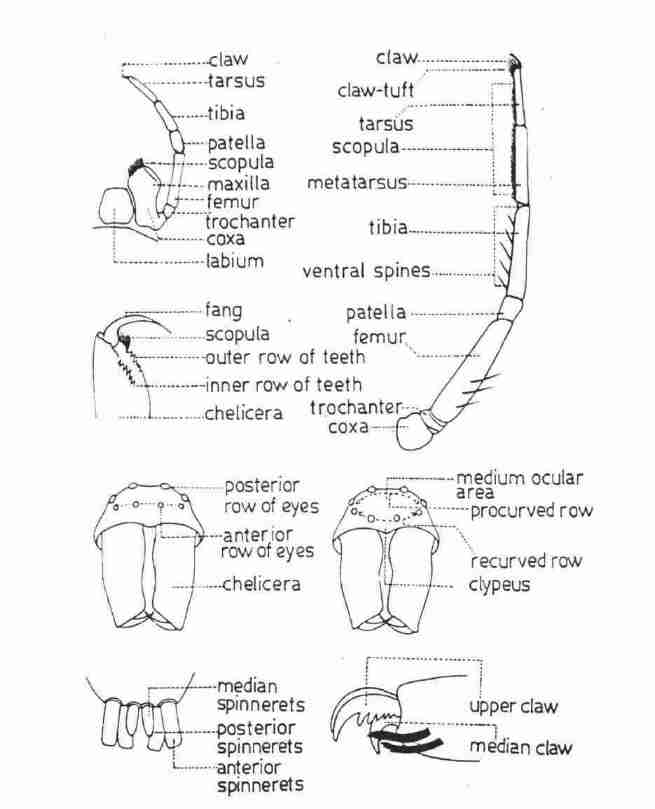
Terminolog1

Apex

Distal tip

Apomorphy

Derived character

Apical

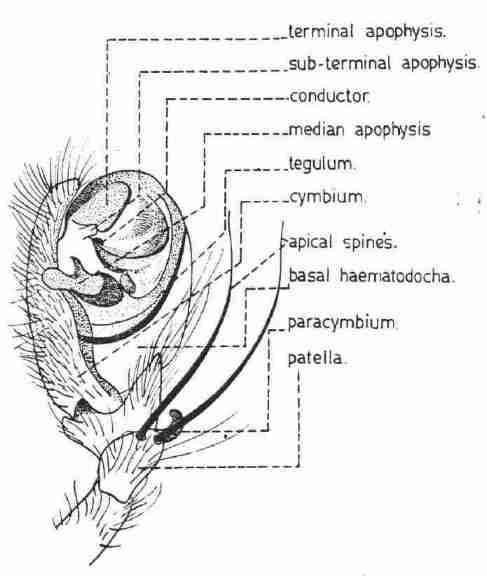
Male palp: the conductor and the embolic subdivision comprise the apical division of the bulb.

BulbusTerm1

Apophysis

An excrescence or appendage changing the general cylindrical or globular shape of a sclerite; most often used in description of male palp.

BulbusTerm2
Atrium (pl. atria)

Internal chamber at the entrance of copulation tract in female haplogyne spiders

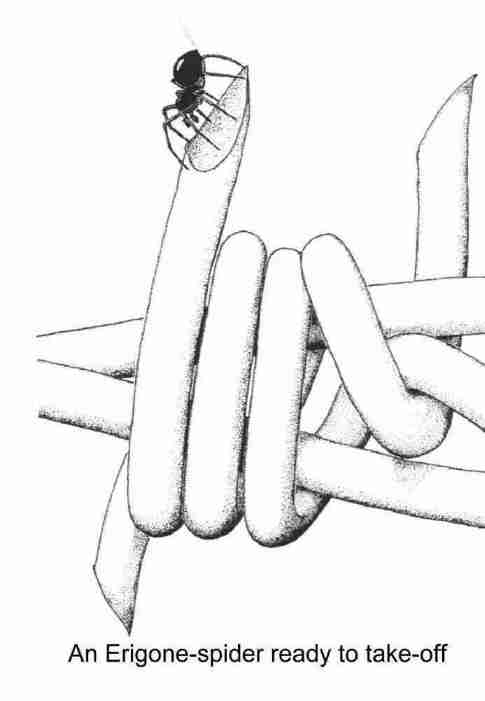
Ballooning

Aeronautical dispersing by means of air currents acting on strands of silk

Ballooning

Booklung

An air-filled cavity, containing sacks of blood-filled leaves, opening on the underside of the abdomen

Branchial opperculum

A sclerotized, hairless plate overlying the book lung

Terminlog2

Bulbus

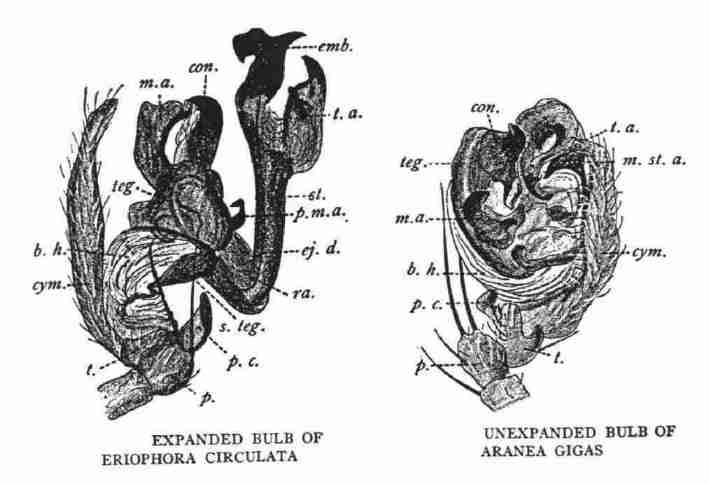
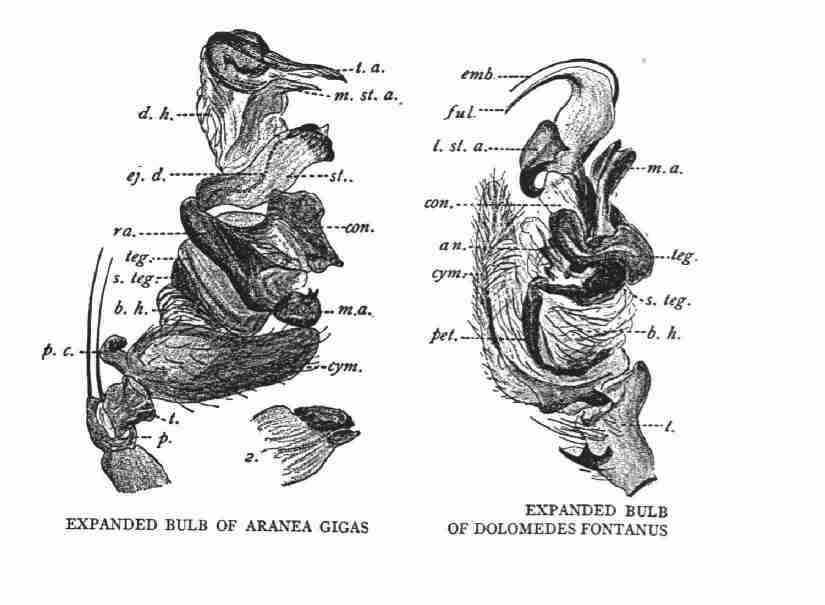
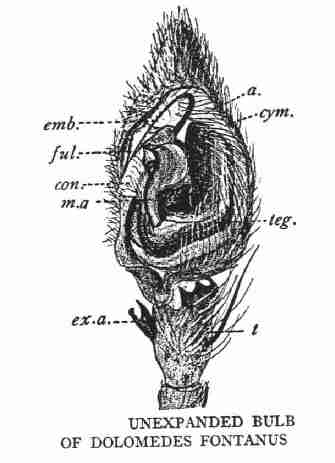
The genital bulb is the terminal segment of the palpus. It's an hollow organ with external elaborations. The bulbus is divided into three divisions: (1) Basal division, (2) Middle division and (3) Apical division

BulbusTerm2

Calamistrum

A comb-like series of hairs on metatarsus IV of cribbelate spiders

Calamistrum/Cribellum
Caput (pl. capita)

Another name for the cephalic region of the cephalothorax

Terminlog2

Carapace

The exoskeleton covering, or shell, over the dorsal (upper) surface of the cephalothorax

Thorax

Cardiac mark

An elongate midline mark on the anterior, dorsal surface of the abdomen which overlies the heart

Terminlog2

Cephalothorax

The anterior (front) of the two major divisions of the body of a spider

Terminlog2

Chelicerae

The jaws, each one comprising a large basal part and an fang

Terminolog1
Chelate

Said of chelicerae in which the fang closes down on a tooth-like process

Chilum (pl. Chila)

Small sclerite at the base of chelicerae, just under the clypeus

Chitin

A linear homopolysacheride found as the characteristic molecule in the cuticle of arthropods. The molecules are layered in chains and cross-linked to form a strong, lightweight basis of the cuticle

Claw tuft

A bunch of hairs at the tip of the leg tarsus in spiders with only two claws

Terminolog1

Clypeus

The area between the anterior row of eyes and the anterior edge of the carapace

Terminolog1

Colulus

A small midline appendage or tubercle arising just in front of the anterior spinners in some spiders

Conductor

A semi-membranous structure in the male palp which supports and guides the embolus in insemination

BulbusTerm1

Condyle

A smooth, rounded protuberance sometimes present on the outer side of the chelicera, near its base

Coxa (plural: Coxae)

The segment of legs nearest the body; modified in the palp to form the maxilla

Terminolog1

Cribellum

A spinning organ just in front of the spinners which appears as a transverse plate. Only present in cribellate spiders, which also have a calamistrum

Calamistrum/Cribellum
Cryptozoic Living a concealed live

Cymbium

The broadened, hollowed-out tarsus of the male palp within which the palpal organs are attached

BulbusTerm1
BulbusTerm2
Diaxial

Said of chelicerae extending downwards with fangs closing towards midline

Spiderworld
Dionychous

Possessing two claws on tarsus

Distal

Pertaining to the outer end, furthest away from the body or point of attachment

Dorsal

Pertaining to the upper surface

Dorsum

The upper surface

Ecdysis

Moulting; the periodic casting off the cuticle

Ecribellate Without a cribellum and calamistrum
Edentate

Without teeth

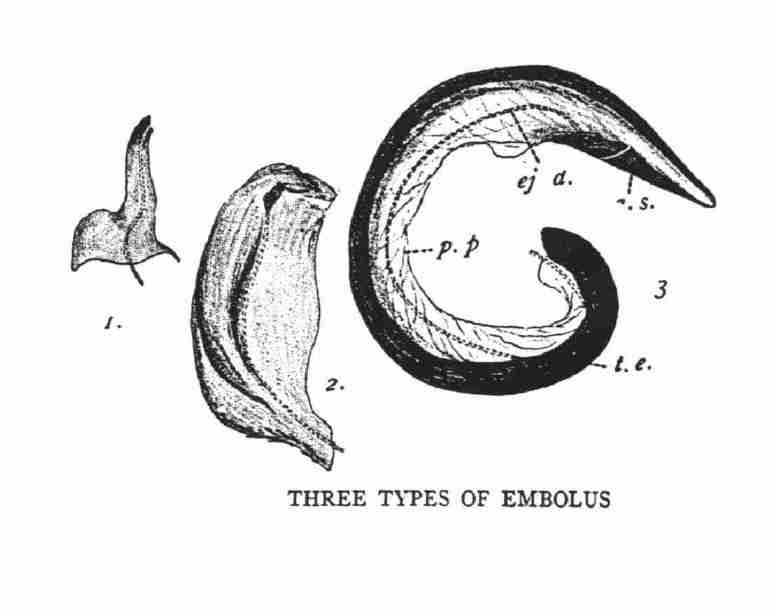
Embolus

The structure, in the male palp, containing the terminal part of the ejaculatory duct and its opening. It may be very small, or long, whip-like or coiled and is sometimes divided into several structures

BulbusTerm1
Embolus
Endite

Basal segment of palp, also called the maxilla or gnathocoxa

Terminolog1

Entelegyne

The group of spiders in which the females have an epigyne

Epigastric fold

A fold and groove separating the anterior part of the ventral abdomen (with epigyne and book lungs) from the posterior part

Terminlog2

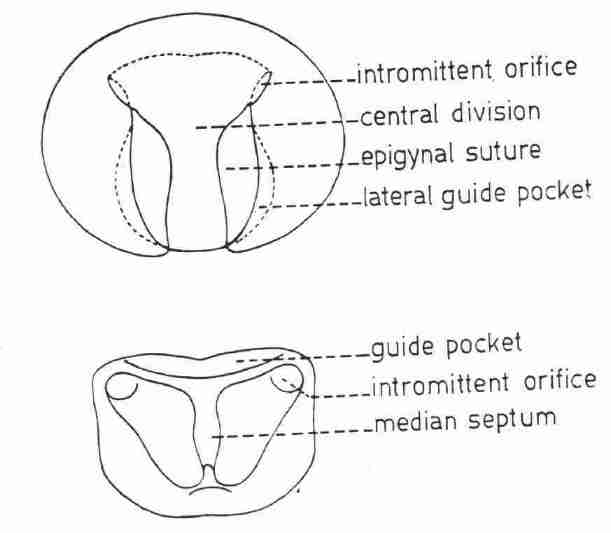
Epigyne

A more or less sclerotized and modified external structure associated with the reproductive openings of adult females of most spiders

Terminlog2
Epigyne1

Exoskeleton

The hard ,external, supportive covering found in all arthropods

Exuviae

The parts of cuticle cast off during moulting

Fang

The claw-like part of each chelicera; the poison duct opens near its tip

Terminolog1

Femur (pl. femora, adj. femoral)

The third segment of the leg, counting from the body

Terminolog1
Fissidentate

Teeth having more than one point

Folium

Any pattern of pigment on the dorsum of the abdomen which is fairly broad and leaf-shaped

Terminlog2

Fovea

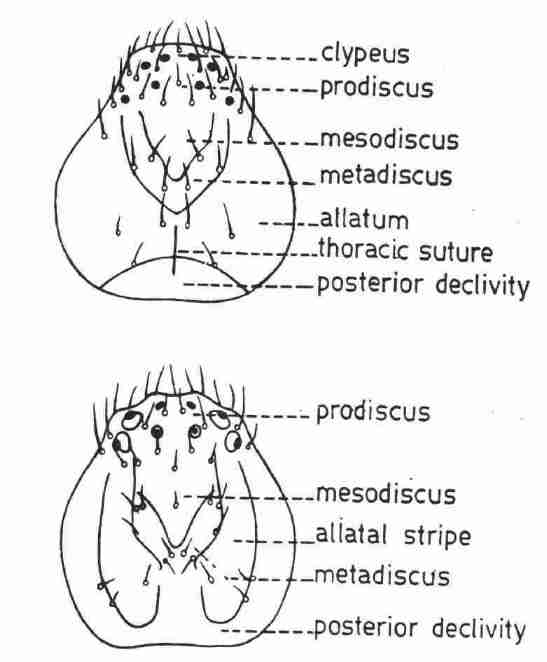
A short median groove on the thoracic part of the carapace which marks the internal attachment of the gastric muscles

Terminlog2

Gnathocoxa (pl. gnathocoxae)

Basal segment of palp, also called maxilla or endite

Terminolog1

Gossamer

A light film of silk threads, or groups of these floating through the air

Haematodocha

A balloon of elastic connective tissue between groups of sclerites in the male palp which distends with blood during insemination causing the sclerites to separate and rotate

BulbusTerm2

Haplogyne

The group of spiders in which the females have no epigyne

Head

The part of the carapace carrying the eyes which is separated from the thorax by a shallow groove

Terminolog1

Labium

The lip, under the mouth opening and between the maxillae, attached to the front of the sternum

Terminolog1

Lateral

Pertaining to the side

Lanceolata

Tapering to a point

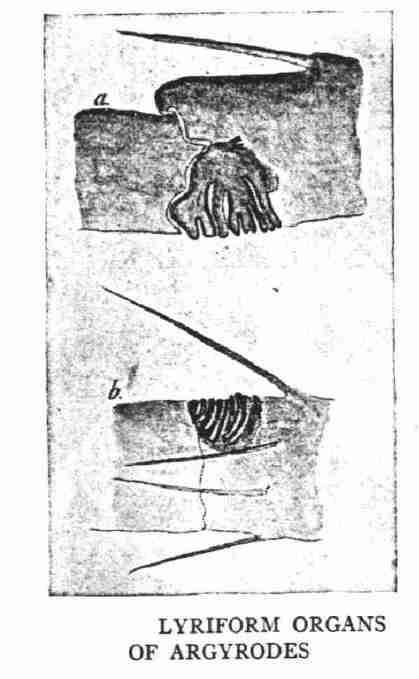
Lyriform organ

A sensory organ near the distal end of limb segments formed of a group of parallel slit organs

Spiderworld

Maxilla

The mouthparts on each side of the labium which are the modified coxae of the palps

Terminolog1

Median

In the midline or in the middle

Terminolog1

Median apophysis

An sclerite arising from the middle division of the male palpal organs

BulbusTerm2

Median septum

Longitudinal sclerite on floor of epigynal atrium

Epigyne2

Metatarsus (pl. Metatarsi)

The sixth segment of the leg, counting from the body

Terminolog1
Onychium (pl. Onychia)

Ventral extension of tip of tarsus bearing the claws

Terminolog1

Orb web

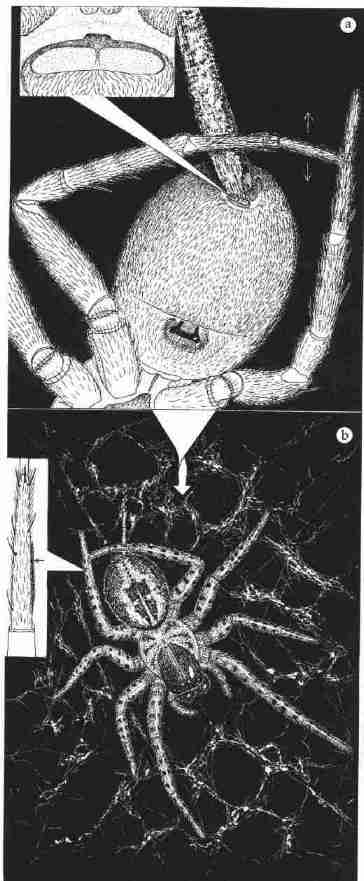
A two dimensional web, roughly circular in design (and strictly speaking, a misnomer). Silk threads radiate like spokes from a central hub. These are then overlaid with a spiral of silk, running from the periphery almost to the hub.

There is a very nice movie on my home page.... Have a look...Spiderworld

Palp

Short for the pedipalp. The appendage arising just in front of the legs, the coxa of which also forms the maxilla. It has no metatarsal segment and in adult males is greatly modified for the transfer of semen

Terminolog1

Palpal organs

The more or less complex structures found in the terminal part of the adult male palp. They comprise groups of sclerites separated from each other and the cymbium by up to three haematodochae and contain the semen reservoir which opens via ducts through the tip of the embolus

BulbusTerm1

Paracymbium

A structure in the male palp branching from, or loosely attached to, the cymbium

BulbusTerm2
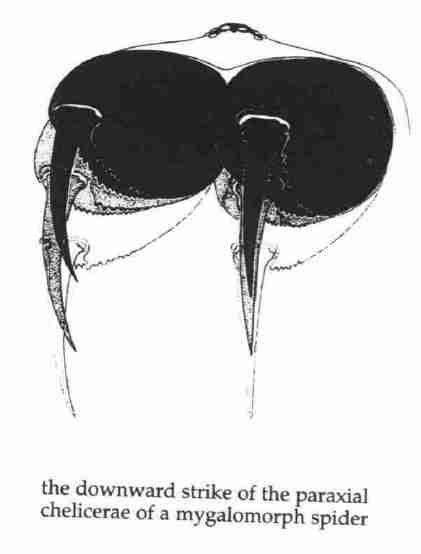
Paraxial

Said of chelicera extending forwards, with fangs closing towards abdomen

Spiderworld

Patella(pl. Patellae)

The fourth segment of the leg or palp, counting from the body

Terminolog1
Paturon Basal segment of chelicera Terminolog1

Pedicel

The narrow stalk connecting the cephalothorax and the abdomen

Terminlog2

Pheromone

A chemical secreted by an animal in minute amounts which brings about a behavioural response in another, often of the opposite sex

Phylogenetic

Pertaining to evolutionary relationships between and within groups

Pluridentate

Having more than one tooth

Porrect

Said of chelicera directed forwards

Posterior

Near the rear end

Terminlog2

Process

A projection from the main structure

Procurved

Curved as an arc having its ends ahead of its centre

Terminolog1

Prolateral

Projecting from, or on, the side facing forwards

Proximal

Pertaining to the inner end; closest to the body or point of attachment

Punctate

Covered with tiny depressions

Rastellum (pl. rastella)

Rake-like structure at extremity of chelicerae in Mygalomorpha, often reduced to a few strong spines; use for burrowing

Receptaculum (pl. receptacula) See: spermathecea BulbusTerm1

Recurved

Curved as an arc having its ends behind its centre

Terminolog1

Reticulated

Like network

Retrolateral

Projecting from, or on, the side facing backwards

Rugose

Rough, wrinkled

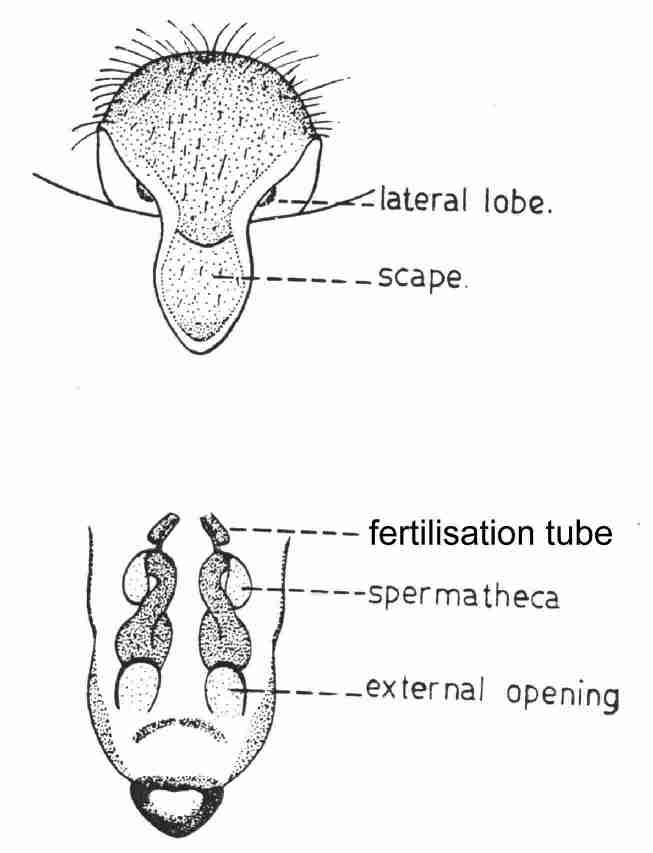
Scape (Scapus)

A finger-, tongue-, or lip-like projection from the midline of the female epigyne

Epigyne1

Sclerite

Any separate sclerotized structure connected to the other structures by membranes

Sclerotized

Hardened or horny; not flexible or membranous

Scopula (pl. Scopulae)

A brush of hairs on the underside of the tarsus and metatarsus in some spiders

Terminolog1

Scutum

A hard, often shiny, sclerotized plate on the abdomen of some spiders

Septum

A partition separating two cavities or parts

Epigyne2

Serrated

Saw-toothed

Seta (pl. setae)

Hair-like, tapered and flexible structures on legs and body (cf. spine and trichobothrium)

Terminolog1

Sigillum (pl. Sigila)

An impressed, sclerotized spot, often reddish-brown. Often present on the dorsal surface of the abdomen and marking points of internal muscle attachments

Slit organ

A stress receptor in the exoskeleton

Spermathecae

The sacs or cavities in female spiders which receive and store semen

Epigyne1

Spiderling

The nymphal or immature spider, generally resembling the adult, but smaller; fully mobile and no longer dependant on yolk

Spine

A thick, stiff hair or bristle

Terminolog1

Spinners

Paired appendages at the rear end of the abdomen, below the anal tubercle, from the spigots of which silk strands are extruded

Spiderworld
Terminolog1

Spiracle

The opening of the tracheae on the underside eof the abdomen

Sternum

The heart-shaped or oval exoskeletal shield covering the under surface of the cephalothorax

Terminlog2

Stria (pl. striae)

Paired depressions; usually three pairs of darkened stripes radiating from fovea

Stridulating organ

A file-and-scraper for sound production; may be variously located on chelicerae, palps, legs, abdomen and carapace

Subadult

Almost adult; the last instar before maturity

Synonym

Each of two or more scientific names of the same rank used to denote the same taxon. The senior synonym is the name first established

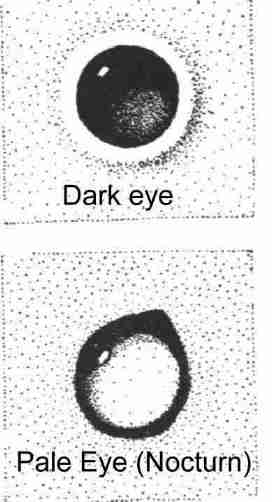
Tapetum (pl. tapeta)

A light-reflecting layer in secondary eyes; eyes appear pale in colour; assumed to be used for nocturnal vision

Spiderworld

Tarsus (pl. Tarsi)

The most distal (or end) segment of a leg or palp

Terminolog1

Taxon

Any taxonomic unit (e.g. family, genus, species)

Spiderworld

Taxonomy

The theory and practice of classifying organisms; part of systematics, the study of the kinds and diversity of organisms

Spiderworld

Tegulum

Part of the male palp: a discoidal sclerite

Tegulum
BulbusTerm2
Tegument

External cuticular skin

Thorax

That part of the cephalothorax behind the head region and separated from it by a shallow groove

Terminlog2
Thorax

Tibia (pl. Tibiae)

The fifth segment of the leg or palp counting from the body

Terminolog1

Tracheae

Tubes through which air is carried around the body and which open at the spiracles

Trichobothrium (pl. Trichobotria)

A long, fine hair rising almost vertically from a socket on the leg. Trichobothria detect air vibrations and currents

Trochanter

The second segment of the leg or palp, counting from the body

Terminolog1

Unidentate

Having one tooth

Ventral

Pertaining to the underside

Vulva

Internal structure of female copulatory organs, including entrance ducts, spermathecae and fertilisation ducts (in entelegyne spiders); internal genitalia including ducts and spermathecae (in haplogyne spiders)

Epigyne1


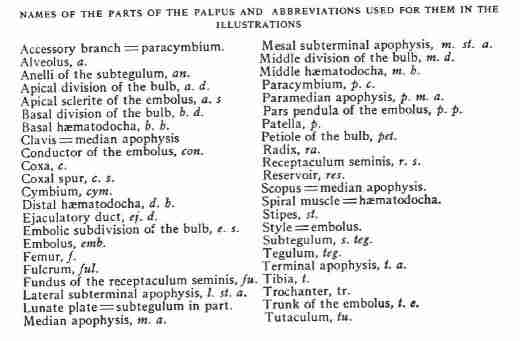
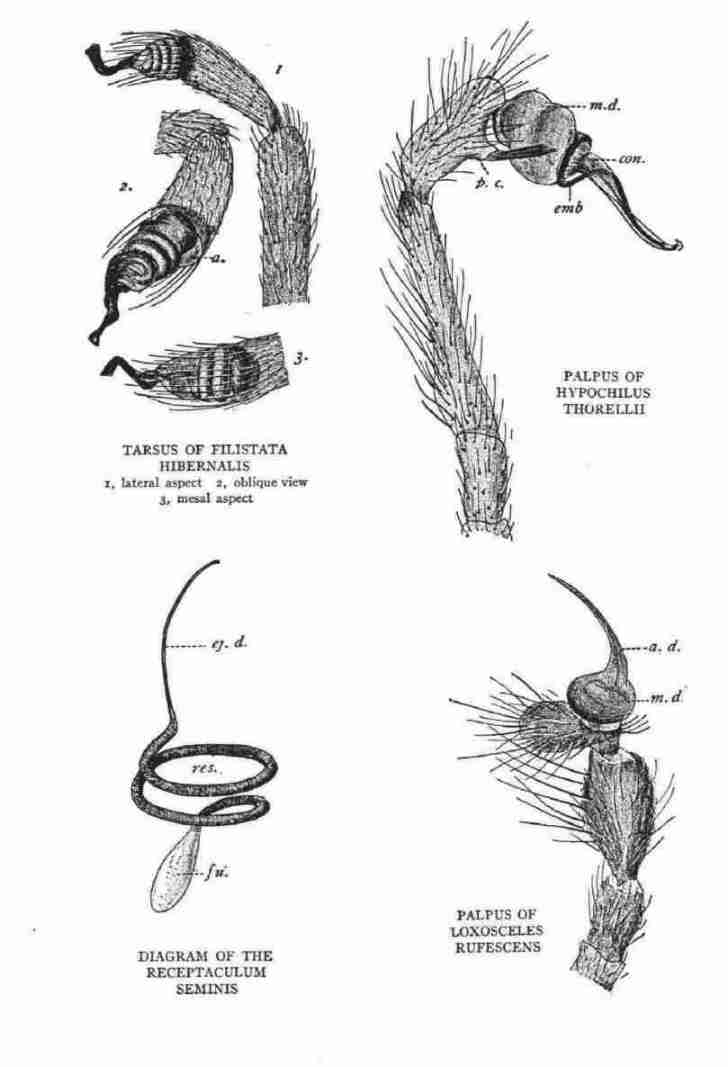
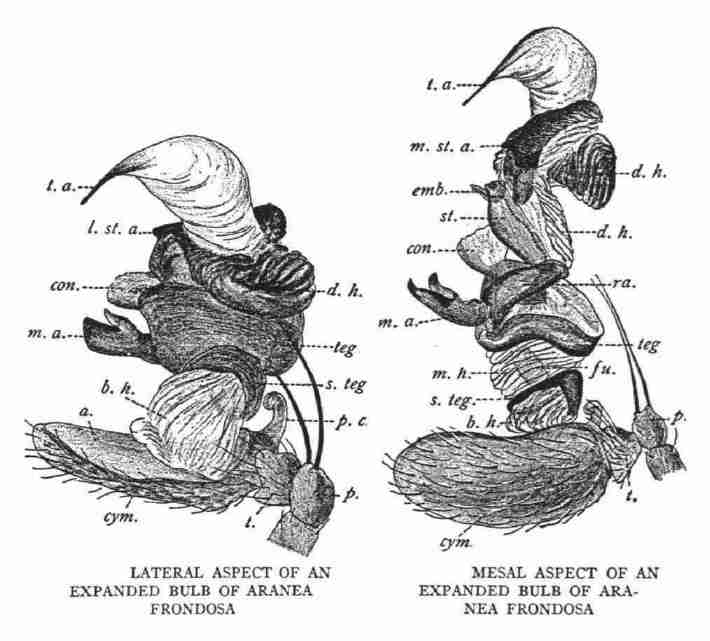
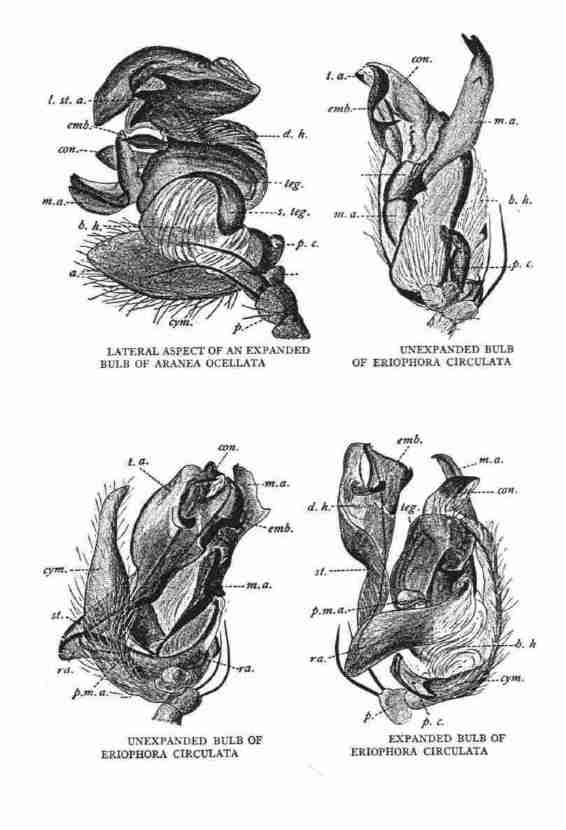
For those who are really interested in the whole genital-bunch, I included here some other drawings... Do not forget to READ the Abbreviation-part first... otherwise you'll understand the hell of it... (Except perhaps the few experienced ones...)
Enjoy yourself... Push the buttons!!!!!!

OtherImagesPush the button for the Abbreviations...

OtherImages OtherImages


Any Comments???? Email them to [email protected]

IndexPagina

Hosted by www.Geocities.ws

1