 Get your own Free Home Page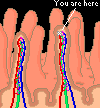

The inner walls of the small intestine are lined with thousands of tiny finger-like
projections known as villi. It is within the villi that the absorption of nutrients
obtained from the food during digestion takes place. The reason why the villi perform
this function instead of the intestinal walls themselves is that for efficient
absorption of nutrients, the surface area of the intestinal walls must be maximized. This
is accomplished by the villi, which provide significantly more surface area than would the
intestinal wall underneath and around them. Each villus is supplied by a small artery and
vein, and the capillaries joining the two surround a lacteal1, which
carries away products of fat digestion.
With all this talk about digestion, you start to feel hungry. So you decide to have
a nice bowl of Cheerios -- your cereal of choice as it carries the seal of approval
from the National Heart Association. Unfortunately, however, for some unexplainable
reason, all of the cereal in your food storage compartment is freeze-dried, just like
everything else in there. It's probably your stupid assistant's fault again. You decide
to eat the freeze-dried mass of Cheerios anyway, even though you can't pour any milk on them
for two reasons: one, the freeze-dried Cheerios would instantly disintegrate as soon as they
came into contact with any form of liquid; and two, you don't have any milk.

 Get your own Free Home Page