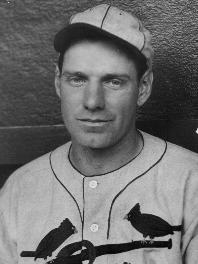
That picture is one of Leo Durocher playing for the mid 1930's Gashouse Gang. Probably one of the most beloved teams during that period, especially given the effects of the Great Depression in America. Watching the St. Louis Cardinals was fun at its best.
Leo Durocher would never be much of a hitter, but his fielding was his trademark talent along with his fiery demeanor. He would work for Branch Rickey, the GM of the Dodgers, who brought in Jackie Robinson. Leo stood up to the negative ballplayers that didn't get along with Jackie early on in his career. But Leo had little qualms about doing things that were considered 'unpopular' and 'possibly immoral', given the times and circumstances.
He was indicted and suspended for fighting a fan under the bleachers after a ballgame. He got fired by Mr. Rickey for his conduct, which included gambling and consorting with Bugsy Siegel of mob fame. But then 'got back' on Branch Rickey by winning pennants in both 1951 and 1954, finally winning the big one in 1954 with the NL archrival of the Dodgers: The New York Giants.
To change the subject, I wrote this piece on baseball changes between 1940-2000 to a sport reporter. It was mainly about the rule changes to the game, but it includes some thoughts about the concept of right-handed and left-handed hitting.
First, in 1950, the strike zone was redefined as being from the armpits to the top of the knee. Evidently, the umps back then (or complaints from the players) were getting out of hand and hitters and pitchers needed this stated again for their benefit. (See: Baseball Encyclopedia for rule changes and game scoring changes.) Or this was just to further define rules that were not so clear cut.
Second, in 1963, the strike zone was expanded to the top of the shoulders to the bottom of the knees. Analysis of pitching strikeouts per team during this era reflects greater strikeout percentages. With the Pitching Mound all ready ‘set’ at 15 inches (a rule change originally made in 1903), this did give power pitchers (or great curveball pitchers) an advantage over most all hitters.
In 1969, after 6 years of anemic offense, the mound was lowered and the strike zone shrunk back to 1950 standards. This did not however precipitate an enormous increase in offense in the impending years. Essentially, run scoring did revert back to pre-1963, post-1950 standards. But strikeouts continued much as they had for a decade. Hitters were probably more willing to expand their strike zones instinctually and it is generally reflected in strikeouts records of that era (the early 1970’s.) Hitting the long ball was partly the reason for this too.
The turmoil of the mid -1970’s and early 1980’s era was due to the introduction of unrestricted free agency (and the reentry draft), league expansion (a continuation of the 1960’s), owner lockouts, player strikes and the DH rule. All would have a significant role in the ‘redefining’ of the AL versus the NL play, but also the players’ wants versus the owners’ greed. Statistically, this era shows the first significant change in run scoring for each league upon adoption of the DH.
Oddly, the stolen base was the real 'new' weapon, at least statistically, that emerged during this era. Before 1974, the league average never top 100 SB/per team since 1941. Since then, rarely has it dipped below that marker. Speed has always been a plus, but rarely have players taken advantage of using it like they do during these recent times.
Homeruns/per team/per season did not rise until after 1994. Whether it is just steroids, newer ballparks (designed for power – the ‘Coors effect’, The Ballpark at Arlington, Minute Maid, U.S. Cellular or Kauffman Stadium to name a few hitters’ havens), overly aggressive league expansion (causing a watering down of pitching talent vs. better hitters) or just chance, something has skewed the offensive numbers significantly enough to have increased run scoring to new heights. Strikeouts are higher than ever, though possibly due to ‘going for homeruns’ instead of solid contact hitting, like the 1950’s and 1960’s are deemed to have been. (Walks have never varied much by league during the last 65 years…)
As a side note, the theory about left-handed hitters being better low-ball hitters is possibly due to using ‘bottom hand’ more on hitting. As you stated, the tendency of lefties is to uppercut when swinging (due to gravity aiding the batters’ swing), but also this might pertain to their using their right hands better. This is due to a left-hander having to utilize their right hands more in a right-hand dominant world, against what they would usually do. As such, it becomes easier to swing a bat in that particular way. Whereas, right-hand hitters, use their left hands less, in general, because they don’t need to, in normal, every day life.
Therefore, righties are more likely to be top-hand dominant swingers, or at least less proficient at bottom-hand methods. (Strength of handedness is measurable and seen in many players’ swings.) Obviously, the best hitters can utilize both types of swings (rolling over the top hand or rotating the bottom hand), depending on the pitch location and situational hitting. (Usage of top hand by lefties works against the natural gravity argument you made, unless it is necessitated by the pitch location, and thus they are probably less prone to use it...)
This relative theory is also combined with pitcher vs. hitter handedness match ups. But that is also defined by pitch selection and which side of the plate the pitcher works best and the hitters’ aptitude for hitting specific pitches at given velocities in given locations. (Having a slider-speed bat…for example.)