
The Fisherman's Net Malawi Journal


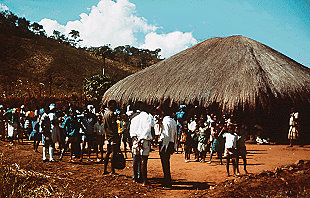

The people gather around the church building to visit before the Sabbath worship service begins. The traditional order
of service is a formal worship service first followed by Sabbath School. Because many people have to come long distances
there is usually a dinner after the Sabbath School.
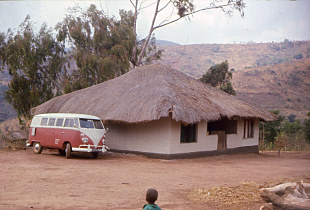
Pastor Mzamara had a parsonage that was large enough for all of us to stay in while we held services in Uzamara Village. Notice the similarity in the pastor's name and the name of the village. In the chiChewa language the "M" means "the people of..." and the "U" means "the place of..."
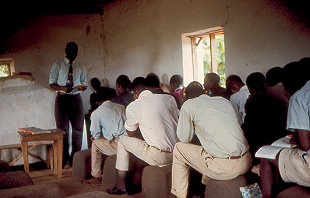
The Seventh Day Baptist church buildings in Malawi do not have separate rooms for Sabbath School
classes. One class will usually meet inside and the other classes meet outside. Even during the rainy season the
mornings are usually a dry time.
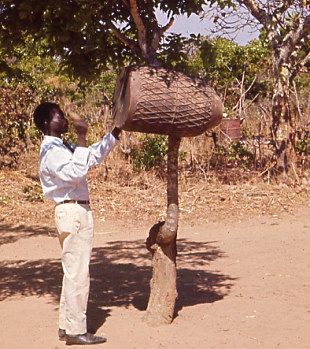
Here in the United States as well as in many places in the world a church bell is rung to announce the time
of worship. Not so in the northern region of Malawi. In this area a traditional African drum is used to call worshippers
to the Sabbath worship service. The singing is also different in the North with more a traditional African musical score. Click the button at the top to listen to a typical Tumbuka hymn.
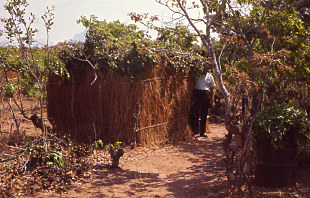
The first year I arrived in Malawi I went with David and Betty Pearson to
visit churches in the Northern region of Malawi. I did not realize that I needed to bring my own tent in which to
sleep so I stayed part of the time in a little shed made by the villagers out of tree branches while the Pearsons slept in a tent.
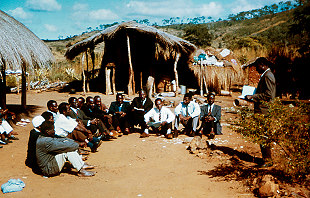
Although the men's Sabbath School class usually meets inside the church building, this one is meeting outside. Because it it the dry season, meeting out of doors is not a problem. During a bad rainy season Sabbath School classes are limited or not held at all.
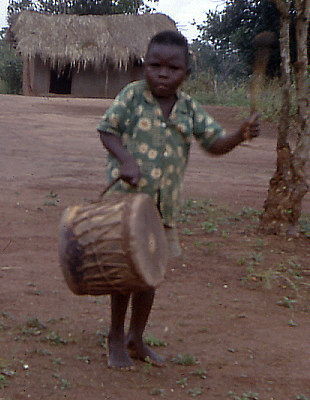
In another village a young boy was given the privilege of calling the worshippers. Although both he and the drum are much
smaller than the one in the previous village, he made up the difference by his enthusiasm!
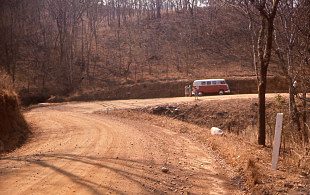
We made our own "rest stops" when we needed to prepare lunch en route. There wasn't any place to pull off the road in
this area but no matter. We never saw another vehicle on the road in either direction all that day and most of the other days as well.
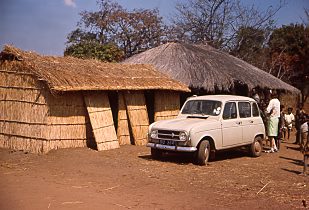
Joyce and I and the boys made a trip with Mbusa Watson Mataka to visit the
Seventh Day Baptist Churches in the Central region of Malawi. The churches of
the Central region had expected us to also stay in a grass and branch shed but
since no one told us what to expect on the trip we hadn't come prepared for it.
We ended up staying in a nearby government rest house near Lake Malawi. When
the Marlboro Young Adult class wrote and asked us if there was anything they
could send us that we needed, we asked them to send us a tent.
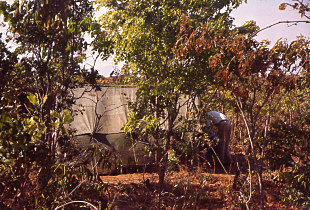
That first year I went with David and Betty Pearson to visit churches in the Northern region of Malawi, this is the tent in which the Pearsons slept. A little roomier than the little grass shed I was using, wouldn't you say? I'm glad we were visiting during the dry season.
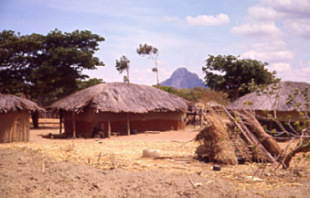
Many of the people in the north painted their homes. This one was painted orange.
On one of our many trips to bush churches we had a very unusual experience. An elderly lady had come forward at the close of a church service in response to an invitiation given to accept Jesus as her Savior and become a Christian. She told us all her life she had believed that there had to be such a God.
Go to
the Mount Mulanje Page
Go to
the Malawi Index Page

.
.

Last update: January 8, 2004.


Tumbuka WAV file Copyright © 1999 Conrod Technical Services


 Get your own Free Home Page