
The Greeks Completed in November 1999, 'The Greeks: Crucible of Civilization' was a major three-year project involving a multi-talented production team drawn from both traditional documentary television and the new media technologies.
The Prehistoric Archaeology of the Aegean 29 lessons. Introductory lesson explains Helladic, Cycladic, and Anatolian. Others on palaces in the Aegean, Minoan art, shaft graves, religious architecture, and ordinary housing.
Greek Civilizations in the BRONZE AGE Lake Forest has a pretty darn good site on Bronze Age Greece.
MINOS'S PALACE AT KNOSSOS The palace of King Minos was rich in mythological lore. Minos himself was believed to be the son of Zeus--the result of one of Zeus's many affairs with mortal women.
Introduction to Ancient Greece The history of Greece can be traced back to Stone Age hunters. Later came early farmers and the civilizations of the Minoan and Mycenaean kings. This was followed by a period of wars and invasions, known as the Dark Ages. In about 1100 BC, a people called the Dorians invaded from the north and spread down the west coast. In the period from 500-336 BC Greece was divided into small city states, each of which consisted of a city and its surrounding countryside.

MEET THE GREEKS! Explore the daily life of the ancient Greeks here.
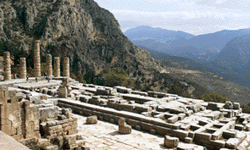
The Land of Ancient Greece Greece is the southeasternmost region on the European continent.
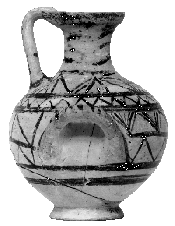
Sub-Mycenaean Period and the Early Iron Age The final collapse of the Mycenaean civilization around 1100 BC marked the end of the Aegean Bronze Age. A period of severe economic and cultural depression followed.
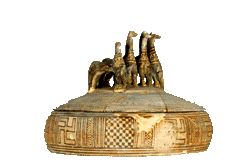
Geometric Period The Geometric period was a time of startling innovation and transformation in Greek society. The population dramatically increased and proto-urban life re-emerged, bringing with it overcrowding and political tensions. The Greeks moved to new lands to the east and west where they founded commercial trading posts and colonies.

Archaic Period During the Greek Dark Ages, the Greeks lived in small tribal units; some of these small tribes were sedentary and agricultural and some were certainly nomadic. They had abandoned their cities between 1200 and 1100 BC for reasons that remain shrouded in mystery; the Greeks believed that a cataclysmic and ferocious invasion of northern Greek barbarians, the Dorians, had wiped out the Mycenean civilization.
Early Archaic Period The Geometric period was a time of startling innovation and transformation in Greek society. The population dramatically increased and proto-urban life re-emerged, bringing with it overcrowding and political tensions. The Greeks moved to new lands to the east and west where they founded commercial trading posts and colonies.

Classical Greece The Classical Age of Greece begins with the Persian War (490-479 B.C.) and ends with the death of Alexander the Great (323 B.C.). Besides war and conquest, in this period the Greeks produced great literature, poetry, philosophy, drama, and art.
The Persian Wars Like the Trojan War, the Persian Wars were a defining moment in Greek history. The Athenians, who would dominate Greece culturally and politically through the fifth century BC and through part of the fourth, regarded the wars against Persia as their greatest and most characteristic moment.
Classical Period The end of the Persian Wars marked the beginning of the Classical period.


The Age of Pericles In 461 BC, under the leadership of Pericles, Cimon was ousted from power. Athens overnight changed direction in domestic and foreign politics. In foreign affairs, Athens began to define its role in direct relationship with Sparta rather than in relationship with Persia.

The Peloponnesian War Suspicious and fearful of Athenian power and wealth, the Spartans were not happy with the thirty year peace they had agreed to. The Athenians themselves had become chauvinistic and power hungry, and seemed ready to begin to reassert their power on the mainland of Greece. In 431, spurred on by a relatively trivial event in a distant part of the Greek mainland, Sparta and Athens fell into another war which is simply called, The Peloponnesian War.

Athens Athens entered the Archaic Period in the same way so many of its neighbors, as a city-state ruled by a basileus , or "king." Unlike Sparta, however, Athens' history was not dominated by invasion of a neighbor, for the land around Athens was agriculturally rich and the city had a harbor so that it could trade easily with city-states around the Aegean.

Sparta It's hard for textbooks to say anything nice about the Spartans. Take up any world history textbook and read; you'll find that the Spartans were "an armed camp," "brutal," "culturally stagnant," "economically stagnant," "politically stagnant," and other fun things. The reality, of course, lies somewhere behind the value judgements.
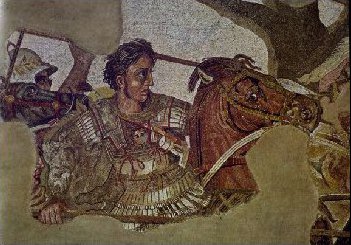
Hellenism In spite of the political turbulence and chaos of the fourth century BC, Greece was poised on its most triumphant period: the Hellenistic age. The word, Hellenistic, is derived from the word, Hellene, which was the Greek word for the Greeks. The Hellenistic age was the "age of the Greeks; during this time, Greek culture and power extended itself across the known world.
Hellenistic Period Following the death of Alexander the Great, his kingdom was split into three by his generals. The Antigonid dynasty maintained control of mainland Greece. The Seleucids governed the entire eastern empire, the largest portion of the territory, while the Ptolemies ruled the land of ancient Egypt.

Philip of Macedon ascended the throne of Macedon in his late twenties. He had found himself regent, that is, the individual in charge of the kingdom because the king was only an infant. As regent, he promptly overthrew his infant nephew, the king, and crowned himself king in 359 BC. In his early twenties, however, he had been a Macedonian hostage living in Thebes during the heyday of the Theban hegemony.

Alexander the Great The decisive battle of Philip's conquest of Greece occurred in 338 BC at Chaeronea in Boeotia, when Philip beat the Athenians and their allies. The military feat that won that day was a cavalry charge by Philip's eighteen year old son, Alexander. Alexander seems to have inherited much from his brilliant father: physical courage, arrogance, extreme intelligence, and, most importantly, unbridled ambition. For when his father died in 336 BC at an assassin's hand, Alexander quickly consolidated his power and set out to conquer the world. At the age of twenty-one.

The Three Empires While there is much controversy among historians about the significance of Alexander in Greek history and culture, there is no question that the Alexandrian empire was built because of his military genius and his unbridled ambition. Whether or not Alexander could have kept this unimaginably large empire together is an unanswerable and ultimately useless question. It is clear, however, that his death, only a year after completing his Herculean conquest of the world, spelled the end of the empire he had acquired so quickly.
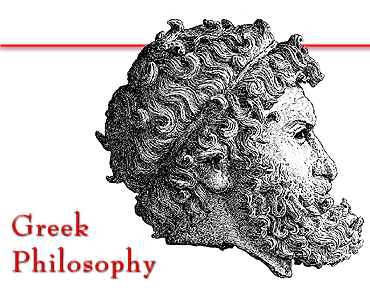

Sophists, Pythagoreans, Xenophanes , etc... What we like to think of as "philosophic thought" first appears in Greece in a poem, Theogony , written by Hesiod about 725 B.C.; the Theogony retells the myths of the gods and speculates in part about the origins of things and the order of the universe. What we generally call "Greek philosophy" was almost certainly derived by the Greeks from Egyptian culture, particularly natural science (physics and math) which preoccupied Greek thought up to the time of Plato.

Socrates Socrates (469-399), despite his foundational place in the history of ideas, actually wrote nothing. Most of our knowledge of him comes from the works of Plato (427-347), and since Plato had other concerns in mind than simple historical accuracy it is usually impossible to determine how much of his thinking actually derives from Socrates.

Plato The most famous of Socrates's pupils was an aristocratic young man named Plato. After the death of Socrates, Plato carried on much of his former teacher's work and eventually founded his own school, the Academy, in 385. The Academy would become in its time the most famous school in the classical world, and its most famous pupil was Aristotle.

Aristotle Aristotle represents for most of us an icon of difficult or abstruse philosophical thinking; to know Aristotle often provokes hushed whispers even from highly educated people. For all this reputation, though, Aristotle is actually quite an easy read, for the man thought with an incredible clarity and wrote with a superhuman precision.

Epicureanism, Stoicism, & Scepticism Alexander's great conquests led to the end of the independence of most of the small city-states and the founding of huge empires ruled by dynasties of monarchs, with arbitrary powers and a massive bureaucracy; there was also a great deal of mixing of Greeks and non-Greeks because of the settlements of Greek armies and the founding of new cities, such as Alexandria and Antioch.
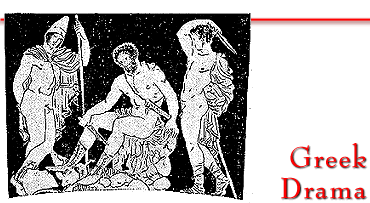
Tragedy and Comedy Three types of drama were composed in Athens: tragedy, comedy, and satyr plays , the latter of which seemed not to be taken quite as seriously, at least during the Greek Enlightenment (450-400).
Who's Who in Greek Legend When you're reading the literature and history of Ancient Greece, there are a few names that should be as familiar to you as Shakespeare, the Bible, Kennedy, or Hitler. Below you will find a list of such major names from legend for quick reference. Related features on this site are listed beneath each description.

Who was Hercules? There were many heroes who could claim Zeus as their father, but few were immortal. Hercules (also called Heracles) and his half brother Dionysus (Bacchus) claimed immortality as an accident attendant at birth.
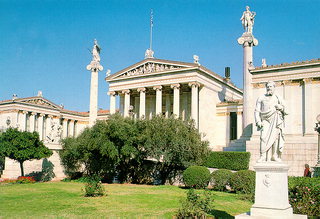
Alphabetical List of Monuments From The Greek Ministry of Culture, a list of photos of Greek monuments both ancient and modern.
Ancient Greek Architecture Thirteen structures with architectural details. Include Temples of Athena Nike, Paestum, Artemis, Apollo, and Fourth Temple of Hera.
Who Were the Greek Historians? "Should one take each being singly and clarify its nature independently, making individual studies of, say man or lion, or ox and so on, or should one first posit the attributes common to all in respect of something common?" (Aristotle).

Athletics, War, and Aggression in the Greco-Roman World The purpose of this talk is to examine the connection between Greek athletics and warfare, with a brief excursion into Roman sport. Our sources will be selections from the Iliad and the Odyssey: the funeral games for Patroclus presided over by Achilles, the informal athletic meet held by the Phaeacians in honor of Odysseus, and the battlefield confrontation between Achilles and Hector as one example of Homeric warfare. You have also the selections that accompanied Prof. Harris' lecture on Homeric and hoplite warfare.
The Ancient Olympics The Centennial Olympic Games were held in Atlanta, Georgia from July 19-August 4, 1996. In their honor, we've created this exhibit on the ancient Olympics, using information from the Perseus Project, a digital library on ancient Greece. The Perseus Project is centered in the Classics Department at Tufts University.
Battle To Know About
