
The History of Ancient Egypt This site is a comprehensive overview of everything you might be interested in about Ancient Egypt. More details can be found in the links below.
Daily Life in Ancient Egypt What was life like for the average person in Ancient Egypt? Go here for answers.

The Valley of the Nile Like a giant lifeline in the midst of desperation, the Nile River, longest river in the world, cuts a swath of green and life through the barrenness of the giant Sahara desert in North Africa.

The Great Desert Seven or eight thousand years ago, at the farthest reaches of human memory, before there was Egypt or the pyramids, North Africa was a lush and green place.
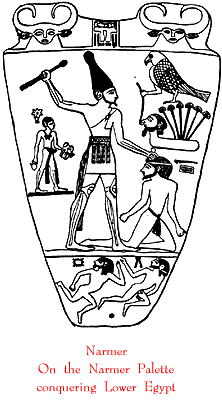
The Archaic Period From 3900 to 3100 B.C., the villages along the Nile valley grew in wealth and power. Two of these villages became particularly powerful and wealthy, so much so that it is not an exaggeration to think of them as cities. In the north, the city of Nekheb (named by the Greeks, Hieraconpolis or "city of the falcon") grew powerful, while in the south, Nekhen grew powerful.

The Old Kingdom While the unification of Egypt in the Archaic period was the single most important event in Egyptian history, it was a long and drawn-out affair. Although Narmer is credited with unifying the country, all the kings of the first two dynasties had to fight constant wars against considerable opponents all along the Nile.

1st Intermediate Period After the magnificence and creative energy of the Old Kingdom, the Nile began to a series of poor floods which caused widespread hunger and death.

The Middle Kingdom For one hundred years after the decline of the Old Kingdom (2134-2040 BC), the once proud land of Egypt splintered into dozens of independent states. It seemed as if the Two Lands and the king of the Two Lands would never appear again; but two kings, Intef and Mentuhotep, in the region of Luxor re-established order and reinstituted the institution of the Egyptian king.

The Hyksos The large-scale immigration of foreigners into the Nile Valley during the Middle Kingdom eventually spelled the end of the Middle Kingdom in Egypt. These foreigners remained non-naturalized "Asiatics" in the land of the pharoahs; they established their own communities and lived by their own laws. Eventually, as their numbers increased, they threatened the power of the Egyptian monarchy itself and Egypt fell into disarray.

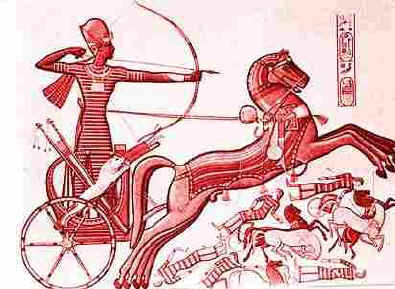
The Warrior-Kings After Amosis drove out the Hyksos and established the Eighteenth Dynasty, the Egyptian kings dedicated themselves to preventing the Hyksos disaster from ever happening again. The period of Hyksos domination was a chaotic and shameful time for the Egyptians, and they were determined never to see a foreign king lording it over Egypt ever again.

3rd Intermediate Period After the collapse of the Nineteenth Dynasty, the so-called Ramesside kings, Egypt descended into another period of political chaos.

The Late Period In 728 BC, after three hundred years of political chaos, Egypt was invaded by its sister civilization to the south, Nubia. The Nubians had built a civilization on the model of the Egyptians and had maintained Egyptian values and culture with a high degree of conservatism.

Ptolemaic Egypt When the Greek conqueror, Alexander the Great, entered Egypt in 332 BC, he intended to found a universal empire. At its height, Alexander's brief empire included all of Egypt, Greece, Thrace, Turkey, the Near East, Mesopotamia, and Asia all the way to India.


The Religion of Ancient Egypt Everything a beginner would ever need to know about Egyptian theology and more!
Egyptian gods and goddesses Here you will find a table of the major Egyptian gods and goddesses. Click on the links to learn more about a specific god or goddess.
Amen (Amon) and Amen-Ra, King of the Gods, and the Triad of Thebes Among the gods who were known to the Egyptians in very early times were Amen and his consort Ament, and their names are found in the Pyramid Texts, e.g., Unas, line 558, where they are mentioned immediately after the pair of gods Nau and Nen, and in connection with the twin Lion-gods Shu and Tefnut, who are described as the two gods who made their own bodies, and with the goddess Temt, the female counterpart of Tem.
Ancient Egyptian Religion In Egypt, what we now call religion, was so widely acknowledged that it did not even need a name. There is no indigenous name for religion within their own language.
Directory of Ancient Egyptian Gods Select the first letter of the Ancient Egyptian God you are looking for from the list above to jump to appropriate section of the directory.
Egyptian Gods Theme In 1993, the Social Science Data Lab at the University of Colorado at Boulder switched to a unix-based operating system and needed a theme for naming its machines. We decided on Egyptian Gods. Listed below are the names of all the machines on our network. Our initial server was osiris, and sobek is the server we installed in the summer of 1995.
Walk Like An Egyptian A glossary of the gods.
TWO APPROACHES TO AN EGYPTIAN PANTHEON: MEMPHIS AND HELIOPOLIS The following should not be viewed as a comprehensive explanation of Egyptian religion. The hundreds of Egyptian gods not mentioned below may be aspects of, or the same as, those who are included. However, this outline addresses only the first and second of the official cults of Egypt. From time to time and place to place in Egypt, one or the other of the gods or aspects of god might be advanced as the High God. The Memphite Theology predominated before about 2700 BCE, while the HELIOPOLITAN per-ception predominated intermittently thereafter.
Archaeology of Egypt Napoleon I and Vivant Denon paved the way in the discovery of Egypt in archeology. On July 2, 1798 Napoleon stepped onto Egyptian soil after leaving France. He was on his way to seize British lands in India but came upon resistence from British Naval forces.
Egypt Revealed This is by far the single most reliable web site for the latest studies and discoveries in ancient Egypt. This is the web site for Scientific American's new archaeology magazine, Egypt Revealed, the first, best place to begin!
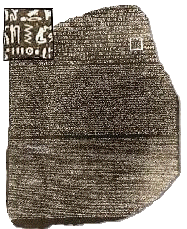
Hieroglyphs Great site. Full of information about hieroglyphics and more!
The Rosetta Stone Before about 1800, attempts at trying to uncover the secrets held by the ancient Egyptian hieroglyphics found on walls inside numerous tombs was useless. The pictures were falsely believed to be symbolic, representing some sort of object or idea. Something soon changed all that. The year 1799 was the beginning of an amazing breakthrough for Egyptology. This was the year in which French troops stumbled across the Rosetta Stone near a town in Lower Egypt known as Rosetta. The black basalt stone was inscribed with three different forms of writing: Egyptian hieroglyphics, demotic (a short-hand of hieroglyphics), and Greek written in 196 BC. The Rosetta Stone then became a key element in the decipherment of an Egyptian form of writing known as hieroglyphics!
The Hieroglyphic Alphabet Translate our alphabet into Egyptian Hieroglyphs!
MEDICINE IN ANCIENT EGYPT Historically, many Egyptologists focused primarily on the very visible aspects of ancient Egyptian society, such as the pyramids, much to the bain of those interested in more than just monumental architecture. From the beginning of the scholarly study of Egypt's past there have been few scholars who recognized the importance of the process of disease and health on a population.