

Liberty! is the story of the American Revolution---two and a half decades of debate and rebellion, war and peace. It begins in the aftermath of the French and Indian War and ends with the creation of the Constitution. LIBERTY! is a production of KTCA-TV, St. Paul/Minneapolis, in association with Middlemarch Films.
User's Guide to the Declaration of Independence The User's Guide to the Declaration of Independence provides a great resource for teaching a better understanding of the ideas on which American democracy is founded. The Declaration of Independence is fully hyperlinked to explanations of the terms and phrases and their historical context. Scanned copies of the original document are available in draft, engrossed, and printed forms. The site includes clear explanations of the essential ideas contained in documents. The Interactive Timeline chronicles the founding era of American history from 1763-1791. Included in this section are short biographies of historical figures of the time. The Issues section provides information on the relevance of issues of the day and contemporary issues. If visitors can't find the answer to a question, there is a link for sending it in to an "expert."
American Revolution Homepage By The Middle Of The 18th Century, Differences In Life, Thought, And Economic Interests Had Formed Between The American Colonies and Great Britain . . . This Is A Small Part of The History of That Struggle, Which Has Formed The Greatest Nation In The World.
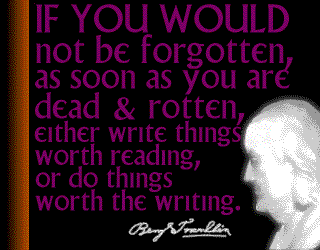
Benjamin Franklin America has never forgotten Benjamin Franklin because he did both. He lived these words of wisdom by writing as much as he possibly could and by doing even more. He became famous for being a scientist, an inventor, a statesman, a printer, a philosopher, a musician, and an economist. Today, we honor Ben Franklin as one of our Founding Fathers and as one of America's greatest citizens. Although he was born in Boston, the city of Philadelphia is remembered as the home of Ben Franklin. In Philadelphia, you can find both Ben's gravesite and the Benjamin Franklin National Memorial. You'll also find The Franklin Institute Science Museum.

Patriots Not a complete list but a good place to start to learn about the great men that risked EVERYTHING so we could be free today.
The Road to Independence America's struggle for Independence from 1774 - 1783.
Valley Forge Valley Forge is the story of the six month encampment of the Continental Army of the newly formed United States of America under the command of General George Washington, a few miles from Philadelphia, Pennsylvania.

Declare the Causes: The Declaration of Independence Students have been known to complain at times. (So have their teachers.) Even the Founding Fathers of our country indulged in gripe sessions. In fact, a list of grievances comprises the longest section of the Declaration of Independence; however, the source of the document's power is its firm philosophic foundation.

Why do we have an American flag? Most students can recognize their country�s flag, but have they ever thought about how it was designed and what it represents? It�s important that they start thinking about the ways in which people have joined together to form nations, states, and other unions. Learning about national flags will help them in this process. They�ll consider how a flag represents a country�s people and resources and why a flag can evoke emotions.
Battles To Know About
Lexington & Concord On the 15 of April 1775, when General Thomas Gage, British Military Governor of Massachusetts, was ordered to destroy the rebel's military stores at Concord.
Bunker(Breeds) Hill After retreating from Lexington in April, 1775, the British Army occupied Boston for several months. Realizing the need to strengthen their position in the face of increasing anti-British sentiment in and around Boston, plans were developed to seize and fortify nearby Dorchester Heights and Charlestown peninsulas.
Saratoga Historians consider the Battle of Saratoga to be the major turning point of the American Revolution. This battle proved to the world that the fledgling American army was an effective fighting force capable of defeating the highly trained British forces in a major confrontation. As a result of this successful battle, the European powers, particularly the French, took interest in the cause of the Americans and began to support them.
Monmouth As British General Clinton prepared to evacuate Philadelphia there was strong sentiment in the Continental Army command that a cooperative effort between their army and the newly allied French naval fleet might result in winning the war,