ITALIAN MOUNTAIN TROOPS
5th Alpini Regiment
The Italian Withdrawal from the Don River(15 January 1943 -5 February 1943).
Out the Pocket after the Russian "Little Saturn" Operation.
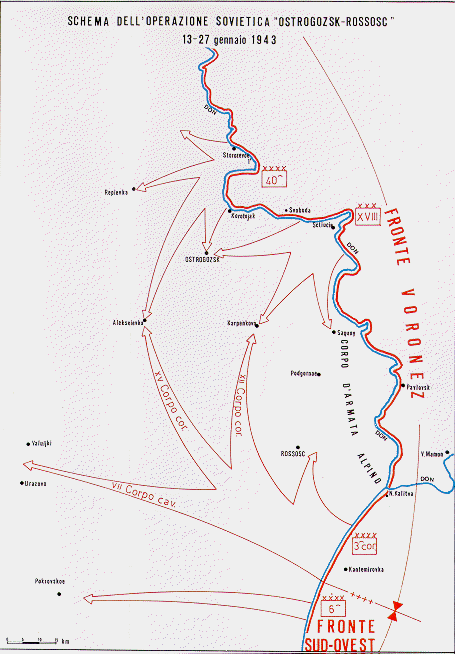
Ostrogoshsk - Rossoch Operation
The Russian drive's lineage against Axis' troops -13-23 January194 (From Stato Maggiore Esercito)
1 December 1942
At this moment the line's strenghtening had achieved the most efficiency: There were barbed wires, mine fields (antitank and antimen) over several sequences. In front of Belogorije an antitank ditch had a lenght of about 1 kilometer and almost completely it closed up the entry to the dell. There were machinegun and antitank guns' armoured weapon-pits, skilful to hold at medium calibers, and many bunkers for the men. The trenches and the paths were deep, well drafted and all covered; The defensive works were deep echeloned; the reinforcements adeguate, well arranged, at commanders' disposal; the command and observation posts were serviceable and safe, linked by moltiple wire and radio nets, also enable to operate in very cold days and after the heavy shellings of the "katiushes".
The framework's soundness and the detachments' firmness pointed up on 16 and 17 January 1943, when along 48 hours the "Edolo" Battalion had subject at heavy shellings and furious attacks by the Russian infantry even more numerous.
Across the positions of the Alpini Korps Russians pointed towards Rossoch. Here they didn't pass, but they had succesfull to reach the town through the breach that had open in December in the front held by Italian II Corps, pushing on about 200 kilometers towards West and reaching Rossoch with a strong heavy tank column. At this point the "Tridentina" Alpine Division became hard: while its parts held the front line them allotted on the Don River, repelling all Russian attacks, at dawn of 15 January more than 20 Russian T34 by surprise penetrated into Rossoch, where the command of Alpine Corps was situated, coming from West , from the rear.
The Rossoch's defensive fighting was hard and complex, also muddled. While the Place's Headquarters managed the defence, several Stukas flew over the place shooting the Russian tanks that were wandering in the town and upsetting the organizing and logistic net. The Russian fusiliers, clung to the tanks, in agreement with the local population, managed continuous guerrilla warfare attacks. A violent fighting followed ( 9 tanks were immobilized and the other 11 were forced to retreat). In this defensive fightning, sudden and breath, great was the role of the "Monte Cervino" alpine ski Battallion, that was at rest in Rossoch and of a squadron of Don Cossacks. This detachment was formed by anticommunist voluntaries and was under the command of a Italian officer ( a major).
This assault was a confirmation that the Russian pincer attack, at north and at south of the Alpine Corps was in full progress, with a clear risk of encircling. In fact, the 8th Army in Russia's (ARMIR) headquarters , while confirmed the order of holding the line at all costs, issued its first directives for retreat to avoid the enciclement.
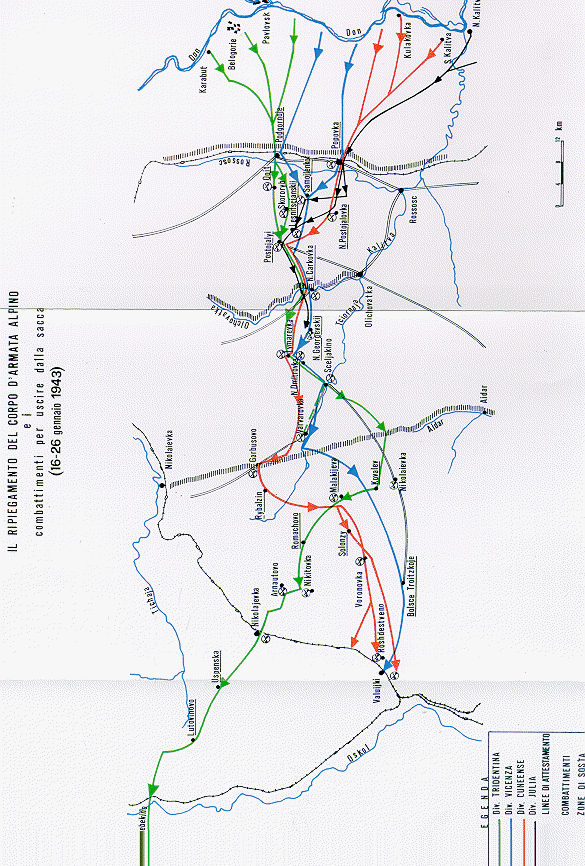
The Alpine Corps' withdrawal between 16 - 27 January 1943 (From Stato Maggiore Esercito)
Chronology and Timeline:
15 January 1943
By order of "Tridentina" alpine Division's command, the 5th Alpini Regiment started the move and gathering around Podgornje of the ammunitions, food and supplies. During this night, also the 618th Field Hospital had transfert on Podgornije.
At dawn two patrouls of the "Edolo" Battalion, supported by some engeeners from Bassowka carried on an raid across the Don River, in a Russian zone, to destroy bunkers and weapon posts and capture prisoniers. By surprise, the patrouls crossed the iced river and by charges manged esplode two bunkers, knocking out their defenders. But only a patroul managed to come back in the Axis's line, the second, under the command of Lt. Raiteri, with three alpines and three engeeners had been taken prisoniers. The action of the patrouls caused the Russian reaction, and the Red Army's soldiers seized all their threnchs and paths situated in the wood on the little islands, in a way so massive to constitue the best target for the guns of the "Val Camonica" Alpine Artillery Group, that hammered the Russian troops. In the afternoon, the regimental base of Ssirotowka had cleared, and the next day the bases of Morossowko and Kuleschowka.
16 January 1943.
At 06.30 a.m. hours, Russian started an intense shelling with artillery and mortars on the "Edolo" Battalion's positions.
At 08.00 a.m.hours, the Russian infantry, by closed platoons, moved against the strongholds "Foresto" and "Lovere". The immediate intervention of alpine artillery and mortars and the violent reaction of men of the "Edolo" Battalion opened wide holes into the Russian columnes, first stopped and decimated and then pushed back on their start's positions. This attack however had caused many losses among the alpinis, also an officer, the Cpt. Gino Fannucchi, Commander of the 52nd Fusiliers Company, died.
At 09.30 a.m. hours, when ranks of 52nd company had been just filled up by the immission of men and officers from the "Edolo" headquartiers company and from sapper platoon, Russians again restarted the attack. Also this attack had pushed back, but the Russian columnes withdrew only few hundreds of meters.
At 11.00 a.m. hours, a new attempt of advance by Russians. A new strong reaction of the "Edolo" Battalion, so at noon, Russians withdrew on their starting posts.
At dust, again Russians, without support fire and by silence, came up to Italian lines. Their attack was violent and sudden. A this time Russians, acting on the junction point between "Edolo" and "Vestone" battalions succeded to penetrate into Italian line and to reach the first hauses of Bassowka hamlet, where however were annihilated by the fire of artillery and mortars and by a determined counterattack of a reinforced big patroul of 5th Alpini Regiment. In the night it seemed that the calm had come back, while Russian picked up by sleds the hundreds of their dieds and woundes that lay in front of the line. In accord to their humanity, the alpinis didn't hinter this pitful work.
In the meantime, at 11.00 a. m., The Alpine Korps Headquartiers, that was at Podgornpje, where had shifted its tactic headquartiers, received the issue of retreat from the Don River, this withdrawal had been got "by a close contact VII Ungarian Korps". While it issued the operational orders to depending detachments it knew about Russian seized the Postujoli roadcross and they were heading towards north to Karpenkowo. The seize of these two spots meant that the circle around the Axis' units disposed along the Don River, was tied up, because the only two retreat roads, the Podgonoje -Postujali - Karpenkowo - Alexejewka roadway and the Podgornoje -Opit - Karpenkowo track had been cut off. It was necessary to hurry, before the poket's closing ring became too thick to be broken. In each case, for order of Korps Command, the release of alpini regiments had been begin at durst of 17 January.
But at 11.00 a. m., on the northern flank the 53th Division of Ungarian VII Korps, in contact with the "Tridentina" alpine Division, had leaved its positions, on southern side the German XXIV Korps, shifted under orders of Alpine Korps, held its positions, but it seemed rather weakened. The Alpine Korps, therefore, didn't have almosto any support on its wings and really it was cutt off.
17 January 1943.
At 07.00 a.m., Russians again attacked the strongholds of 5th Alpini Regiment "Foresto" and "Tonale", but were again forced to retraet with heavy losses. Two Russian war prisoniers confirmed that the attacking troops of previous day were of 973rd Infantry Regiment and in Pawlosk 20 tanks waited for exploiting the possible breakthrough.
At 11.00 a.m., Russian repeated his attack, but with less fury. This attack was repelled back and the attacker seemed to give up.
At 17.00 p.m., the detachments of the sector held by "Edolo" Battalion, except for a third part of men remaining by camouflage and cover, began an ordinated withdrawal. In the same time also the other detachments of alpin 5th Regiment, under command of Col. Adami ("Tirano" alpini Battalon, 2ndBattalion of 278th Infantry Regiment, "Bergamo" and Val Camonica" Mountain Artillery Groups, Health 5th Section, Commissariat 5th Team, foot Squadrons of Cavalry "Savoia" and "Novara" Regiments) withdrew on Podgornoje. The troops of the Belogoje sector along the Marossowka directrix, while those of the Bassowka sector along Ssirotowka path. In the same way of the "Edolo" Battalion also "Tirano" Battalion and "Val Camonica" and "Bergamo" Mountain Artillery Groups left on the line a third part of own effective power by task to hold forcovering the withdrawal till at 04.00 p.m. of the next day.
The 5th Alpini Regiment's commander with the headquartiers company left the command post at 07.00 p.m. and through Marossowka headed for Podgornje. The alpini "Morbegno" Battalion, the third battalion of the 5th Alpini Regiment, followed the withdrawal moviment under command of "Vicenza" Infantry Division.
18 January 1943.
At dawn Russian attacked the line in front of Bassowka, but the few defenders held by resolution and pushed back them. Here the Russian stopped their attacks. Not so fair was the affair in the Postojalli sector, where the arrival of Russian tanks gained the upper hand over trhe men there detached. The whole detachment, under command of Cpt. Spazzi, was almost completely smashed. At durst what remined of these cover troop, withdrew and reached Podgornoje. Here the rearguard took a difensive position at north of railway's station to block the eastern access paths.
In the afternoon the 5th Alpini Regiment received from Alpine "Tridentina" Division the following order:
1) to take the command of o column formed by 5th Alpini Regiment,(except the "Morbegno" Battalion that is under orders of "Vicenza" Infantry Division), by 2th Batt/278th Infantry Regiment, by "Val Camonica" Mountain Artillery Group, by 11th Korps Artillery Detachment (800 men, without guns but with machineguns), by foot Squadron Groups of "Savoia" and "Novara" Cavalry Regiments, by two 75/38 pieces towed by tractors and by Divisional Gun 82nd Company;
2) to head, at dawn of 19 January, for Postojalli along the Skorobib directrix, attacking and seizing, at all costs, this place that is held by Russian;
3) The column will be preceded by "Tirano" Battalion, by task to attack the village.
Immediately the "Tirano" Battalion, under the command of Major Maccagno, reinforced by 28th Battery of "Val Camonica" Mountain Artillery Group, started at hours 07.00 p.m. to occupy Skorobib.
19 January 1943.
At 05.00 a.m., the column started its move by following order:
- vanguard: "Edolo" Battalion, supported by two anti tank 73/38 pieces and by 29th^ Battery of "Val Camonica" Mountain Artillery Group;
- main body: 2nd Battalion/278th Infantry Regiment., "Val Camonica" Mountain Artillery Group Headquartiers, 11th Korps Artillery Detachment;
- rearguard: "Savoia" and "Novara" Cavalry Squadrons.
The train followed its own detachment while the Services Teams were at the end of 2nd/278th Infantry Regiment. The lorries jerkily followed the move.
This route in the fisrt part occurred over a steep slope the cut the shoulder of the balka heading South-North. The route's difficulty was increased by continuous fittings into the troops' column of German sleds and lorries, with the risk that the column lost its own homogeneousness.
Meanwhile, "Tirano" Battalion durin its nihgt advance towards Skorobib, was attacked with a most violent machinguns' fire on its shoulders by russian big patrouls. The vanguard commander, in the impossiblity to cohordinate the attack in the dark and with his tired troops, decided to stop and to wilddraw till the first hause of Budijenni hamlet, mantaining the contact with the enemy by patrouls to attack on the next morning.
At 07.30 a.m, while the "Tirano" Battalion was adopting the attack formation, the colomn's commander order it to stop and to let pass the "Edolo"Battalion, whose men were fresher. When the colomn reached the Budijenni-Opijt crossroad a German Korps' officer, under order of Gen. Heibel issue to Col. Adami that the actual order was to direct the German colomns towards Skorobib and Italian colomns to Opijt. Col. Adami disagreeded and he was invited to reach in Opijt's neighborood the " Tridentina" Division, Alpine Korps and German Korps' commanders. Here he received the order to retake his journey towards Skorobib- Postojalli, upon seizing at all costs of Skorobib village, held by Russian. ( The German officer's counterorder at cross road, it was replaid to col. Adami has been a mistake of that German officer. Only train and Services had been directed for Opijt, non the breakthrough's troops). Cleared the situation, Col. Adami came back with his colomn and ordered to "Edolo" Battalion to advance more quick possible, overtaking the "Tirano" Battalion, the German colomn, formed by an artillery regiment without pieces, a engeneers' group and 200 men of assault infantry.
At 01.00 p.m. "Edolo" Battalion, near the saddle that rose the Skorobib village, reached the colomn's head, under attack by Russian tanks. The "Edolo" Battalion commander on German commander's request to taker part to a common action, was agreed and received the Col. Adami's approval. The situation showed heavy because Russian were firing by 122mm pieces, 75 mm. antitank guns and machineguns, causing many losses among alpinis and German soldiers, while three T34 tanks headed against the alpinis. The tanks were attacking, but the Italian 75/38 antitank guns for frost weren't able to make fire. The danger was resolved by a German sel-propelled gun that by few shots destroied the first tank, immobilized the second and forced the tird tank to withdraw. In this fighting, however, the German colonel hd remained heavy wuonded, so asked to Col. Adami to take also the command of his own men. In the meantime, the attack of the "Edolo" Battalion and of German detachment continue with great bravery. The "Edolo" Battalion's right wind was reinforced by a "Tirano" Battalion's, while another two companies were send on the left to neutralize the Russian fire from the wood, that extended until the village, hammering the attackers' flank.
At hours 03.00 p.m. happened the decisive assault of alpinis and German infantry that threw on the village, hammering the Russian defenders entrenched in the houses and freeing 150 men of alpine "Julia" Division, taken prisoniers the previous day and seizing many prisoniers, guns and machin guns. The russian main body speedly withdrew coverd by two tanks towards Ssamailenko hamlet. In the village the attakers discoverd the effectiveness of the shellings of the "Val Camonica" Mountain Artillery Group, that had neutralized two 122 mm. pieces and destroied a lorries autocolomn.
After have communicated the news of the village's seizing, Col. Adami received order to spend the night in the village waiting next orders. Recalled his detachments pursuing Russian, together German and Italian commanders managed the village defense for the night.
At hoors 08.00 p.m., under "Tridentina" Alpine Division's radioissue, Col. Adami gave orders for the next day, having as target first the village of Werklessiskanski and then that of Postojalli. The first village had been seized with the aid of "Vicenza" Infantry Division coming from the left; then the 5th Alpini Regiment had been support the 6th Alpini Regiment's attack against the Russian garrison at Postojalli. The attack was fixed at hours 09.00 a.m. of the next day.
Therefore, Col. Adami gave the following orders:
1)To form two colomns; left colomn, under command of Col. Adami, target Werklessinskanski, formed by "Tirano" Battalion with a battery, in first echelon and by "Edolo" Battalion, with the second battery, in support echelon; right colomn, under command of Col. Mai, formed by 2nd Battalion/278th Infantry Regiment, with a radio set to link with Col. Adami and two 75 mm. antitank guns plus a German selfpropelled gun in vanguard; by the German artillery regiment; by services, sleds and trains of all Italian and German detachments of the colomn, by 11th Korps Artillery detachments and by lorries, as main body; in rearguard, by Cavalry Squadron Groups, supported by a German selpropelled gun;
2) Attack by the left colomn and seizing of Werklessinskanski village and, eventually, of Postojalli.
20 January 1943.
About hours 02.00 a.m. the Squadron Groups' Headquartiers, placed at defence of the eastern path of Skorobib, communicated the arrival of Russian tanks and infantry coming from Budijenni hamlet. From Opijt came the communication of Divison headquartiers che also this village was under attack by tanks, artillery and infantry. So was strenghtened the defence sistem, but the Russian attack only limited to few machinguns' bursts.
At 07.00 a.m. the move started. During its journey the "Tirano" Battalion, in first echelon, found in front of it other colomns of "Vicenza" Infantry Division and of Alpine "Julia" Division that, seize after a short fighting the Werklessinskanski hamlet, headed towards Postojalli. Consequently to the "Tirano" Battalion was flanked the "Edolo" Battalion and both headed to north to reach more fastly the Werklessinskanski - Postojalli roadway without hold up the other detachments runnig on the same directrix.
About noon yhe colomn reached the road, linked to the right colomn that had had several losses by an air attackt. The two colomns so reached Postojalli. Here, the "Morbegno" Battalion again was placed under the command of its own regiment, the 5th Alpini, while the 2nd Battalion/278th Infantry was given back to "Vicenza" Infantry Division's command. Also the "Venzone" Alpini Battalion, of 6th Alpini Regiment was placed undr the command of Col. Adami, who received the task of pro tempore commander of the "Tridentina" Alpin Division, because Gen Reverberi had gone to command the Army vanguard's detachments.
At hours o7.00 p.m., was coming the order to retake the run, except the "Venzone" Battalion that had been remain there as cover detachment till at hours 00.00 of the next day. The colomn advanced with difficulty, for the dark and the continuos fitting during the run of scattered elements of the "Vicenza", "Julia", "Cuneense" Divisions and of German detachments and train, attacked in continuity by Russian detachments positionated on the border of a wood and on the hills between Postojalli and Nowo Karkowka. During this confused phase, The German Gen.Heibel, while were on a armored vehicle, remained heavy wounded by a granade and received the first aid by Lt. doctor Crosta of the 5th Health Section, but he died.*
21 January 1943.
At dawn the column's head reached Nowo Karkowka, where the detachments placed in its adsigned zones. Soldiers were tired and the sleds of wounded and frozen at disposal began to get scarce. Durind this halting Gen. Martinat by upper orders took the command of colomn's main body.
At hours 02.00 p.m. The journey restarted in this order:
- vanguard: "Tirano", "Edolo", "Morbegno" Battalions, each with a "Val Camonica" Mountain Artillery Group's Bactery (28th ,29th ) and "Bergamo"Mountain Artillery Group's Bactery (31st);
- main body: "Bergamo"Mountain Artillery Group's headquartiers and other Bacteries, "Savoia" and "Novara" Squadron Groups and 11th Korps Artillery Detachment;
- rearguard; "Venzone" Alpini Battalion with its Bactery and two towed antitank pieces.
The main part of frozen run on their feet and, bit by bit, lorries carrying rations and ammunitions had been left by fuel's lack. Temperature had descended to - 30 C degrees, while snow was tall and floury.
At hours 08.00 p.m., the colomn's main body came in Krawzowka hamlet, where received by "Tridentina" Alpine Division's commander, Gen. Reverberi, the order to continue till to Limarewka hamlet, that was reached at hours 10.00 p.m.. This night was coldest and many men didn't manage to find a cover.
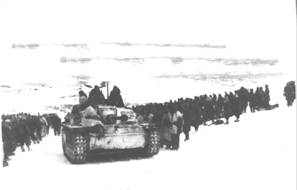
January 1043. In the pocket during the withdrawal from Don River (From Stato Maggiore Esercito)
22 January 1943.
At hours 06.00 a.m., after the Alpini 6th Regiment, followed by "Verona" Battalion, the Adami colomn took again its run. The drawnig up into colomn wae very difficult by tha large presence and incoming of scattered soldiers of the "Vicenza", "Julia", "Cuneense" Divisions, of the Korps detachments, as well as of German and Ungarian. At the crossings of the next bridges, were situated some barrages to permit to 5th Alpini Regiment and other detachments still serviceable to advance till to reach the 6th Alpini Regiment.
The ammassment of scattered soldiers grew at point to cause heavy dangers to the efficient detachments' move that the same Gen. Martinat in person had been step in to stem this muddled flow. In some cases the detachments had been resort at weapon. Col. Adami went in front ho his detachments at the "Vestone" Battalion's headquartiers, that having met some resistance by Russian detachments, were attacking the Schelijakino's village. Here was reached by "Tridentina"alpine Division's commander, Gen. Reverberi, by Col. Paolo Sguaini commander of 6th Alpini Regiment. Since on the colomn's left had been seen in the distance tanks and armored cars, they decided to send in that direction the "Edolo" Battalion to cover the colomn's flank seizing a large hillock dominating the Lessikov village, the neighboroughs of Scheljiakino and the southern paths of the village. Maj. Belotti, "Edolo" Battalion's commander, moved his battalion supported by "Val Camonica" Mountain Artillery Group's 29th Bactery, advanced in accord to fixed plan and seized his targets. From there attacking by a conversion Lessikov seized to continue on the right till the Schelijakino village. Here the battalion was attacked by two armored cars an a tank, but reacting by a ready fire action of the 110th mortar company, it knocked out two armored vehicles and forced others to withdraw. Both Alpini Korps' Commander, Gen. Nasci, and German officers that had seen this fighting congratulated the "Edolo"'s men.
In the same way "Tirano" Battalion, by order of 5th Alpini Regiment's commander, carried out the same action on the right and placed near the village before balkas. "Morbegno" Battalion, didn't take part to action for the great number of scattetred soldiersi that had blocked the road waiting the breakthrough ( about 40.000 men). As soon as "Edolo" and "Vestone" Battalions reached the Schelijakino's houses, by support of German antitank guns forcing the Russian tank to withdraw, they penetrated into the village and assembled in the main square.
Was in this moment that a new Russian tank attack appened between the village and the Schelijakino's hillock. Whille scattered soldiers ran anywhere, Col. Adami orderd to "Val Camonica" Group and to 110th Mortar Company to open fire against tanks. A Russian tank was hit and others withdrew. So the colomn continuated its run, with "Tirano" Battalion at the head, followed by "Val Camonica" artillery Group, by "Edolo" Battalion and by train, while "Morbegno" Battalion still didn't mange to reach the village. At two kilometers from the village the colomn stopped to reorganize its parts. The halting was over two hours, but despite this time no news arrived from "Morbegno" Battalion and from 82nd Guns Company.
Col Adami ordered to column to retake its run and at hours 00.00 a.m. of the next day it came in into Shabskoje village, full seized by Axis' troops. The column was forced to stop outdoor along all the night among snow, wind and cold. Many were freezing and mental derangement cases. During all the night was heard the gun's roar and the echo of mortar and machingun's hit. A sudden alarm caused the usual desordered escape of scattereds and of the German and Ungarian sleds. In this confusion Col. Adami tried vainly to find the Squadron Groups, the 25th Train Section and the Korps Artillery 11th Detachment.
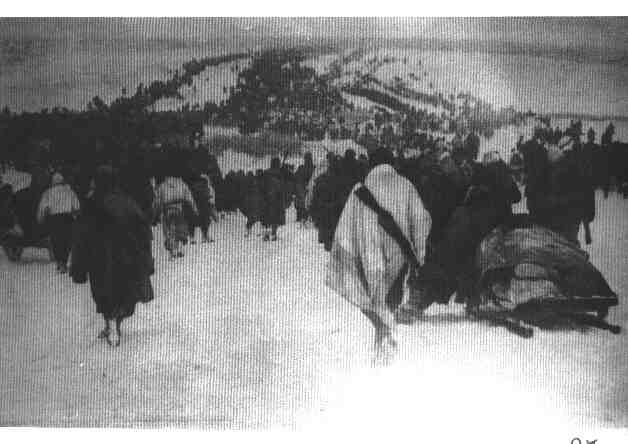
January 1943 Russian Front. In the pocket, scattered, sleds and efficient detachments, among infinite difficulties, heading towards west (From Stato Maggiore Esercito)
23 January 1943.
At hours 05.00 a.m. the 5th Alpini Regiment left Shanskoje to reach the assembling place at three kilometers from the village and there were waiting the 6th Alpini Regiment's pass. There are "Tirano" and "Edolo" Battalions, but without their train, and "Val Camonica" Mountain Artillery Group. While the column was starting, col. Adami send back a ski patroul, under command of Cpt. Stucchi, to know about "Morbegno" Battalion and other lost detachments. At hours 01.30 p.m. the patrolus came back with fighting's near Warworowka, that also "Morbegno" Battalion had taken part, but without usueful result for finding the loitered detachments.
Arrived at the Malakejewka village and desposed the halting for the night, Col. Adami knew tha "Morbegno" Battalion, with 82ne Guns Company, 25th Train Section and "Tirano" and "Edolo" Battalions, while were running on the Warworowka road were been attacked along all the night and the next morning by Russian tanks and infantry, against whom had fought by gallantry. The death of Maj Sarti, Battalion's Commander and those of many officers brang to thinkh hard the battalion's survivors had managed to find the safety's way. (The Morbegno fate)**
24 January 1943.
The Col. Adami's column from Malakejewka retook the journey at hours 05.00 a. m., but was forced at once to stop because the 6° Alpini Regiment, in vanguard, was attacked by Russian that tried to bar the column's run. With resolution Col. Adami opened up his way among scattered and sleds and reached the vanguard that yet had ended victoriously the fighting. The run retook with extreme difficulty by tiredness, lack of food and rest. When the column came in at Romankowo village, at hours 08.00 p.m., the troops did find quartering because all the "isbes" were occupied by German and Ungarian troops. Was necessary to remain outdoor around the bivouac's fires and to combact another fighting against the cold. The temperature had descended to - 40 C degrees.
25 January 1943.
At 06.00 a.m. the run retook, following 6th Alpini Regimend that was tha vanguard. The parts run in the following order: "Edolo" Battalion, Headquarters Regimental Company, "Tirano" Battalion, "Val Camonica" Mountain Artillery Group and the left over services (5th Health Section, 5th Commissariat Team, 618th Field Hospital). Too late, a German aircraft landed near the column, while other German aircrafts were dropping parachutes with food and ammunition, but only for German troops. This fact originated some disontents amomg the alpinis, but also some relief because the German parts could retake its strenghtness and to be able to fight. In the first hours in the afternoon the column came in at Nikitowka village. Here Gen Reverberi ordered to 5th Alpini Regiment to quarter there, while the 6th Alpini Regiment continued tull a hamlet near Nikolajewka. The General had met the Regiments' commanders and gave the folowing orders for the next day:
a) At hour 06.00 a.m., start of 6th and 5th Alpin Regiments from respective quarters;
b) Attack by 6th Alpini Regiment against Nikolajewka village;
c) Run orders for 5th Alpini Regiment and aggregated detachments, as it follows: "Tirano Battalion, German "Fischer" Artillery Group, "Vicenza" Artillery Group, "ValCamonica" Mountain Artillery Group, "Edolo" Battalion, Services;
d) Bar astride of run directrix North-West of Nikitowka, to realize at hours 04.00 a.m by a company of "Edolo" Battalion, reinforced by 5th Alpini Regiment's train to prevent the jump of any detachment and of scattered men;
e) to secure, during the night, the Nikitowka village.
But during the night Russian attack started. "Val Chiese" Battalion was attacked, but Russian was repel back. At 01.00 a.m of the next day Arnontowo hamlet was attacked, and there "Val Chiesa" Battalion and "Bergamo" Mountain Artillery Group's 35th Bactery strongly defended, also with heavy losses. The attack was pushed back.
26 gennaio 1943.
Start began at hours 05.00, while a partisan attack was waiting. "Tirano" Battalion began the move, followed by too much sleds of German "Fischer" sleds. As well as the alpinis reached the first houses of Arnatowo the explorer platoon told to have bring contact with adavancing Russian. Maj. Moccagno, the Battalion's commander, advanced in front of column to recognize the situation while the fisrt mortar bombs fell down and the machine guns fired primi colpi di mortaio e le mitragliatrici hanno aperto il fuoco. Russian decisely pressed on the column's left flank, while the road to Arnatowo was strongly barred by antitank guns, mortars and machineguns, and Russian large patrouls were acting on the high hilloch on the column's right. Major ordered the deployment of the battalion with the 49th Company on the left, the 64th Company in the center and the Headquarters Company on the right, the last with the task to operate a large flancking move. He also ordered to mortars' crews to open fire. On suggestion of a Cavalry officer, cho knew the places the column, except the "Fischer" Group's sleds, converged to a secondary road that deviated to right heading on the hiilock, while sleds and lorries continued along the main road, supportd by 48th Company. On the left Russian heavy pressed and so the column 's commander launched on the right a machinegun crew of 48th Company and asked the immediate intervention of "Vicenza" and "Val Camonica" artillery Groups to support to "Tirano" Battalion. Ordered to clear in every way the sleds from the road to consent the advance of the artillery. Ordered to "Edolo" Battalion to go in front of column. Waiting the alpine bacteries a 105 mm. piece of "Fischer" Group, on recall of Maj. Moccagno, opened fire on a house at height 210, compelling the Russian elements there barricated to come out, helping so the advance of headquarters company and of "Tirano" Battalion's machine gun crews yhat were advancing in that direction. Also the other weapon at Tirano's disposal, a 81 mm. mortar and a antitank 47 mm. gun, entred in action against the Russian posts.
The three fusilier companies of the battalion fermly resisted to russian attack, utilizing individual weapon and granades. In spite of increasing losses, the fighting turned in favour of the alpine battalion for two factors: the violen action of headquarters company and machine gun crews of 48th Company and the intervention of a "Val Camonica" mountain Artillery Group's bactery. Russian speedy withdrew leaving on the ground guns, mortars, automatic weapon and mani died and wounded men.
While the Tirano Patrouls pursuited withdrawing Russian, Gen. Reverberi ordered to retake run towards Nikolajevka. More late, near Nijkolajewka the column halted because were other Russian troops, while the Fischer Group bacteries opende the fire. Came in the news that a attack was in course by "Vestone" Battalion and "Val Chiese" Battalion's elements against the Nikolajewka village. But this attack was blocked near railway that limited the right border of villagefor the Russian fire's intensity. Beside "Fischer" Group a Bergamo Group was placed, while Viccenza Groups was crowding on the post. For the increasing difficulties in front of Nikolajewka Gen. Reverberi order "Tirano" Battalion's intervention, that was reassembling after the losses of the Artonowo fighting. So two officers and 150 men were directed on the left of "Vestone" Battalion.
Lt.col. Chierici of 6th Alpini Regiment communicated tahe the regiment's few troops at disposal couldn't seize the village heavy garrisoned and called the 5th Alpini Regiment's support. Gen. Reverberi then ordered Col. Adame to assemble all elements of the regiment and to urge the "Edolo" Battalion for a speeder advance.
Immediately the "Edolo" Headquarters Company came in, under the comman of Lt. Portinari, that was more forward than other battalion's parts. Col. Adami gave order to descend toward railway and form a reinforcement to "Val Chiese" Battalion, still blocked by heavy losses. Despite the a few at time intervention, as well as they came in, officers, alpini and cannoniers went in line, the situation remined uncertain. Two German tanks, gone across the railway, for ammunition and fuel' lack, decided to come back. Russian, by a continuos fire of all his weapon, hammered troops helding the railway and those coming down to reach them. The afternoon was advancing without the situation unblocked. This night cannot pass outdoor, therefore every man who had still his weapon and was able to combact had to partecipate to the action. Gen. Reverberi then climbed on a tank and decided personally to lead the last attack.
Across the crowd of 40.000 scattered, wounded, frozen, "Edolo" Battalion and "Val Camonica" Mountain Artillery Group advanced with difficulty opening their way. Col. Adami was hit at a leg while was running towards the village, but he saw "Edolo" Battalion and "Val Camonica"'s gun come in. The "Edolo" Battalion's commander, Maj. Belotti, went to Gen. Reverberi. Disposed the 51st Companyon the right and the 50th Company on the left, the battalion corssed the railway and stroke the village. Two pieces of "Bergamo" Mountain Artillery Group and the weapons of Mortar 110th Company gave a valid support to the attack. The two German tanks with Gen. Reverberi re took the move forward. Besides the alpinis by rifle's hits, granade reached the first houses and wiped out the defenders. The Russian defence more and more confused began to fall. Briefly, russian withdrew from the village. While Col. Adami, medicated, retooke to advance togheter the cannoneers of "Val Camonica" 29th Bactery, jast arrived, it reported the Gen. Martinat's death, knocked out while was advancing in front of his alpinis.
27 January 1943.
At hours 05.00 a.m. the 5th Alpini Regiment's column set again on the way., the "Edolo" Battalion in first echelon. In short time acrossed all troops and sleds both Italian, German and Ungarian. It was said to Maj. Belotti that are no Axis' troops in front but Russian elements with two heavy machine guns and an antitank gun, barring the road. Col. Signorini of 6th Alpini Regiment.ordered Belotti to attack by the support of two o trhee German selpropelled guns. Taken arrangeement with Germans the "Edolo" Battalion's commander moved his men on the left a long a parallel path and after about a kilometer, by a short fire action from the 51st Company an Headquarters Company eliminaed thi resistance, seized the two automatic weapon ,while the German selfpropelled guns had smashed the Russian antitank gun.
But more before Russian had organized others and more stronger bars of the road. The column turned on the right on a very bad path. The run continued with great difficulty, escaping the new encercling's attempts done by Russian tanks and on ly in the late evening it came in at Lutowinowo, Having lost on the way many men, exhausted and incapable to march on foot.
28 January 1943.
At hours 05.00 the column started, with "Tirano" Battalion in front, headed to Nowjoskal stronghold, that it was known garrisoned by Ungarian troops. When men had come in at Olkowig hamlet, there was a surprise because the stronghold had been seized by Russian and to across it needed to take by weapon. The colomn was divided in two parts: at right the "TRidentina" Alpine Division's suvivors, at left all other men. Col. Adami received order to form a "Kampfgruppe" gathering men of 5th and 6th alpini regiments an artillery group and German armored vehicles and to attack the Nowojoskol stronghold. Before the action's starting Col. Adami Knew that the German tanks were immobilized by fuel's lack. But also ammunition are very short and the troops health conditions advised to avoid if possible theLa scarsità delle munizioni e lo stato delle armi a disposizione oltre alle condizioni generali della truppa consigliano di breakthrough. Then the column turn at left. the snow was tall and the journey difficult. The Graught animals were so tired that the guns had been left. About hours 08.00 p.m., without meeting obstacles, tired and unsteading, the exhaused men reached Slonowka hamlet, where spent the night.
29 gennaio 1943.
This was only a trasfer step without Russian at heel neither danger of tanks' raids. It seemed to be out the pocket. When the column came in at Bessarab, there were not anough lodges to sped the night and meny spent outdoor also this night.
30 January 1943.
The column marched from Bessarab to Bolske Troskoje. Here, the next day it was sayed to alpini that more late the had found the ambulances for wonuded end frosten.
31 January 1943.
Otherlatecomers continued to come in at Bolske Troskoje where they were switched by incaricated officers towards the assembling place oh their divisions. The colomn arrived to Wosnessowka, after having carrierd on the waiting ambulances ther wounded and frozen men. Ther wass present also Gen. Gariboldi, 8th Italian Army's commander, that could also to embrace his son, a 5th alpiin Regiment's leutenant.
1 February 1943.
5th Alpini Regiment, as best one can, on the foot, without haltings in the next days travelled the following steps: Belgorod, Sejetino, Golodscino, PissarewkaStoraja Riabina, Kutusoje, Tschenandino, Mali Grunj, Stupki, Welka Paulowka, Gladiasch, Lipowaja Dalina, Sassulse, Mals Burij, Melojo Sribnoje, Perowolotschana, Preluki.
In fifteen days, 5th Alpini Regiment had effectuated on foot a trip of more than 800 kilometers, largeky in fighting and always in unconfortable conditions by snow and cold.
From Priluki trasfered by train to Gomel and to Schlobin on the Dniepr River. The regiments' parts, also if reducet in strenght and in the number, were still efficient that the German commander of Schlobin ordered to regiment to reach a near place to fighting against partisans. After a two week's period and without fight with partisans, that seemed absented, regiment came back to Schlobin and started towards Italy.
The troop trains carried out the following journey: Bobruisk - Minsk -Boranowicze - Brest Litovsk - Cracovia - Vienna- Tarvisio.
The alpini's event on the Don River was really grandiose so that Russian War Bulletin n.630 of Febrary 8th 1943 literally said ".... only the Italian Alpini Korps must be considered unbeaten on the Russian soil...".
The last balance of 5th Alpini Regiment of this campaign is the following:
Period |
|
Fallen |
Wounded or Frosten |
Missing in action |
from August 28 1942 to January 15 1943 |
Officers Non commisioned and Soldier |
3 49 |
12 180 |
= = |
from January 15 1943 to January 31 1943 |
Officers Sottufficiali e Soldati |
20 101 |