..To Ancient SDA's ............ To "What's New?"
Part Two
Leviticus Chapter 16
Rearranged to show the order of events on the Day of Atonement
The text is from the KJV but modified and modernised for easier reading.
Some explanations from the Spirit of Prophecy have been inserted.
The comments in square brackets are mine.
Restricted entry
1 And the LORD spoke to Moses after the death of the two sons of Aaron, when they offered before the LORD, and died [Leviticus 10:1-2]; 2 and the LORD said to Moses, Speak to Aaron your brother, that he come not at all times [without special preparation and protection] into the holy place within the veil [the second apartment] before the mercy seat, which is upon the ark [of the covenant]; that he die not: for I will appear in the cloud upon the mercy seat.
[Aaron was allowed in that room only on one day of the year, but he did go in and out of it several times on that day. However, Jesus as our High priest stays in it for all the ceremonies for in reality it all takes place inside Him.]
First: an offering for sin
3 Thus shall Aaron come into the holy place: with a young bullock for a sin offering [for confession of his sins], and a ram for a burnt offering [as a dedication of his life].... 6 And Aaron shall offer his bullock of the sin offering, which is for himself, and make an atonement for himself, and for his house. [The ram is used later in the day, in verse 24.]
..... 17 And there shall be no man in the tabernacle of the congregation [the first apartment] when he goes in to make an atonement in the holy place, until he come out, and have made an atonement for himself, and for his household, and for all the congregation of Israel.
{Patriarchs & Prophets 357.3}
"As Christ's ministration was to consist of two great divisions, each occupying a period of time and having a distinctive place in the heavenly sanctuary, so the typical ministration consisted of two divisions, the daily and the yearly service, and to each a department of the tabernacle was devoted."
{Great Controversy 1888ed 420.2}
"Such was the service performed ‘unto the example and shadow of heavenly things.’ And what was done in type in the ministration of the earthly sanctuary, is done in reality in the ministration of the heavenly sanctuary. After his ascension, our Saviour began his work as our high priest. Says Paul, ‘Christ is not entered into the holy places made with hands, which are the figures of the true; but into Heaven itself, now to appear in the presence of God for us.’ [HEB. 9:24.]"
{Spalding & Magan Collection (of some early visions, March 18, 1852.) 2A.3}
"The sins of Israel must go to judgment beforehand. Every sin must be confessed at the sanctuary, then the work will move. It must be done now. The remnant in the time of trouble will cry, My God, My God, why hast Thou forsaken me?"
{The Great Controversy 428.3}
"In the service of the earthly sanctuary, which, as we have seen, is a figure of the service in the heavenly, when the high priest on the Day of Atonement entered the most holy place, the ministration in the first apartment ceased. God commanded: ‘There shall be no man in the tabernacle of the congregation when he goeth in to make an atonement in the holy place, until he comes out.’ Leviticus 16:17.
"So when Christ entered the holy of holies to perform the closing work of the atonement, He ceased His ministration in the first apartment. But when the ministration in the first apartment ended, the ministration in the second apartment began. When in the typical service the high priest left the holy on the Day of Atonement, he went in before God to present the blood of the sin offering in behalf of all Israel who truly repented of their sins.
"So Christ had only completed one part of His work as our intercessor, to enter upon another portion of the work, and He still pleaded His blood before the Father in behalf of sinners."
The sin offering
..... 11 And Aaron shall bring the bullock of the sin offering, which is for himself, and shall make an atonement for himself, and for his house, and shall kill the bullock of the sin offering which is for himself.
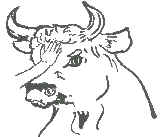
[In Leviticus 4:4-7 it is explained in this way...
And he shall bring the bullock to the door of the tabernacle of the congregation before the LORD; and shall lay his hand upon the bullock's head, and kill the bullock before the LORD. And the priest that is anointed shall take of the bullock's blood, and bring it to the tabernacle of the congregation: and the priest shall dip his finger in the blood, and sprinkle of the blood seven times before the LORD, before the veil of the sanctuary. And the priest shall put some of the blood upon the horns of the altar of sweet incense before the LORD, which is in the tabernacle of the congregation; and shall pour all the blood of the bullock at the bottom of the altar of the burnt offering, which is at the door of the tabernacle of the congregation.
In this case, because he is the high priest, Aaron does the sprinkling himself on the altar of incense, and in the second apartment.]
Incense symbolises protection
12 And he [Aaron] shall take a [portable] censer full of burning coals of fire from off the altar before the LORD [the golden altar of incense], and his hands full of sweet incense beaten small, and bring it within the veil [Hebrews 9:3-4]. 13 And he shall put the incense upon the fire before the LORD, that the cloud of the incense may cover the mercy seat that is upon the testimony, that he die not. 14 And he shall take of the blood of the bullock, and sprinkle it with his finger upon the mercy seat eastward; and before the mercy seat [on the ground] shall he sprinkle of the blood with his finger seven times.
[This was all done in his normal coloured clothes which had bells on them, Exodus 39:22-26. Having completed the transfer of the sins INTO the sanctuary, Aaron now prepares to REMOVE them.]
A change of clothing
..... 4 [Then, back in the first apartment] He shall put on the holy linen coat, and he shall have the linen breeches upon his flesh, and shall be girded with a linen girdle, and with the linen mitre shall he be attired. These are holy garments; therefore shall he wash his flesh in water, and so put them on.
[These are made of pure white linen and have no bells. They were kept stored in the first apartment, verse 23.]
{Acts of the Apostles 33.3}
"As in the typical service the high priest laid aside his pontifical [coloured] robes and officiated in the white linen dress of an ordinary priest; so Christ laid aside His royal robes and garbed Himself with humanity and offered sacrifice, Himself the priest, Himself the victim. As the high priest, after performing his service in the holy of holies, came forth to the waiting congregation in his pontifical robes; so Christ will come the second time, clothed in garments of whitest white, ‘so as no fuller on earth can white them.’ Mark 9:3. He will come in His own glory, and in the glory of His Father, and all the angelic host will escort Him on His way."
{Desire of Ages 25.1}
"As the high priest laid aside his gorgeous pontifical robes, and officiated in the white linen dress of the common priest, so Christ took the form of a servant, and offered sacrifice, Himself the priest, Himself the victim. ‘He was wounded for our transgressions, He was bruised for our iniquities: the chastisement of our peace was upon Him.’ Isa. 53:5."
Second: Two goats and a ram
 5 And he
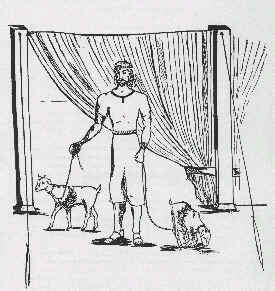
shall take of the congregation of the children of Israel two kids
of the goats for a sin offering, and one ram for a burnt
offering. [The ram is used
later in the day, verse 24.]
5 And he
shall take of the congregation of the children of Israel two kids
of the goats for a sin offering, and one ram for a burnt
offering. [The ram is used
later in the day, verse 24.]
..... 7 And he shall take the two goats, and present them before the LORD at the door of the tabernacle of the congregation. 8 And Aaron shall cast lots upon the two goats [so God could show which was His]; one lot for the LORD, and the other lot for the scapegoat [they looked so much alike].
9 And Aaron shall bring the goat upon which the LORD'S lot fell, and offer him for a sin offering [without laying on of hands because he had been made "clean" by the bullock offering]. 10 But the goat, on which the lot fell to be the scapegoat, shall be presented alive before the LORD, to make an atonement with him, and to let him go for a scapegoat into the wilderness.
[So he is moved to one side to await the end of the ceremony, along with the ram of the burnt offering].
This is in the reverse order to the "daily"
..... 15 Then shall he kill the goat of the sin offering, that is for the people, and bring his blood [directly] within the veil, and do with that blood as he did with the blood of the bullock, and sprinkle it upon the mercy seat, and before the mercy seat. [This time he is "picking up" the sins!]. 16 And he shall make an atonement for the holy place [by the removal of its sins], because of the uncleanness of the children of Israel, and because of their transgressions in all their sins: and so shall he do for the tabernacle of the congregation, that remains among them in the midst of their uncleanness.
.... 18 And he shall go out to the altar that is before the LORD [the golden altar of incense], and make an atonement for it; and shall take of the blood of the bullock [he had done this on the way in, Leviticus 4:7], and [now] of the blood of the goat, and put it upon the horns of the altar round about. 19 And he shall sprinkle of the blood upon it with his finger seven times, and cleanse it, and hallow it from the uncleanness of the children of Israel.
 20 And when he has made an end of reconciling the
holy place, and the tabernacle of the congregation, and the
altar, he [the fit man of
verse 21] shall bring [to him] the
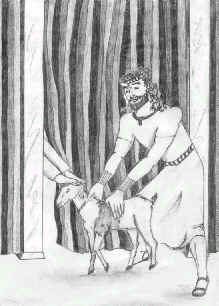
live goat. 21 And Aaron shall lay both his hands upon
the head of the live goat [unlike
the daily confession in which only one hand is needed], and confess over him ALL the iniquities
of the children of Israel, and ALL their transgressions in
ALL their sins [he has
acquired these sins through the blood of the sinless goat], putting them upon the head of the [live] goat,
and shall send him away by the hand of a fit man into the
wilderness. 22 And the goat shall bear upon him all their
iniquities to a land not inhabited:
20 And when he has made an end of reconciling the
holy place, and the tabernacle of the congregation, and the
altar, he [the fit man of
verse 21] shall bring [to him] the
live goat. 21 And Aaron shall lay both his hands upon
the head of the live goat [unlike
the daily confession in which only one hand is needed], and confess over him ALL the iniquities
of the children of Israel, and ALL their transgressions in
ALL their sins [he has
acquired these sins through the blood of the sinless goat], putting them upon the head of the [live] goat,
and shall send him away by the hand of a fit man into the
wilderness. 22 And the goat shall bear upon him all their
iniquities to a land not inhabited:
and he shall let go the goat in the wilderness. [Note that he does not kill it.]
{Patriarchs & Prophets 355.4}
"Not until the goat had been thus sent away did the people regard themselves as freed from the burden of their sins. Every man was to afflict his soul while the work of atonement was going forward. All business was laid aside, and the whole congregation of Israel spent the day in solemn humiliation before God, with prayer, fasting, and deep searching of heart."
{Patriarchs & Prophets 358.1-2}
"As in the final atonement the sins of the truly penitent are to be blotted from the records of heaven, no more to be remembered or come into mind, so in the type they were borne away into the wilderness, forever separated from the congregation.
"Since Satan is the originator of sin, the direct instigator of all the sins that caused the death of the Son of God, justice demands that Satan shall suffer the final punishment.
"Christ's work for the redemption of men and the purification of the universe from sin will be closed by the removal of sin from the heavenly sanctuary and the placing of these sins upon Satan, who will bear the final penalty. So in the typical service, the yearly round of ministration closed with the purification of the sanctuary, and the confessing of the sins on the head of the scapegoat."
{Spalding & Magan Collection [of EGW material] 2.1}
"Then I saw that Jesus’ work in the sanctuary will soon be finished. And after His work there is finished, He will come to the door of the first apartment, and confess the sins of Israel upon the head of the Scape Goat.
"Then He will put on the garments of vengeance. Then the plagues will come upon the wicked, and they do not come till Jesus puts on that garment, and takes His place upon the great white cloud.
"Then while the plagues are falling, the Scape Goat is being led away. He makes a mighty struggle to escape, but he is held fast by the hand that leads him. If he should effect his escape, Israel would lose their lives. I saw that it would take time to lead away the Scape Goat into the land of forgetfulness after the sins were put on his head."
[The high priest did not come into the courtyard to lay his hands on the scapegoat. He put his hands out through the curtain while the "fit" man held the goat. The courtyard represents the earth (the sacrifice was killed there) and Christ does not come to the earth until AFTER the plagues. After the transfer of sin He retreats into the first apartment to change into His kingly robes.]
{SpM 2.2}
"The great white cloud I saw was not the holy place, but entirely separate from the holy and most holy place, entirely separate from the sanctuary."
{SpM 2.3}
"Then the angel repeated these words, and said, ‘This is the time spoken of in Isaiah. He saw that there was no man, and wondered that there was no intercessor.’ [Isaiah 59:16]. He had no mediator between God and man, and these plagues could be withheld no longer, for Jesus had ceased to plead for Israel, and they were covered with the covering of the Almighty God, and then they could live in the sight of a holy God, and those who were not covered, the plagues fell upon them, for they had nothing to shelter or protect them from the wrath of God."
Another change of clothes
23 And Aaron shall come into the tabernacle of the congregation, and shall put off the linen garments, which he put on when he went into the holy place, and shall leave them there. 24 And he shall wash his flesh with water in the holy place, and put on his [normal] garments [this is a picture of Jesus putting on His kingly robes], and come forth
The burnt offering of dedication
and offer his burnt offering, and the burnt offering of the people, and make an atonement for himself, and for the people. 25 And the fat of the sin offering shall he burn upon the altar. [As in chapter 4:8-10].
The "fit" man returns
26 And he that let go the goat for the scapegoat shall wash his clothes, and bathe his flesh in water, and afterward come into the camp.
A "clean" man
27 And the [body of the] bullock for the sin offering, and the [body of the] goat for the sin offering, whose blood was brought in to make atonement in the holy place, shall one carry forth without the camp; and they shall burn in the fire their skins, and their flesh, and their dung. 28 And he that burns them shall wash his clothes, and bathe his flesh in water, and afterward he shall come into the camp.
A permanent ceremony
29 And this shall be a statute for ever to you: that in the seventh month, on the tenth day of the month, you shall afflict your souls [search your hearts], and do no work at all, whether it be one of your own country, or a stranger that sojourns among you: 30 for on that day shall the priest make an atonement for you, to cleanse you, that you may be clean from all your sins before the LORD. 31 It shall be a sabbath of rest to you, and you shall afflict your souls, by a statute for ever.
To be continued by all the high priests of the future
32 And the priest, whom he shall anoint, and whom he shall consecrate to minister in the priest's office in his father's stead [when the high priest dies], shall [also] make the atonement, and shall put on the linen clothes, even the holy garments: 33 and he shall make an atonement for the holy sanctuary [the second apartment], and he shall make an atonement for the tabernacle of the congregation [the first apartment], and for the altar [of incense], and he shall make an atonement for the priests, and for all the people of the congregation.
34 And this shall be an everlasting statute to you, to make an atonement for the children of Israel for all their sins once a year. And he did as the LORD commanded Moses.
{Patriarchs & Prophets 355.5}
"Important truths concerning the atonement were taught the people by this yearly service.
"In the sin offerings presented during the year, a substitute had been accepted in the sinner's stead; but the blood of the victim had not made full atonement for the sin. It had only provided a means by which the sin was transferred to the sanctuary.
"By the offering of blood [in the daily service of forgiveness], the sinner acknowledged the authority of the law, confessed the guilt of his transgression, and expressed his faith in Him who was to take away the sin of the world; but he was not entirely released from the condemnation of the law.
"On the Day of Atonement the high priest, having taken an offering for the congregation, went into the most holy place with the blood and sprinkled it upon the mercy seat, above the tables of the law. Thus the claims of the law, which demanded the life of the sinner, were satisfied.
"Then in his character of mediator the priest took the sins upon himself, and, leaving the sanctuary, he bore with him the burden of Israel's guilt. At the door of the tabernacle he laid his hands upon the head of the scapegoat and confessed over him ‘all the iniquities of the children of Israel, and all their transgressions in all their sins, putting them upon the head of the goat.’
"And as the goat bearing these sins was sent away, they were, with him, regarded as forever separated from the people. Such was the service performed ‘unto the example and shadow of heavenly things.’ Hebrews 8:5."
{Vol. 1 Spirit of Prophecy 274.2}
"Only once a year could the high priest enter into the most holy place, after the most careful and solemn preparation. No mortal eye but that of the high priest could look upon the sacred grandeur of that apartment, because it was the especial dwelling-place of God's visible glory. The high priest always entered it with trembling, while the people waited his return with solemn silence. Their earnest desires were to God for his blessing. Before the mercy-seat, God conversed with the high priest. If he remained an unusual time in the most holy, the people were often terrified, fearing that because of their sins, or some sin of the priest, the glory of the Lord had slain him. But when the sound of the tinkling of the bells upon his garments was heard, they were greatly relieved. He then came forth and blessed the people."

To Ancient SDA's ............ To "What's New?"
This page hosted by  Get your own Free Home Page